
Mapa mental
Distributions
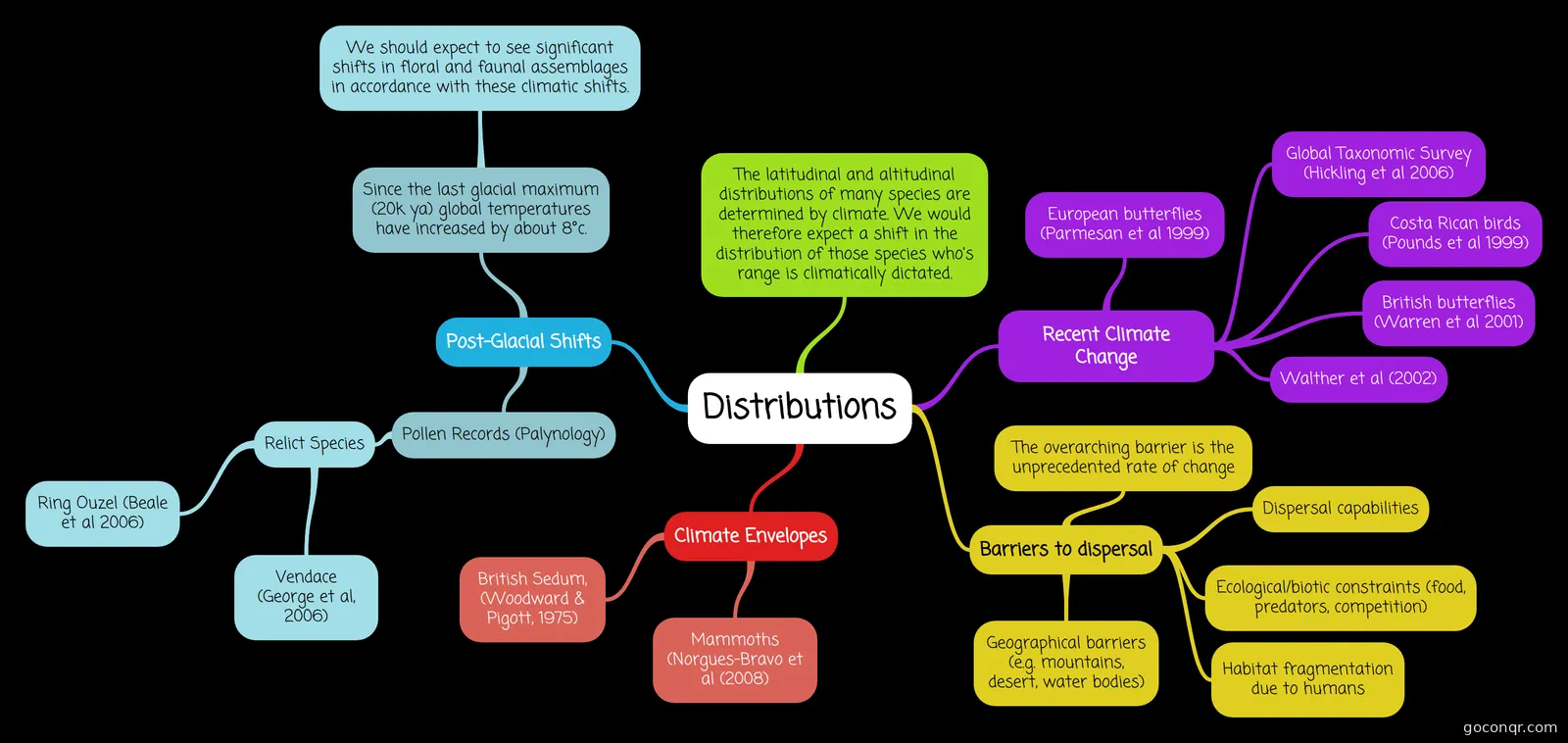
Mind map: Distributions
Contenido del mapa
Distributions
The latitudinal and altitudinal distributions of many species are determined by climate. We would therefore expect a shift in the distribution of those species who's range is climatically dictated.
Post-Glacial Shifts
- Since the last glacial maximum (20k ya) global temperatures have increased by about 8°c.
- We should expect to see significant shifts in floral and faunal assemblages in accordance with these climatic shifts.
- Pollen Records (Palynology)
- We can study shifts in vegetation through geological time by looking at pollen records stored in peat bogs and lake deposits. Pollen grains don't break down very easily and so we are able to use them to understand the vegetative assemblages that existed in certain periods dated back quite far by creating a pollen profile of the strata. Pollen is unique to each species and so in many cases we can identify the species relatively easily. Additionally, we can use pollen records from various places to map shifts of species and whole assemblages throughout times of climatic change.
- Relict Species
- As climate warmed, many species retreated northwards to track their cooler climates. However, in some cases species got left behind in upland refugia where the climate remained suitable. These species are called ice-age relicts.
- Ring Ouzel (Beale et al 2006)
- The ring ouzel is a northern species which favours cooler, wetter climates. It's most southerly population is on Dartmoor where it survived as an ice-age relict due to the micro-climatic conditions caused by Dartmoor's relative elevation. However, current climate change is endangering the species due to increased temperature and reduced precipitation. Lower levels of precipitation make it harder for the ring ouzel to forage for worms, which could subsequently impact the population through lower recruitment and individual survival.
- Vendace (George et al, 2006)
- Vendace are found in only two lakes in Cumbria and they avoid water over 19°c. In Bassenthwaite however, climate change is causing the water to increase in temperature, which in turn is causing increased stratification of the lake. This is a problem for the species as they (like all salmonids) require high levels of oxygen. Therefore they are caught in a catch 22 whereby the cool water in the bottom layer does not contain enough oxygen, but the top layer is too warm for them to survive, causing a decline in the population.
- Since the last glacial maximum (20k ya) global temperatures have increased by about 8°c.
Climate Envelopes
- A species niche can be thought of as being determined by a series of environmental and ecological tolerances. In terms of climate change, the factors that we expect to most influence species' distribution are temperature and precipitation. The relationship between survival and each of these factors is a bell-shaped curve which illustrates optimal range. In the middle, at the top, of this curve, is where species' are performing at their optimal capacity. This is known as it's climatic envelope. If you change the level of temperature or precipitation so that it is in the far reaches of that species tolerance, you will negatively impact the physiology of the species potentially fatally. This is of course, unless the species moves to track it's climatically suitable niche. Typically, we expect organisms to move to higher latitudes or elevations to escape increased temperatures and track their climatic envelope. We can use knowledge of species' climatic envelopes and predictions of different climate change scenarios to map projected future distributions of species.
- British Sedum, (Woodward & Pigott, 1975)
- Two species of British sedum (S. rosea and S. telephium) grow naturally at different altitudes. They were grown experimentally in competition with each other at each's respective natural altitude. At lower altitude, S telephium was larger than rosea and the reverse was true for higher altitudes. This is because each species outcompeted the other at their natural altitude due to their thermal tolerances.
- Mammoths (Norgues-Bravo et al (2008)
- We can also use climatic envelope information to examine the shifts of species throughout history, as long as we have information regarding their climatic niche and their population movements. A study by Norgues-Bravo et al (2008) looked at the causes of the extinction of the woolly mammoth by using climatic envelope modelling. They found a drastic reduction in suitable climate for the mammoth after the ice age. This habitat contraction led to decreased and fragmented populations which in turn made them more vulnerable to human hunting, which is thought to have been the final driver of extinction.
Barriers to dispersal
- Geographical barriers (e.g. mountains, desert, water bodies)
- Habitat fragmentation due to humans
- Ecological/biotic constraints (food, predators, competition)
- Dispersal capabilities
- The overarching barrier is the unprecedented rate of change
Recent Climate Change
- The climate has been warming at an unprecedented rate over the last 150yrs and the rise is set to continue. In Europe the temperature rose by 0.8c during the 20thC, corresponding to a northward shift in climatic isotherms of about 120km.
- European butterflies (Parmesan et al 1999)
- Looked at range shifts of non-migrating butterflies throughout Europe and down the to northern-most regions of Africa over the 20thC. Of 52 species examined, the northern boundaries for 65% were extended. Range shifts varied greatly from 35-240km, roughly in line with the advance of isotherms. To ensure that their results were robust in that it was in fact climate driving these shifts, they chose generalist species to lessen the chance that they were being affected by factors such as land-use change or habitat loss.
- Costa Rican birds (Pounds et al 1999)
- Looked at altitudinal range shifts in a number of species of birds in Monteverde, Costa Rica. The warming of sea surface temperatures has affected cloud formation in the region, causing cloud cover to shift upwards. Consequently, temperatures at lower altitudes have increased. They compared bird abundance of two species groups between 1979-1998 and found that lower montane species (which live in cloud forests) remained stable but pre-montane species increased in abundance over the time period as a result of increased suitable habitat. Since there's been no real change in land use or deforestation since the 50s, climate change is thought to be the primary driver.
- British butterflies (Warren et al 2001)
- Looked at range shifts in British butterflies. Species showed variable success in tracking climate through fragmented landscapes. Mobile generalists had successfully moved in line with climate. However, less mobile habitat specialists failed to keep up with warming climate and declined. Ecosystems will likely be dominated by generalists as a results of their higher capability of tracking climate thanks to better dispersal capabilities.
- Global Taxonomic Survey (Hickling et al 2006)
- Looked at distribution of 16 terrestrial & freshwater taxonomic groups. 12 taxonomic groups (84% of species) showed northward shifts, including mammals, birds, fish and inverts. This demonstrates that there is no discernible pattern between taxonomy, ecology or physiology. Species will be affected regardless of these factors.
- Walther et al (2002)
- This review highlights the ecological impacts of climate change. In terms of phenology, they identified a clear global pattern in both hemispheres of species shifting their phenologies to match recent climate change.
Información
- Descripción
- BSc Degree (Global Change) Conservation Biology Mapa Mental sobre Distributions, creado por Madison Burt el 21/05/2016.
- Creado por
- Madison Burt
- Visitas
- 1
- Valoración