
Mapa mental
Types of Processors
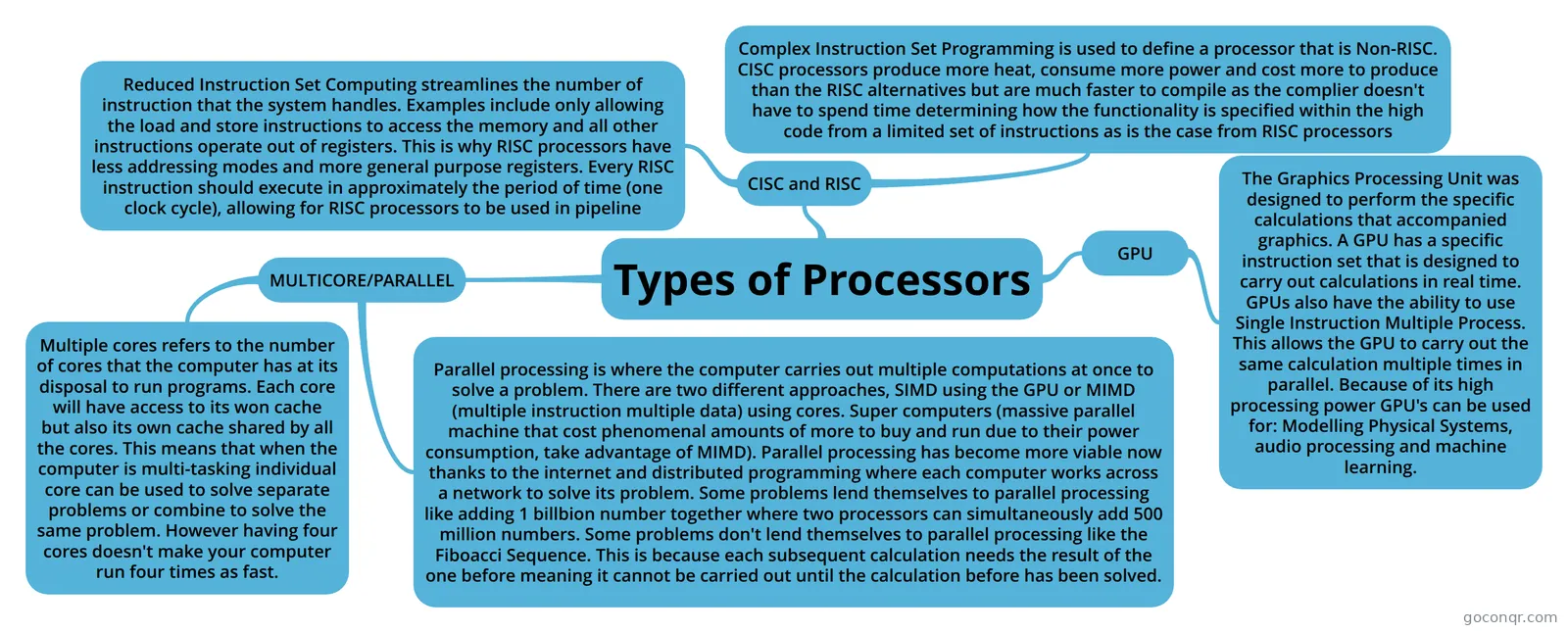
Mind map: Types of processors
Contenido del mapa
Types of Processors
CISC and RISC
- Reduced Instruction Set Computing streamlines the number of instruction that the system handles. Examples include only allowing the load and store instructions to access the memory and all other instructions operate out of registers. This is why RISC processors have less addressing modes and more general purpose registers. Every RISC instruction should execute in approximately the period of time (one clock cycle), allowing for RISC processors to be used in pipeline
- Complex Instruction Set Programming is used to define a processor that is Non-RISC. CISC processors produce more heat, consume more power and cost more to produce than the RISC alternatives but are much faster to compile as the complier doesn't have to spend time determining how the functionality is specified within the high code from a limited set of instructions as is the case from RISC processors
GPU
- The Graphics Processing Unit was designed to perform the specific calculations that accompanied graphics. A GPU has a specific instruction set that is designed to carry out calculations in real time. GPUs also have the ability to use Single Instruction Multiple Process. This allows the GPU to carry out the same calculation multiple times in parallel. Because of its high processing power GPU's can be used for: Modelling Physical Systems, audio processing and machine learning.
MULTICORE/PARALLEL
- Multiple cores refers to the number of cores that the computer has at its disposal to run programs. Each core will have access to its won cache but also its own cache shared by all the cores. This means that when the computer is multi-tasking individual core can be used to solve separate problems or combine to solve the same problem. However having four cores doesn't make your computer run four times as fast.
- Parallel processing is where the computer carries out multiple computations at once to solve a problem. There are two different approaches, SIMD using the GPU or MIMD (multiple instruction multiple data) using cores. Super computers (massive parallel machine that cost phenomenal amounts of more to buy and run due to their power consumption, take advantage of MIMD). Parallel processing has become more viable now thanks to the internet and distributed programming where each computer works across a network to solve its problem. Some problems lend themselves to parallel processing like adding 1 billbion number together where two processors can simultaneously add 500 million numbers. Some problems don't lend themselves to parallel processing like the Fiboacci Sequence. This is because each subsequent calculation needs the result of the one before meaning it cannot be carried out until the calculation before has been solved.
Información
- Descripción
- Mapa Mental sobre Types of Processors, creado por Harry Taylor el 18/09/2016.
- Creado por
- Harry Taylor
- Visitas
- 2
- Valoración