
Mapa mental
Arbitration vs Litigation
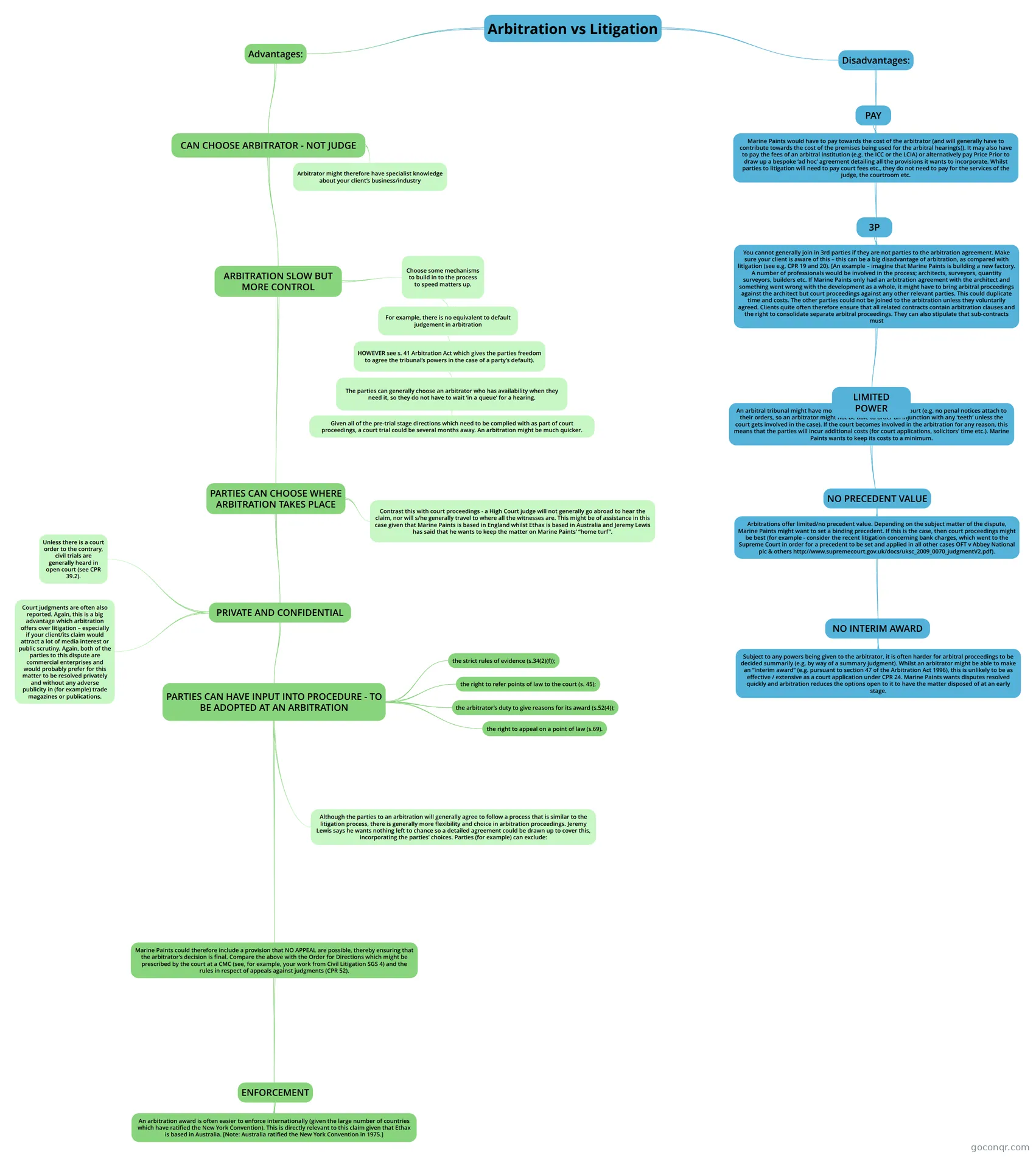
Mind map: Arbitration vs litigation
Contenido del mapa
Arbitration vs Litigation
Advantages:
- CAN CHOOSE ARBITRATOR - NOT JUDGE
- ARBITRATION SLOW BUT MORE CONTROL
- PARTIES CAN CHOOSE WHERE ARBITRATION TAKES PLACE
- PRIVATE AND CONFIDENTIAL
- PARTIES CAN HAVE INPUT INTO PROCEDURE - TO BE ADOPTED AT AN ARBITRATION
- the strict rules of evidence (s.34(2)(f));
- the right to refer points of law to the court (s. 45);
- the arbitrator’s duty to give reasons for its award (s.52(4));
- the right to appeal on a point of law (s.69).
- Marine Paints could therefore include a provision that NO APPEAL are possible, thereby ensuring that the arbitrator’s decision is final. Compare the above with the Order for Directions which might be prescribed by the court at a CMC (see, for example, your work from Civil Litigation SGS 4) and the rules in respect of appeals against judgments (CPR 52).
- An arbitration award is often easier to enforce internationally (given the large number of countries which have ratified the New York Convention). This is directly relevant to this claim given that Ethax is based in Australia. [Note: Australia ratified the New York Convention in 1975.]
- ENFORCEMENT
- An arbitration award is often easier to enforce internationally (given the large number of countries which have ratified the New York Convention). This is directly relevant to this claim given that Ethax is based in Australia. [Note: Australia ratified the New York Convention in 1975.]
- Although the parties to an arbitration will generally agree to follow a process that is similar to the litigation process, there is generally more flexibility and choice in arbitration proceedings. Jeremy Lewis says he wants nothing left to chance so a detailed agreement could be drawn up to cover this, incorporating the parties’ choices. Parties (for example) can exclude:
- Unless there is a court order to the contrary, civil trials are generally heard in open court (see CPR 39.2).
- Court judgments are often also reported. Again, this is a big advantage which arbitration offers over litigation – especially if your client/its claim would attract a lot of media interest or public scrutiny. Again, both of the parties to this dispute are commercial enterprises and would probably prefer for this matter to be resolved privately and without any adverse publicity in (for example) trade magazines or publications.
- PARTIES CAN HAVE INPUT INTO PROCEDURE - TO BE ADOPTED AT AN ARBITRATION
- Contrast this with court proceedings - a High Court judge will not generally go abroad to hear the claim, nor will s/he generally travel to where all the witnesses are. This might be of assistance in this case given that Marine Paints is based in England whilst Ethax is based in Australia and Jeremy Lewis has said that he wants to keep the matter on Marine Paints’ “home turf”.
- PRIVATE AND CONFIDENTIAL
- Choose some mechanisms to build in to the process to speed matters up.
- For example, there is no equivalent to default judgement in arbitration
- HOWEVER see s. 41 Arbitration Act which gives the parties freedom to agree the tribunal’s powers in the case of a party’s default).
- The parties can generally choose an arbitrator who has availability when they need it, so they do not have to wait ‘in a queue’ for a hearing.
- Given all of the pre-trial stage directions which need to be complied with as part of court proceedings, a court trial could be several months away. An arbitration might be much quicker.
- The parties can generally choose an arbitrator who has availability when they need it, so they do not have to wait ‘in a queue’ for a hearing.
- HOWEVER see s. 41 Arbitration Act which gives the parties freedom to agree the tribunal’s powers in the case of a party’s default).
- For example, there is no equivalent to default judgement in arbitration
- PARTIES CAN CHOOSE WHERE ARBITRATION TAKES PLACE
- Arbitrator might therefore have specialist knowledge about your client’s business/industry
- ARBITRATION SLOW BUT MORE CONTROL
- CAN CHOOSE ARBITRATOR - NOT JUDGE
Disadvantages:
- Marine Paints would have to pay towards the cost of the arbitrator (and will generally have to contribute towards the cost of the premises being used for the arbitral hearing(s)). It may also have to pay the fees of an arbitral institution (e.g. the ICC or the LCIA) or alternatively pay Price Prior to draw up a bespoke ‘ad hoc’ agreement detailing all the provisions it wants to incorporate. Whilst parties to litigation will need to pay court fees etc., they do not need to pay for the services of the judge, the courtroom etc.
- You cannot generally join in 3rd parties if they are not parties to the arbitration agreement. Make sure your client is aware of this – this can be a big disadvantage of arbitration, as compared with litigation (see e.g. CPR 19 and 20). [An example – imagine that Marine Paints is building a new factory. A number of professionals would be involved in the process; architects, surveyors, quantity surveyors, builders etc. If Marine Paints only had an arbitration agreement with the architect and something went wrong with the development as a whole, it might have to bring arbitral proceedings against the architect but court proceedings against any other relevant parties. This could duplicate time and costs. The other parties could not be joined to the arbitration unless they voluntarily agreed. Clients quite often therefore ensure that all related contracts contain arbitration clauses and the right to consolidate separate arbitral proceedings. They can also stipulate that sub-contracts must
- An arbitral tribunal might have more limited powers than the court (e.g. no penal notices attach to their orders, so an arbitrator might not be able to order an injunction with any ‘teeth’ unless the court gets involved in the case). If the court becomes involved in the arbitration for any reason, this means that the parties will incur additional costs (for court applications, solicitors’ time etc.). Marine Paints wants to keep its costs to a minimum.
- Arbitrations offer limited/no precedent value. Depending on the subject matter of the dispute, Marine Paints might want to set a binding precedent. If this is the case, then court proceedings might be best (for example - consider the recent litigation concerning bank charges, which went to the Supreme Court in order for a precedent to be set and applied in all other cases OFT v Abbey National plc & others http://www.supremecourt.gov.uk/docs/uksc_2009_0070_judgmentV2.pdf).
- Subject to any powers being given to the arbitrator, it is often harder for arbitral proceedings to be decided summarily (e.g. by way of a summary judgment). Whilst an arbitrator might be able to make an “interim award” (e.g. pursuant to section 47 of the Arbitration Act 1996), this is unlikely to be as effective / extensive as a court application under CPR 24. Marine Paints wants disputes resolved quickly and arbitration reduces the options open to it to have the matter disposed of at an early stage.
- NO INTERIM AWARD
- NO PRECEDENT VALUE
- Subject to any powers being given to the arbitrator, it is often harder for arbitral proceedings to be decided summarily (e.g. by way of a summary judgment). Whilst an arbitrator might be able to make an “interim award” (e.g. pursuant to section 47 of the Arbitration Act 1996), this is unlikely to be as effective / extensive as a court application under CPR 24. Marine Paints wants disputes resolved quickly and arbitration reduces the options open to it to have the matter disposed of at an early stage.
- LIMITED POWER
- Arbitrations offer limited/no precedent value. Depending on the subject matter of the dispute, Marine Paints might want to set a binding precedent. If this is the case, then court proceedings might be best (for example - consider the recent litigation concerning bank charges, which went to the Supreme Court in order for a precedent to be set and applied in all other cases OFT v Abbey National plc & others http://www.supremecourt.gov.uk/docs/uksc_2009_0070_judgmentV2.pdf).
- 3P
- An arbitral tribunal might have more limited powers than the court (e.g. no penal notices attach to their orders, so an arbitrator might not be able to order an injunction with any ‘teeth’ unless the court gets involved in the case). If the court becomes involved in the arbitration for any reason, this means that the parties will incur additional costs (for court applications, solicitors’ time etc.). Marine Paints wants to keep its costs to a minimum.
- PAY
- You cannot generally join in 3rd parties if they are not parties to the arbitration agreement. Make sure your client is aware of this – this can be a big disadvantage of arbitration, as compared with litigation (see e.g. CPR 19 and 20). [An example – imagine that Marine Paints is building a new factory. A number of professionals would be involved in the process; architects, surveyors, quantity surveyors, builders etc. If Marine Paints only had an arbitration agreement with the architect and something went wrong with the development as a whole, it might have to bring arbitral proceedings against the architect but court proceedings against any other relevant parties. This could duplicate time and costs. The other parties could not be joined to the arbitration unless they voluntarily agreed. Clients quite often therefore ensure that all related contracts contain arbitration clauses and the right to consolidate separate arbitral proceedings. They can also stipulate that sub-contracts must
- Marine Paints would have to pay towards the cost of the arbitrator (and will generally have to contribute towards the cost of the premises being used for the arbitral hearing(s)). It may also have to pay the fees of an arbitral institution (e.g. the ICC or the LCIA) or alternatively pay Price Prior to draw up a bespoke ‘ad hoc’ agreement detailing all the provisions it wants to incorporate. Whilst parties to litigation will need to pay court fees etc., they do not need to pay for the services of the judge, the courtroom etc.
Información
- Descripción
- Civil Litigation Mapa Mental sobre Arbitration vs Litigation, creado por Millie Farmelo el 31/12/2016.
- Creado por
- Millie Farmelo
- Visitas
- 1
- Valoración
Más sobre Comparing Mediation, Arbitration and Litigation