
Mapa mental
GLOBALISATION
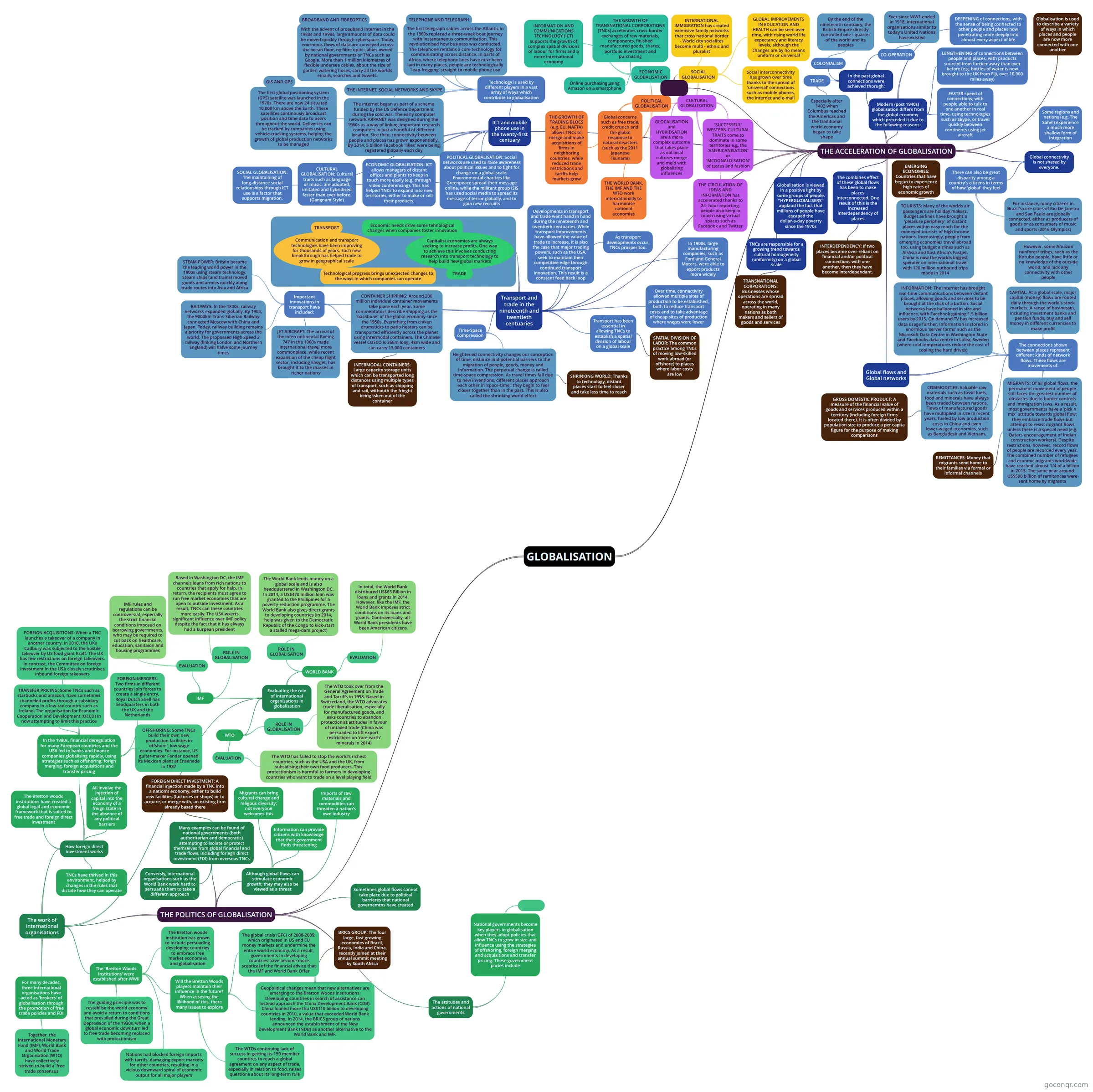
Mind map: Globalisation
Contenido del mapa
GLOBALISATION
THE ACCELERATION OF GLOBALISATION
- Globalisation is used to describe a variety of ways in which places and people are now more connected with one another
- In the past global connections were achieved thorugh:
- TRADE
- Especially after 1492 when Columbus reached the Americas and the traditional world economy began to take shape
- COLONIALISM
- By the end of the nineteenth centuary, the British Empire directly controlled one - quarter of the world and its peoples
- CO-OPERATION
- Ever since WW1 ended in 1918, international organisations similar to today's United Nations have existed
- TRADE
- SOCIAL GLOBALISATION
- CULTURAL GLOBALISATION
- POLITICAL GLOBALISATION
- ECONOMIC GLOBALISATION
- THE GROWTH OF TRANSNATIONAL CORPORATIONS (TNCs) accelerates cross-border exchanges of raw materials, components, finished manufactured goods, shares, portfolio investment and purchasing
- INFORMATION AND COMMUNICATIONS TECHNOLOGY (ICT) supports the growth of complex spatial divisions of labour for firms and a more international economy
- Online purchasing using Amazon on a smartphone
- THE GROWTH OF TRADING BLOCS (e.g. EU, NAFTA) allows TNCs to merge and make acquisitions of firms in neighboring countries, while reduced trade restrictions and tariffs help markets grow
- Global concerns such as free trade, credit crunch and the global response to natural disasters (such as the 2011 Japanese Tsunami)
- THE WORLD BANK, THE IMF AND THE WTO work internationally to harmonise national economies
- ECONOMIC GLOBALISATION
- 'SUCCESSFUL' WESTERN CULTURAL TRAITS come to dominate in some territories e.g. the 'AMERICANISATION' or 'MCDONALDISATION' of tastes and fashion
- GLOCALISATION and HYBRIDSATION are a more complex outcome that takes place as old local cultures merge and meld with globalising influences
- THE CIRCULATION OF IDEAS AND INFORMATION has accelerated thanks to 24- hour reporting; people also keep in touch using virtual spaces such as Facebook and Twitter
- POLITICAL GLOBALISATION
- INTERNATIONAL IMMIGRATION has created extensive family networks that cross national border - World city socialites become multi - ethnic and pluralist
- GLOBAL IMPROVEMENTS IN EDUCATION AND HEALTH can be seen over time, with rising world life expectancy and literacy levels, although the changes are by no means uniform or universal
- Social interconnectivity has grown over time thanks to the spread of 'universal' connections such as mobile phones, the internet and e-mail
- CULTURAL GLOBALISATION
- SOCIAL GLOBALISATION
- Modern (post 1940s) globalisation differs from the global economy which preceded it due to the following reasons:
- LENGTHENING of connections between people and places, with products sourced from further away than ever before (e.g. bottles of water is now brought to the UK from Fiji, over 10,000 miles away)
- DEEPENING of connections, with the sense of being connected to other people and places now penetrating more deeply into almost every aspect of life
- FASTER speed of connections, with people able to talk to one another in real time, using technologies such as Skype, or travel quickly between continents using jet aircraft
- Global connectivity is not shared by everyone.
- Some regions and nations (e.g. The Sahel) experience a much more shallow form of integration
- There can also be great disparity among a country's citizens in terms of how 'global' they feel
- For instance, many citizens in Brazil's core cities of Rio De Janeiro and Sao Paulo are globally connected, either as producers of goods or as consumers of music and sports (2016 Olympics)
- However, some Amazon rainforest tribes, such as the Korubo people, have little or no knowledge of the outside world, and lack any connectivity with other people
- For instance, many citizens in Brazil's core cities of Rio De Janeiro and Sao Paulo are globally connected, either as producers of goods or as consumers of music and sports (2016 Olympics)
- Globalisation is viewed in a positive light by some groups of people. ''HYPERGLOBALISERS'' applaud the fact that millions of people have escaped the dollar-a-day poverty since the 1970s
- TNCs are responsible for a growing trend towards cultural homogeneity (uniformity) on a global scale
- TRANSNATIONAL CORPORATIONS: Businesses whose operations are spread across the world, operating in many nations as both makers and sellers of goods and services
- Global flows and Global networks
- The connections shown between places represent different kinds of network flows. These flows are movements of:
- CAPITAL: At a global scale, major capital (money) flows are routed daily through the world's stock markets. A range of businesses, including investment banks and pension funds, buy and sell money in different currencies to make profit
- COMMODITIES: Valuable raw materials such as fossil fuels, food and minerals have always been traded between nations. Flows of manufactured goods have multiplied in size in recent years, fueled by low production costs in China and even lower-waged economies, such as Bangladesh and Vietnam.
- GROSS DOMESTIC PRODUCT: A measure of the financial value of goods and services produced within a territory (including foreign firms located there). It is often divided by population size to produce a per capita figure for the purpose of making comparisons
- INFORMATION: The internet has brought real-time communications between distant places, allowing goods and services to be brought at the click of a button. Social networks have ballooned in size and influence, with Facebook gaining 1.5 billion users by 2015. On demand TV has increased data usage further. Information is stored in enormous 'server farms' such as the Microsoft Data Centre in Washington State and Facebooks data centre in Lulea, Sweden (where cold temperatures reduce the cost of cooling the hard drives)
- TOURISTS: Many of the worlds air passengers are holiday makers. Budget airlines have brought a 'pleasure periphery' of distant places within easy reach for the moneyed tourists of high income nations. Increasingly, people from emerging economies travel abroad too, using budget airlines such as AirAsia and East Africa's Fastjet. China is now the worlds biggest spender on international travel with 120 million outbound trips made in 2014
- EMERGING ECONOMIES: Countries that have begun to experience high rates of economic growth
- MIGRANTS: Of all global flows, the permanent movement of people still faces the greatest number of obstacles due to border controls and immigration laws. As a result, most governments have a 'pick n mix' attitude towards global flow; they embrace trade flows but attempt to resist migrant flows unless there is a special need (e.g. Qatars encouragement of Indian construction workers). Despite restrictions, however, record flows of people are recorded every year. The combined number of refugees and econmic migrants worldwide have reached almost 1/4 of a billion in 2013. The same year around US$500 billion of remitances were sent home by migrants
- REMITTANCES: Money that migrants send home to their families via formal or informal channels
- The connections shown between places represent different kinds of network flows. These flows are movements of:
- The combines effect of these global flows has been to make places interconnected. One result of this is the increased interdependency of places
- INTERDEPENDENCY: If two places become over-reliant on financial and/or political connections with one another, then they have become interdependant.
- Transport and trade in the nineteenth and twentieth centuaries
- Developments in transport and trade went hand in hand during the nineteenth and twentieth centuaries. While transport improvements have allowed the value of trade to increase, it is also the case that major trading powers, such as the USA, seek to maintain their competitive edge through continued transport innovation. This result is a constant feed back loop
- TRADE
- Capitalist economies are always seeking to increase profits. One way to achieve this involves conducting research into transport technology to help build new global markets
- Economic needs drive some tehnological changes when companies foster innovation
- TRANSPORT
- Communication and transport technologies have been improving for thousands of years. Each new breakthrough has helped trade to grow in geographical scale
- Technological progress brings unexpected changes to the ways in which companies can operate
- Communication and transport technologies have been improving for thousands of years. Each new breakthrough has helped trade to grow in geographical scale
- TRANSPORT
- Economic needs drive some tehnological changes when companies foster innovation
- Capitalist economies are always seeking to increase profits. One way to achieve this involves conducting research into transport technology to help build new global markets
- TRADE
- As transport developments occur, TNCs prosper too.
- In 1900s, large manufacturing companies, such as Ford and General Motors, were able to export products more widely
- Over time, connectivity allowed multiple sites of production to be established, both to reduce transport costs and to take advantage of cheap sites of production where wages were lower
- Transport has been essential in allowing TNCs to establish a spatial division of labour on a global scale
- SPATIAL DIVISION OF LABOR: The common practice among TNCs of moving low-skilled work abroad (or offshore) to places where labor costs are low
- Important innovations in transport have included:
- STEAM POWER: Britain became the leading world power in the 1800s using steam technology. Steam ships (and trains) moved goods and armies quickly along trade routes into Asia and Africa
- RAILWAYS: In the 1800s, railway networks expanded globally. By 1904, the 9000km Trans-Siberian Railway connected Moscow with China and Japan. Today, railway building remains a priority for governments across the world. The propossed High Speed 2 railway (linking London and Northern England) will halve some journey times
- JET AIRCRAFT: The arrival of the intercontinental Boeing 747 in the 1960s made international travel more commonplace, while recent expansion of the cheap flight sector, including EasyJet, has brought it to the masses in richer nations
- CONTAINER SHIPPING: Around 200 million individual container movements take place each year. Some commentators describe shipping as the 'backbone' of the global economy since the 1950s. Everything from chiken drumsticks to patio heaters can be transported efficiently across the planet using intermodal containers. The Chinese vessel COSCO is 366m long, 48m wide and can carry 13,000 containers
- INTERMODAL CONTAINERS: Large capacity storage units which can be transported long distances using multiple types of transport, such as shipping and rail, withouth the frieght being tsken out of the container
- Time-Space compression
- Heightened connectivity changes our conception of time, distance and potential barriers to the migration of people, goods, money and information. The perpetual change is called time-space compression. As travel times fall due to new inventions, different places approach each other in 'space-time': they begin to feel closer together than in the past. This is also called the shrinking world effect
- SHRINKING WORLD: Thanks to technology, distant places start to feel closer and take less time to reach
- Heightened connectivity changes our conception of time, distance and potential barriers to the migration of people, goods, money and information. The perpetual change is called time-space compression. As travel times fall due to new inventions, different places approach each other in 'space-time': they begin to feel closer together than in the past. This is also called the shrinking world effect
- ICT and mobile phone use in the twenty-first centuary
- Technology is used by different players in a vast array of ways which contribute to globalisation
- The first telegraph cables across the Atlantic in the 1860s replaced a three-week boat journey with instantaneous communication. This revolutionised how business was conducted. The telephone remains a core technology for communicating across distance. In parts of Africa, where telephone lines have nevr been laid in many places, people are technologically 'leap-frogging' straight to mobile phone use
- TELEPHONE AND TELEGRAPH
- With the advent of broadband internet in the 1980s and 1990s, large amounts of data could be moved quickly through cyberspace. Today, enormous flows of data are conveyed across the ocean floor, ny fibre optic cables owned by national governments or TNCs such as Google. More than 1 million kilometres of flexible undersea cables, about the size of garden watering hoses, carry all the worlds emails, searches and twwets.
- BROADBAND AND FIBREOPTICS
- The first global positioning system (GPS) satellite was launched in the 1970s. There are now 24 situated 10,000 km above the Earth. These satellites continously broadcast position and time data to users throughout the world. Deliveries can be tracked by companies using vehicle-tracking systems, helping the growth of global production networks to be managed
- GIS AND GPS
- THE INTERNET, SOCIAL NETWORKS AND SKYPE
- The internet began as part of a scheme funded by the US Defence Department during the cold war. The early computer network ARPANET was designed during the 1960s as a way of linking important research computers in just a handful of different location. Sice then, connectivity between people and places has grown exponentially. By 2014, 5 billion Facebook 'likes' were being registered globally each day
- The first telegraph cables across the Atlantic in the 1860s replaced a three-week boat journey with instantaneous communication. This revolutionised how business was conducted. The telephone remains a core technology for communicating across distance. In parts of Africa, where telephone lines have nevr been laid in many places, people are technologically 'leap-frogging' straight to mobile phone use
- ECONOMIC GLOBALISATION: ICT allows managers of distant offices and plants to keep in touch more easily (e.g. through video conferencing). This has helped TNCs to expand into new territories, either to make or sell their products.
- SOCIAL GLOBALISATION: The maintaining of long-distance social relationships through ICT use is a factor that supports migration.
- CULTURAL GLOBALISATION: Cultural traits such as language or music, are adopted, imitated and hybridised faster than ever before. (Gangnam Style)
- POLITICAL GLOBALISATION: Social networks are used to raise awareness about political issues and to fight for change on a global scale. Environmental charities like Greenpeace spread their message online, while the militant group ISIS has used social media to spread its message of terror globally, and to gain new recruiits
- Technology is used by different players in a vast array of ways which contribute to globalisation
THE POLITICS OF GLOBALISATION
- Sometimes global flows cannot take place due to political barrieres that national governemtns have created
- Although global flows can stimulate economic growth; they may also be viewed as a threat
- Imports of raw materials and commodities can threaten a nation's own industry
- Migrants can bring cultural change and religous diversity; not everyone welcomes this
- Information can provide citizens with knowledge that their government finds threatening
- Many examples can be found of national governments (both authoritarian and democratic) attempting to isolate or protect themselves from global financial and trade flows, including foriegn direct investment (FDI) from overseas TNCs
- FOREIGN DIRECT INVESTMENT: A financial injection made by a TNC into a nation's economy, either to build new facilities (factories or shops) or to acquire, or merge with, an existing firm already based there
- Conversly, international organisations such as the World Bank work hard to persuade them to take a differetn approach
- The work of international organisations
- For many decades, three international organisations have acted as 'brokers' of globalisation through the promotion of free trade policies and FDI
- Together, the International Monetary Fund (IMF), World Bank and World Trade Organisation (WTO) have collectively striven to build a 'free trade consensus'
- The 'Bretton Woods Institutions' were established after WWII
- The guiding principle was to restablise the world economy and avoid a return to conditions that prevailed during the Great Depression of the 1930s, when a global economic downturn led to free trade becoming replaced with protectionism
- Nations had blocked foreign imports with tarrifs, damaging export markets for other countries, resulting in a vicious downward spiral of economic output for all major players
- The Bretton woods institution has grown to include persuading developing countries to embrace free market economies and globalisation
- Will the Bretton Woods players maintain their influence in the future? When assesing the liklihood of this, there many issues to explore
- The global crisis (GFC) of 2008-2009, which originated in US and EU money markets and undermine the entire world economy. As a result, governments in developing countries have become more sceptical of the financial advice that the IMF and World Bank Offer
- Geopolitical changes mean that new alternatives are emerging to the Bretton Woods institutions. Developing countries in search of assistance can instead approach the China Development Bank (CDB). China loaned more tha US$110 billion to developing countries in 2010, a value that exceeded World Bank lending. In 2014, the BRICS group of nations announced the establishment of the New Development Bank (NDB) as another alternative to the World Bank and IMF.
- BRICS GROUP: The four large, fast growing economies of Brazil, Russia, India and China, recently joined at their annual summit meeting by South Africa
- The WTOs continuing lack of success in getting its 159 member countires to reach a global agreement on any aspect of trade, especially in relation to food, raises questions about its long-term role
- How foreign direct investment works
- The Bretton woods institutions have created a global legal and economic framework that is suited to free trade and foreign direct investment
- TNCs have thrived in this environment, helped by changes in the rules that dictate how they can operate
- In the 1980s, financial deregulation for many European countries and the USA led to banks and finance companies globalising rapidly, using strategies such as offshoring, forign merging, foreign acquisitions and transfer pricing
- OFFSHORING: Some TNCs build their own new production facilities in 'offshore', low wage economies. For instance, US guitar-maker Fender opened its Mexican plant at Ensenada in 1987
- FOREIGN MERGERS: Two firms in different countries join forces to create a single entry, Royal Dutch Shell has headquarters in both the UK and the Netherlands
- FOREIGN ACQUISITIONS: When a TNC launches a takeover of a company in another country. In 2010, the UKs Cadbury was subjected to the hostile takeover by US food giant Kraft. The UK has few restrictions on foreign takeovers. In contrast, the Committee on foreign investment in the USA closely scrutinises inbound foreign takeovers
- TRANSFER PRICING: Some TNCs such as starbucks and amazon, have sometimes channeled profits through a subsidary company in a low-tax country such as Ireland. The organisation for Economic Cooperation and Development (OECD) in now attempting to limit this practice
- All involve the injection of capital into the economy of a freign state in the absence of any political barriers
- Evaluating the role of international organisations in globalisation
- IMF
- ROLE IN GLOBALISATION
- Based in Washington DC, the IMF channels loans from rich nations to countries that apply for help. In return, the recipients must agree to run free market economies that are open to outside investment. As a result, TNCs can these countries more easily. The USA wxerts significant influence over IMF policy despite the fact that it has always had a Eurpean president
- EVALUATION
- IMF rules and regulations can be controversial, especially the strict financial conditions imposed on borrowing governments, who may be required to cut back on healthcare, education, sanitaion and housing programmes
- ROLE IN GLOBALISATION
- WORLD BANK
- ROLE IN GLOBALISATION
- The World Bank lends money on a global scale and is also headquartered in Washington DC. In 2014, a US$470 million loan was granted to the Phillipines for a poverty-reduction programme. The World Bank also gives direct grants to developing countries (in 2014, help was given to the Democratic Republic of the Congo to kick-start a stalled mega-dam project)
- EVALUATION
- In total, the World Bank distributed US$65 Billion in loans and grants in 2014. However, like the IMF, the World Bank imposes strict conditions on its loans and grants. Controversially, all World Bank presidents have been American citizens
- ROLE IN GLOBALISATION
- WTO
- ROLE IN GLOBALISATION
- The WTO took over from the General Agreement on Trade and Tarriffs in 1998. Based in Switzerland, the WTO advocates trade liberalisation, especially for manufactured goods, and asks countries to abandon protectionist attitudes in favour of untaxed trade (China was persuaded to lift export restrictions on 'rare earth' minerals in 2014)
- EVALUATION
- The WTO has failed to stop the world's richest countries, such as the USA and the UK, from subsidising their own food producers. This protectionism is harmful to farmers in developing countries who want to trade on a level playing field
- ROLE IN GLOBALISATION
- IMF
- For many decades, three international organisations have acted as 'brokers' of globalisation through the promotion of free trade policies and FDI
- The attitudes and actions of national governments
- National governments become key players in globalisation when they adopt policies that allow TNCs to grow in size and influence using the strategies of offshoring, foreign merging and acquisitions and transfer pricing. These government plicies include
- National governments become key players in globalisation when they adopt policies that allow TNCs to grow in size and influence using the strategies of offshoring, foreign merging and acquisitions and transfer pricing. These government plicies include
Información
- Descripción
- A level Geography Mapa Mental sobre GLOBALISATION, creado por Anjali Dhunna el 05/02/2017.
- Creado por
- Anjali Dhunna
- Visitas
- 2
- Valoración