
Mapa mental
Deontological Ethics
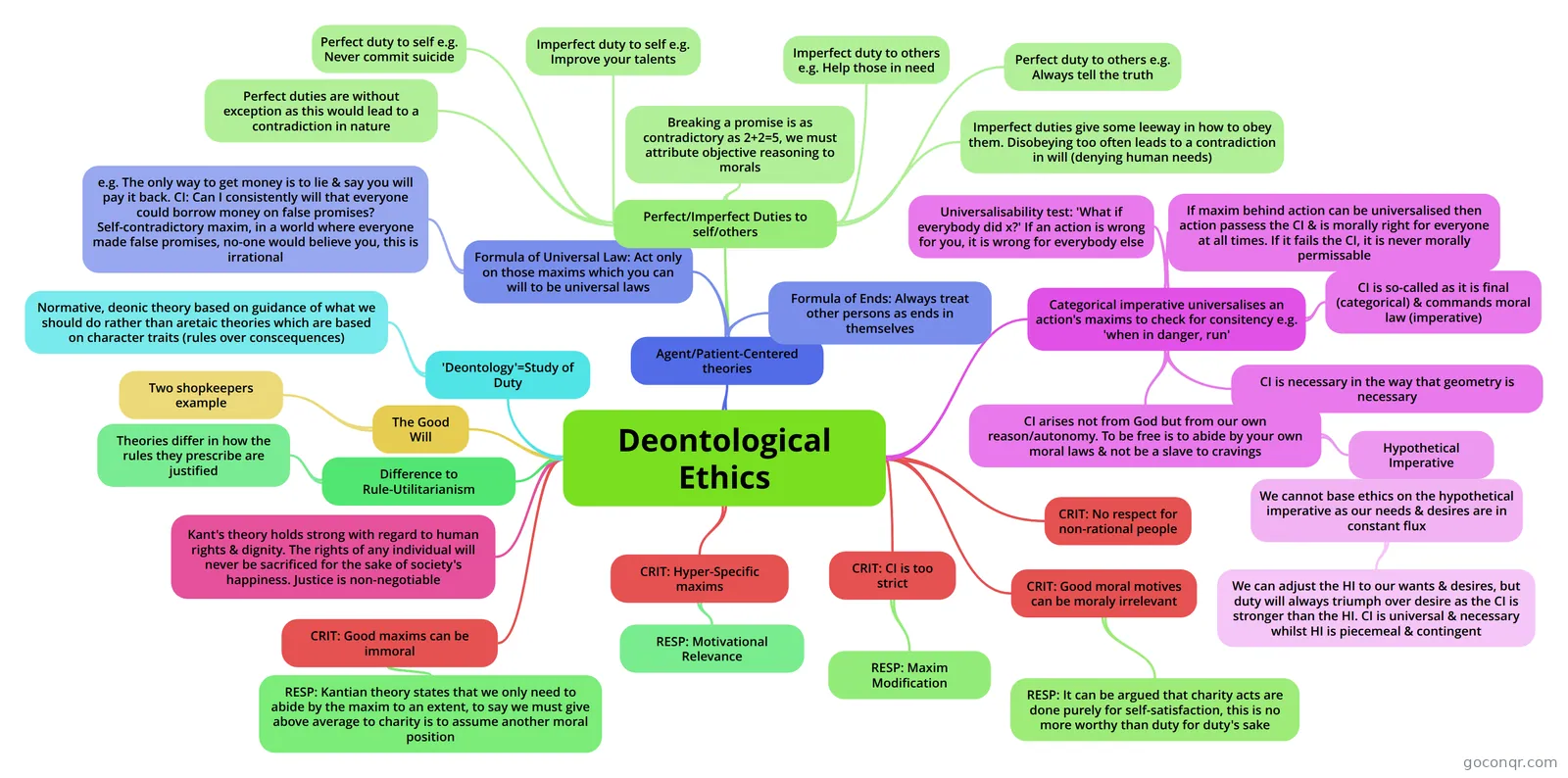
Mind map: deontological ethics
Contenido del mapa
Deontological Ethics
'Deontology'=Study of Duty
- Normative, deonic theory based on guidance of what we should do rather than aretaic theories which are based on character traits (rules over conscequences)
Categorical imperative universalises an action's maxims to check for consitency e.g. 'when in danger, run'
- If maxim behind action can be universalised then action passess the CI & is morally right for everyone at all times. If it fails the CI, it is never morally permissable
- Universalisability test: 'What if everybody did x?' If an action is wrong for you, it is wrong for everybody else
- CI is so-called as it is final (categorical) & commands moral law (imperative)
- CI arises not from God but from our own reason/autonomy. To be free is to abide by your own moral laws & not be a slave to cravings
- Hypothetical Imperative
- Maxim expressing wants/desires in terms of a means-end relationship. 'If you want x then do y'. e.g. If you want sweets, just ask.
- We cannot base ethics on the hypothetical imperative as our needs & desires are in constant flux
- We can adjust the HI to our wants & desires, but duty will always triumph over desire as the CI is stronger than the HI. CI is universal & necessary whilst HI is piecemeal & contingent
- Hypothetical Imperative
- CI is necessary in the way that geometry is necessary
Agent/Patient-Centered theories
- Formula of Universal Law: Act only on those maxims which you can will to be universal laws
- e.g. The only way to get money is to lie & say you will pay it back. CI: Can I consistently will that everyone could borrow money on false promises? Self-contradictory maxim, in a world where everyone made false promises, no-one would believe you, this is irrational
- Formula of Ends: Always treat other persons as ends in themselves
- Perfect/Imperfect Duties to self/others
- Perfect duties are without exception as this would lead to a contradiction in nature
- Imperfect duties give some leeway in how to obey them. Disobeying too often leads to a contradiction in will (denying human needs)
- Perfect duty to self e.g. Never commit suicide
- Irrational implications that this would involve 'reason killing itself'. Self/Love, which is supposed to promote the continuance of Rational Life is being used for its exact opposite. It is everyone's moral duty not to commit suicide.
- Perfect duty to others e.g. Always tell the truth
- Every lie presupposes a social context of truth-telling in general in the way of the perfect fraud painting. Universalisation removes the logical underpinning of the action itself. No-one should ever lie.
- Imperfect duty to self e.g. Improve your talents
- Opposite implies no contradiction, though no human could possibly will for a world where no-one improved their talents as we need these to survive and live a fulfilling life. There would be no doctors, plumbers or musicians and we could not possibly desire a world like this and so the opposite implies a contradiction in will.
- Someone who knows they need x but purposefully denies themselves it is irrational. We are not under moral obligation to always improve our talents, we just need to obey the imperative t an extent.
- Imperfect duty to others e.g. Help those in need
- A world where no-one helped each other is perfectly plausible, however universalising the maxim implies a contradiction in will as it is irrational to will a world where our needs will not be met despite knowing we are likely to need help.
- We could not help all people at all times, as long as we fulfill the duty to an extent that is enough.
- Breaking a promise is as contradictory as 2+2=5, we must attribute objective reasoning to morals
- Formula of Universal Law: Act only on those maxims which you can will to be universal laws
The Good Will
- Kant believed the Good Will is the only thing which is good in itself, all other goods are merely instrumental goods which may be bad in certain circumstances e.g. Happiness can be bad as happy torturers are worse than miserable ones and intelligence makes criminals more dangerous.
- Good will only acts from the motive of RESPECT FOR DUTY, duty for duty's sake. For one's actions to be considered moral, you must do them for duty's sake rather than under some other agenda. A person who acts with good will is someone who acts on principles. It is possible to act on the CI without having moral worth if you are not acting on good will.
- Two shopkeepers example
- One shopkeers sets honest & fair prices to keep good business, whilst the other does the same because it is his moral duty. The 1st person is living by the CI, but not because of the CI. There is a difference in motive: 'Honesty is the best policy' is not a Kantian statement.
Difference to Rule-Utilitarianism
- Theories differ in how the rules they prescribe are justified
- Utiliarianism justifies its rules in terms of the consequences of actions, whilst Kantian theory is justifie rules by their consistency ie by their rationality. Even if the CI leads to unhappiness, it must still be obeyed because it is underpinned by moral law.
- There is no point in obeying a rule if you are the only one to do so according to R-U. Any maxim that satisfies the CI becomes a moral rule, even if only one person pays attention to it. It is a rational right even if no-one else can see it.
- Whilst the rules of utilitarianism may change on the needs of the population at the time, Deontology holds the CI as unchanging, it is as certain as mathematics - it is not subject to human desires or fashions as it is based on objective reasoning & has a priori moral laws
- Theories differ in how the rules they prescribe are justified
Kant's theory holds strong with regard to human rights & dignity. The rights of any individual will never be sacrificed for the sake of society's happiness. Justice is non-negotiable
CRIT: Good maxims can be immoral
- 'Give more than average to charity' is not universalisable and so is condemned to be immoral. It would be impossible for everyone to give more than average to society, because the average must must have people below it.
- RESP: Kantian theory states that we only need to abide by the maxim to an extent, to say we must give above average to charity is to assume another moral position
CRIT: Hyper-Specific maxims
- 'When you're name is Alex & you have blue hair and etc...you can break promises. Maxims can be made so specific that they only apply to one individual so will always pass the CI as they only apply to you.
- RESP: Motivational Relevance
- We shouldn't include motivationally irrelevant things such as hair colour into our moral considerations. Kant's theory doesn't exclude this, however the content of maxims should be our willed intentions. Hair colour is not a willed intention and so should not come into moral consideration.
CRIT: CI is too strict
- Kant allows no exceptions to his moral law, even if a murderer is looking for your friend you must tell him the truth. The murder is supposedly not your fault since you did the right thing. No one would agree with Kant here.
- RESP: Maxim Modification
- We can modify the maxim to 'Always tell the truth unless doing so will help a murderer to kill'. This is easily universalisable.
CRIT: No respect for non-rational people
- We are not morally obliged to treat those who don't live in accordance with the CI with respect to their rights. People with brain-damage may not be able to have a rational acception of moral law and so they technically have no rights according to 2nd formulation of the CI. By 'treating other persons as ends in themselves, Kant refers to people with a rational acceptance for moral law.
CRIT: Good moral motives can be moraly irrelevant
- The only moral motive is 'duty for duty's sake'/respect for the CI. If someone has natural sympathy for others or enjoy being generous, their actions have no moral worth as they are not done simply out of duty. Someone who gives money to oxfam out of sympathy is surely a better person than they who give to Oxfam purely out of duty.
- RESP: It can be argued that charity acts are done purely for self-satisfaction, this is no more worthy than duty for duty's sake
Información
- Descripción
- A-level (Moral Philosophy) Philosophy Mapa Mental sobre Deontological Ethics, creado por louisge el 22/05/2014.
- Creado por
- louisge
- Visitas
- 42
- Valoración