
Mapa mental
Class differences in achievement
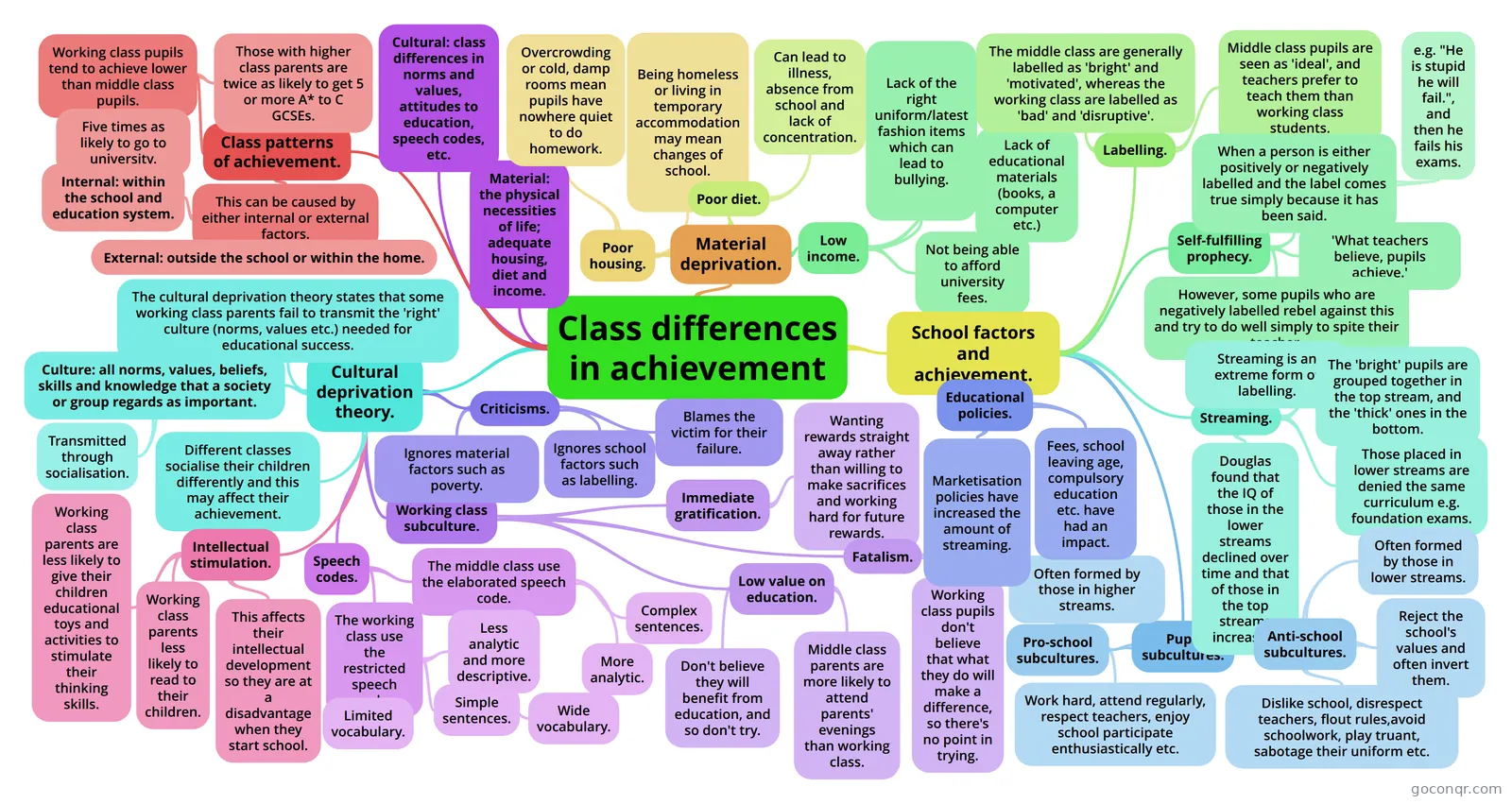
Mind map: Class differences in achievement
Contenido del mapa
Class differences in achievement
Class patterns of achievement.
- Working class pupils tend to achieve lower than middle class pupils.
- Those with higher class parents are twice as likely to get 5 or more A* to C GCSEs.
- Five times as likely to go to university.
- This can be caused by either internal or external factors.
- External: outside the school or within the home.
- Internal: within the school and education system.
- Working class pupils tend to achieve lower than middle class pupils.
Cultural: class differences in norms and values, attitudes to education, speech codes, etc.
Material: the physical necessities of life; adequate housing, diet and income.
Cultural deprivation theory.
- Culture: all norms, values, beliefs, skills and knowledge that a society or group regards as important.
- Transmitted through socialisation.
- Different classes socialise their children differently and this may affect their achievement.
- The cultural deprivation theory states that some working class parents fail to transmit the 'right' culture (norms, values etc.) needed for educational success.
- Intellectual stimulation.
- Working class parents are less likely to give their children educational toys and activities to stimulate their thinking skills.
- Working class parents less likely to read to their children.
- This affects their intellectual development so they are at a disadvantage when they start school.
- Speech codes.
- The working class use the restricted speech code.
- Less analytic and more descriptive.
- Limited vocabulary.
- Simple sentences.
- The middle class use the elaborated speech code.
- More analytic.
- Wide vocabulary.
- Complex sentences.
- The working class use the restricted speech code.
- Working class subculture.
- Immediate gratification.
- Wanting rewards straight away rather than willing to make sacrifices and working hard for future rewards.
- Fatalism.
- Working class pupils don't believe that what they do will make a difference, so there's no point in trying.
- Low value on education.
- Don't believe they will benefit from education, and so don't try.
- Middle class parents are more likely to attend parents' evenings than working class.
- Immediate gratification.
- Criticisms.
- Ignores material factors such as poverty.
- Ignores school factors such as labelling.
- Blames the victim for their failure.
- Culture: all norms, values, beliefs, skills and knowledge that a society or group regards as important.
Material deprivation.
- Poor housing.
- Overcrowding or cold, damp rooms mean pupils have nowhere quiet to do homework.
- Being homeless or living in temporary accommodation may mean changes of school.
- Poor diet.
- Can lead to illness, absence from school and lack of concentration.
- Low income.
- Lack of educational materials (books, a computer etc.)
- Lack of the right uniform/latest fashion items which can lead to bullying.
- Not being able to afford university fees.
- Poor housing.
School factors and achievement.
- Labelling.
- The middle class are generally labelled as 'bright' and 'motivated', whereas the working class are labelled as 'bad' and 'disruptive'.
- Middle class pupils are seen as 'ideal', and teachers prefer to teach them than working class students.
- Self-fulfilling prophecy.
- When a person is either positively or negatively labelled and the label comes true simply because it has been said.
- e.g. "He is stupid he will fail.", and then he fails his exams.
- 'What teachers believe, pupils achieve.'
- However, some pupils who are negatively labelled rebel against this and try to do well simply to spite their teacher.
- When a person is either positively or negatively labelled and the label comes true simply because it has been said.
- Streaming.
- Streaming is an extreme form of labelling.
- The 'bright' pupils are grouped together in the top stream, and the 'thick' ones in the bottom.
- Douglas found that the IQ of those in the lower streams declined over time and that of those in the top streams increased.
- Those placed in lower streams are denied the same curriculum e.g. foundation exams.
- Pupil subcultures.
- Pro-school subcultures.
- Often formed by those in higher streams.
- Work hard, attend regularly, respect teachers, enjoy school participate enthusiastically etc.
- Anti-school subcultures.
- Often formed by those in lower streams.
- Reject the school's values and often invert them.
- Dislike school, disrespect teachers, flout rules,avoid schoolwork, play truant, sabotage their uniform etc.
- Pro-school subcultures.
- Educational policies.
- Marketisation policies have increased the amount of streaming.
- Fees, school leaving age, compulsory education etc. have had an impact.
- Labelling.
Información
- Descripción
- A-Levels (Education) Sociology Mapa Mental sobre Class differences in achievement, creado por WhisperedWishes el 15/05/2013.
- Creado por
- WhisperedWishes
- Visitas
- 559
- Etiquetas
- Valoración