
Mapa mental
The Vietnam War
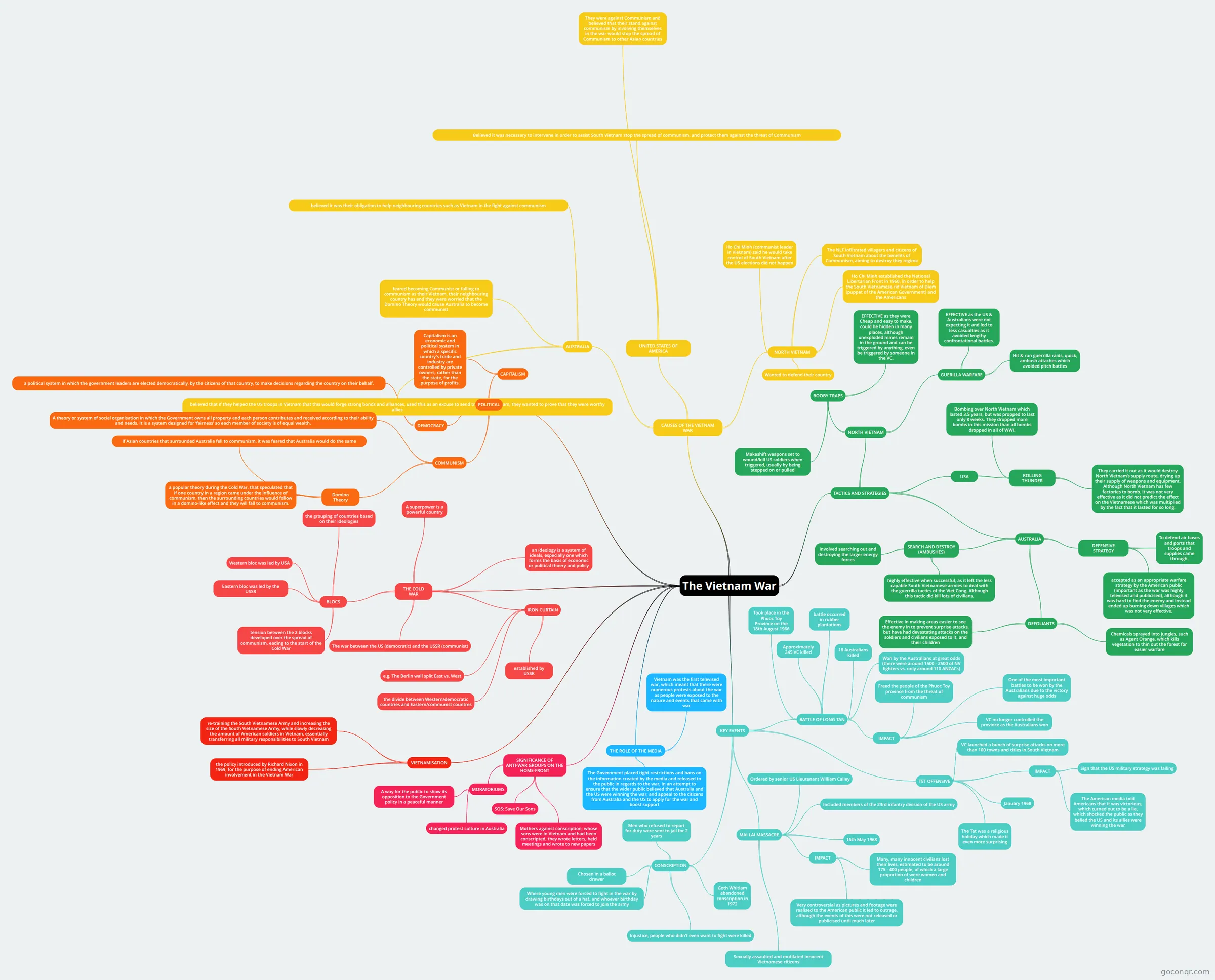
Mind map: The Vietnam War
Contenido del mapa
The Vietnam War
CAUSES OF THE VIETNAM WAR
- UNITED STATES OF AMERICA
- Believed it was necessary to intervene in order to assist South Vietnam stop the spread of communism, and protect them against the threat of Communism
- They were against Communism and believed that their stand against communism by involving themselves in the war would stop the spread of Communism to other Asian countries
- AUSTRALIA
- feared becoming Communist or falling to communism as their Vietnam, their neighbouring country has and they were worried that the Domino Theory would cause Australia to become communist
- believed it was their obligation to help neighbouring countries such as Vietnam in the fight against communism
- believed that if they helped the US troops in Vietnam that this would forge strong bonds and alliances, used this as an excuse to send troops to Vietnam, they wanted to prove that they were worthy allies
- NORTH VIETNAM
- Wanted to defend their country
- Ho Chi Minh (communist leader in Vietnam) said he would take control of South Vietnam after the US elections did not happen
- Ho Chi Minh established the National Libertarian Front in 1960, in order to help the South Vietnamese rid Vietnam of Diem (puppet of the American Government) and the Americans
- The NLF infiltrated villagers and citizens of South Vietnam about the benefits of Communism, aiming to destroy they regime
- UNITED STATES OF AMERICA
VIETNAMISATION
- the policy introduced by Richard Nixon in 1969, for the purpose of ending American involvement in the Vietnam War
- re-training the South Vietnamese Army and increasing the size of the South Vietnamese Army, while slowly decreasing the amount of American soldiers in Vietnam, essentially transferring all military responsibilities to South Vietnam
KEY EVENTS
- BATTLE OF LONG TAN
- Won by the Australians at great odds (there were around 1500 - 2500 of NV fighters vs. only around 110 ANZACs)
- Took place in the Phuoc Toy Province on the 18th August 1966
- 18 Australians killed
- Approximately 245 VC killed
- battle occurred in rubber plantations
- IMPACT
- Freed the people of the Phuoc Toy province from the threat of communism
- VC no longer controlled the province as the Australians won
- One of the most important battles to be won by the Australians due to the victory against huge odds
- TET OFFENSIVE
- January 1968
- VC launched a bunch of surprise attacks on more than 100 towns and cities in South Vietnam
- The Tet was a religious holiday which made it even more surprising
- IMPACT
- Sign that the US military strategy was failing
- The American media told Americans that it was victorious, which turned out to be a lie, which shocked the public as they belied the US and its allies were winning the war
- MAI LAI MASSACRE
- Included members of the 23rd infantry division of the US army
- 16th May 1968
- Sexually assaulted and mutilated innocent Vietnamese citizens
- Ordered by senior US Lieutenant William Calley
- IMPACT
- Many, many innocent civilians lost their lives, estimated to be around 175 - 400 people, of which a large proportion of were women and children
- Very controversial as pictures and footage were realised to the American public it led to outrage, although the events of this were not released or publicised until much later
- CONSCRIPTION
- Where young men were forced to fight in the war by drawing birthdays out of a hat, and whoever birthday was on that date was forced to join the army
- Chosen in a ballot drawer
- Injustice, people who didn't even want to fight were killed
- Men who refused to report for duty were sent to jail for 2 years
- Goth Whitlam abandoned conscription in 1972
- BATTLE OF LONG TAN
THE ROLE OF THE MEDIA
- The Government placed tight restrictions and bans on the information created by the media and released to the public in regards to the war, in an attempt to ensure that the wider public believed that Australia and the US were winning the war, and appeal to the citizens from Australia and the US to apply for the war and boost support
- Vietnam was the first televised war, which meant that there were numerous protests about the war as people were exposed to the nature and events that came with war
SIGNIFICANCE OF ANTI-WAR GROUPS ON THE HOME-FRONT
- MORATORIUMS
- A way for the public to show its opposition to the Government policy in a peaceful manner
- changed protest culture in Australia
- SOS: Save Our Sons
- Mothers against conscription; whose sons were in Vietnam and had been conscripted, they wrote letters, held meetings and wrote to new papers
- MORATORIUMS
THE COLD WAR
- The war between the US (democratic) and the USSR (communist)
- IRON CURTAIN
- established by USSR
- e.g. The Berlin wall split East vs. West
- the divide between Western/democratic countries and Eastern/communist countres
- BLOCS
- the grouping of countries based on their ideologies
- Eastern bloc was led by the USSR
- Western bloc was led by USA
- tension between the 2 blocks developed over the spread of communism, eading to the start of the Cold War
- A superpower is a powerful country
- an ideology is a system of ideals, especially one which forms the basis of economic or political thoery and policy
POLITICAL
- COMMUNISM
- Domino Theory
- a popular theory during the Cold War, that speculated that if one country in a region came under the influence of communism, then the surrounding countries would follow in a domino-like effect and they will fall to communism.
- If Asian countries that surrounded Australia fell to communism, it was feared that Australia would do the same
- A theory or system of social organisation in which the Government owns all property and each person contributes and received according to their ability and needs. It is a system designed for ‘fairness’ so each member of society is of equal wealth.
- Domino Theory
- DEMOCRACY
- a political system in which the government leaders are elected democratically, by the citizens of that country, to make decisions regarding the country on their behalf.
- CAPITALISM
- Capitalism is an economic and political system in which a specific country's trade and industry are controlled by private owners, rather than the state, for the purpose of profits.
- COMMUNISM
TACTICS AND STRATEGIES
- USA
- ROLLING THUNDER
- Bombing over North Vietnam which lasted 3.5 years, but was propped to last only 8 weeks. They dropped more bombs in this mission than all bombs dropped in all of WWI.
- They carried it out as it would destroy North Vietnam’s supply route, drying up their supply of weapons and equipment. Although North Vietnam has few factories to bomb. It was not very effective as it did not predict the effect on the Vietnamese which was multiplied by the fact that it lasted for so long.
- ROLLING THUNDER
- AUSTRALIA
- DEFENSIVE STRATEGY
- To defend air bases and ports that troops and supplies came through.
- accepted as an appropriate warfare strategy by the American public (important as the war was highly televised and publicised), although it was hard to find the enemy and instead ended up burning down villages which was not very effective.
- SEARCH AND DESTROY (AMBUSHES)
- involved searching out and destroying the larger energy forces
- highly effective when successful, as it left the less capable South Vietnamese armies to deal with the guerrilla tactics of the Viet Cong. Although this tactic did kill lots of civilians.
- DEFOLIANTS
- Chemicals sprayed into jungles, such as Agent Orange, which kills vegetation to thin out the forest for easier warfare
- Effective in making areas easier to see the enemy in to prevent surprise attacks, but have had devastating attacks on the soldiers and civilians exposed to it, and their children
- DEFENSIVE STRATEGY
- NORTH VIETNAM
- GUERILLA WARFARE
- Hit & run guerrilla raids, quick, ambush attaches which avoided pitch battles
- EFFECTIVE as the US & Australians were not expecting it and led to less casualties as it avoided lengthy confrontational battles.
- BOOBY TRAPS
- Makeshift weapons set to wound/kill US soldiers when triggered, usually by being stepped on or pulled
- EFFECTIVE as they were Cheap and easy to make, could be hidden in many places, although unexploded mines remain in the ground and can be triggered by anything, even be triggered by someone in the VC.
- GUERILLA WARFARE
- USA
Información
- Descripción
- year 9 History & Science & English Mapa Mental sobre The Vietnam War, creado por Rachel Herron el 31/08/2017.
- Creado por
- Rachel Herron
- Visitas
- 0
- Historial
-
- Creado por Rachel Herron · 29 ago 2017
- Copiado por Rachel Herron · 31 ago 2017
- Valoración
Más sobre Causes of the Vietnam War