
Mapa mental
FIRST LANGUAGE ACQUISITION
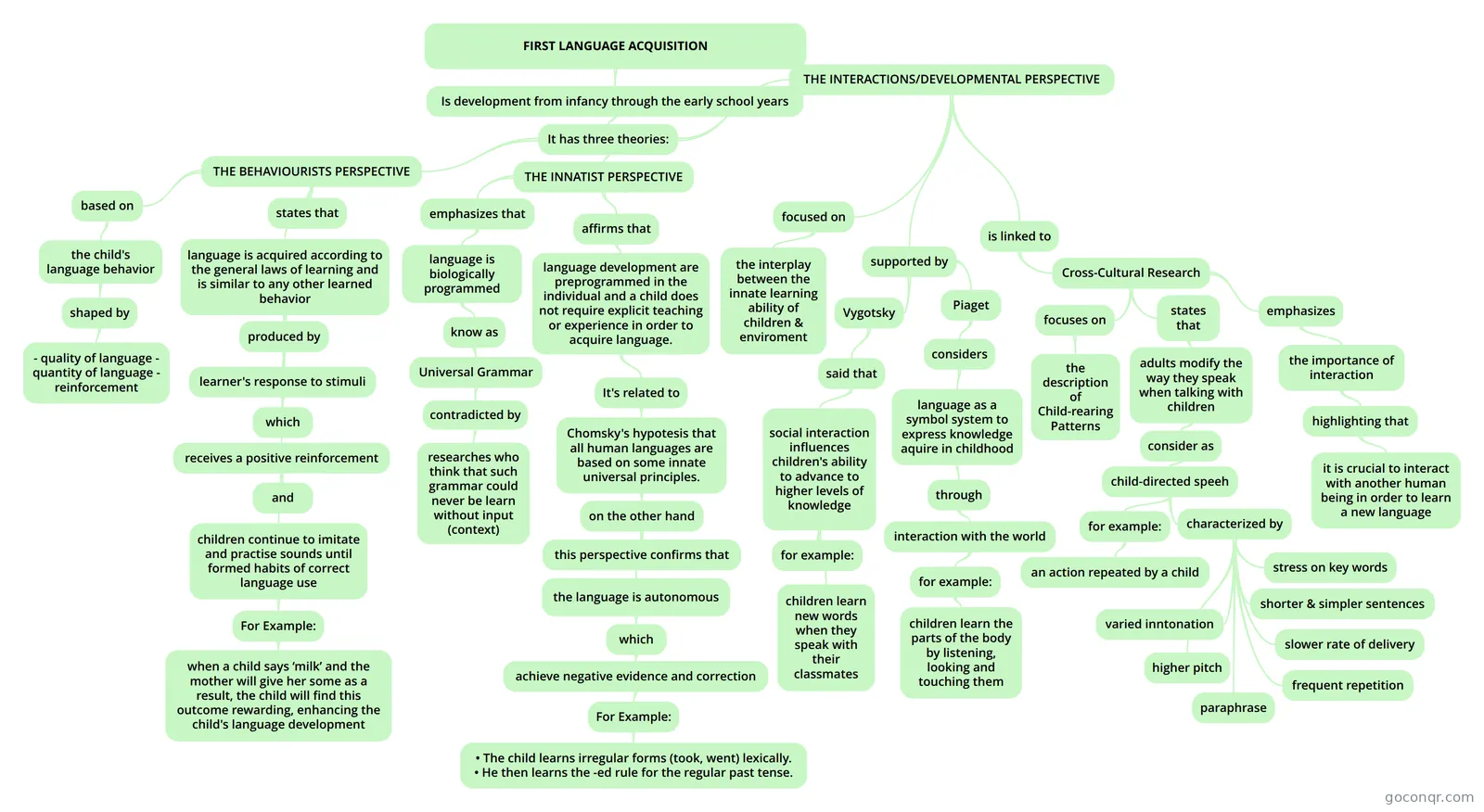
Mind map: first language acquisition
Contenido del mapa
FIRST LANGUAGE ACQUISITION
- FIRST LANGUAGE ACQUISITION
Is development from infancy through the early school years
- It has three theories:
- THE BEHAVIOURISTS PERSPECTIVE
- THE BEHAVIOURISTS PERSPECTIVE
- language is acquired according to the general laws of learning and is similar to any other learned behavior
- receives a positive reinforcement
- children continue to imitate and practise sounds until formed habits of correct language use
- For Example:
- when a child says ‘milk’ and the mother will give her some as a result, the child will find this outcome rewarding, enhancing the child's language development
- For Example:
- and
- children continue to imitate and practise sounds until formed habits of correct language use
- produced by
- learner's response to stimuli
- which
- learner's response to stimuli
- receives a positive reinforcement
- states that
- based on
- the child's language behavior
- shaped by
- - quality of language - quantity of language - reinforcement
- shaped by
- the child's language behavior
- THE INNATIST PERSPECTIVE
- affirms that
- language development are preprogrammed in the individual and a child does not require explicit teaching or experience in order to acquire language.
- It's related to
- Chomsky's hypotesis that all human languages are based on some innate universal principles.
- on the other hand
- the language is autonomous
- which
- achieve negative evidence and correction
- For Example:
- • The child learns irregular forms (took, went) lexically. • He then learns the -ed rule for the regular past tense.
- For Example:
- achieve negative evidence and correction
- which
- this perspective confirms that
- the language is autonomous
- on the other hand
- Chomsky's hypotesis that all human languages are based on some innate universal principles.
- It's related to
- language development are preprogrammed in the individual and a child does not require explicit teaching or experience in order to acquire language.
- emphasizes that
- language is biologically programmed
- know as
- Universal Grammar
- contradicted by
- researches who think that such grammar could never be learn without input (context)
- contradicted by
- Universal Grammar
- know as
- language is biologically programmed
- affirms that
- THE INTERACTIONS/DEVELOPMENTAL PERSPECTIVE
- focused on
- the interplay between the innate learning ability of children & enviroment
- supported by
- Vygotsky
- said that
- social interaction influences children's ability to advance to higher levels of knowledge
- children learn new words when they speak with their classmates
- for example:
- social interaction influences children's ability to advance to higher levels of knowledge
- said that
- Piaget
- considers
- language as a symbol system to express knowledge aquire in childhood
- through
- interaction with the world
- for example:
- children learn the parts of the body by listening, looking and touching them
- for example:
- interaction with the world
- through
- language as a symbol system to express knowledge aquire in childhood
- considers
- Vygotsky
- is linked to
- Cross-Cultural Research
- focuses on
- the description of Child-rearing Patterns
- states that
- adults modify the way they speak when talking with children
- consider as
- child-directed speeh
- for example:
- an action repeated by a child
- characterized by
- shorter & simpler sentences
- stress on key words
- slower rate of delivery
- frequent repetition
- paraphrase
- higher pitch
- varied inntonation
- for example:
- child-directed speeh
- consider as
- adults modify the way they speak when talking with children
- emphasizes
- the importance of interaction
- highlighting that
- it is crucial to interact with another human being in order to learn a new language
- highlighting that
- the importance of interaction
- focuses on
- Cross-Cultural Research
- focused on
- THE BEHAVIOURISTS PERSPECTIVE
- It has three theories:
Información
- Descripción
- Mapa Mental sobre FIRST LANGUAGE ACQUISITION, creado por LARISSA ROMINA QUEZADA PIEDRA el 19/09/2017.
- Creado por
- LARISSA ROMINA QUEZADA PIEDRA
- Visitas
- 14
- Valoración