
Mapa mental
A-level Applied Science: Biology B1

Contenido del mapa
A-level Applied Science: Biology B1
Conversions from M to mm, μm and nm: M -> mm = x1000, M -> μm = x1000 (x2) and M -> nm = x1000 (x3)
- To convert from nm to M just divide by 1000 each time: eg. nm -> mm - Divide by 1000 THEN divide by 1000 again
Cell Theory
- Cell theory is the concept that cells are the fundamental unit of structure, function and organisation in all living organisms
- History of Cell theory
- In the early 1600's dutch scientist Anton Van Leeuwenhoek created his own microscope. and started studying different objects. He discovered bacteria by studying dental scrapings. When leewenhoek wrote about his discoveries he called them animalcules
- In England a scientist called Robert Hooke was looking at a cork under a microscope. when he noticed the little chambers which reminded him of cells. that monks had This is where the name cells came from.
- in 1800's two German scientists (Matthias Schleiden and Theodore Schwann) helped tie together what we know now as the cell theory. Schleiden was a botanist who realized that every plant he looked at under a microscope was made of cell.s. At the same time Schwann also came up with the same conclusion with animals. He looked at many animal cells under a microscope and realized that all animals are made of cells... However, when it came to cell formation both scientists disagreed with each other. Schleiden stated that cells formed from Free cell formation and not from pre-existing cells.. Whilst Theordore Schwann believed that cells were formed from pre exisiting cells.
- It was Rudolf Virchow who stepped in and proved to Schleiden that cells were formed from pre existing cells. He used research from Robert Remak to prove it.
Prokaryotes and Eukaryotes
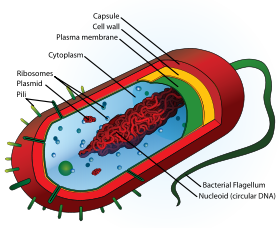
- Prokaryotes - Bacteria. These DO NOT have a nuclues (membrane bound or otherwise)
- Eukrayotes - plant and animal cells have a membrane bound nucelus
Structure of Animal/plant/bacteria cells
- Plant and Animal cells
- Bacteria
Plant Cells
- Plant cells are made from Cellulose. Micro fibrils are cross linked to provide high mechanical strength. Its freely permeable and a complex carbohydrate
- Xylem pits allow the water to enter and leave the plant. Pores in the cell walls of xylem vessels (the tubes in plants that carry water around the plant)
- Chloroplast its got a double membrane. The Fluid inside is called the stroma. Internal membranes form flattened sacs called Thylakoids. Several Thylakoids stacked is known as a Granum. The Granum, is where photosynthesis takes place.
- Plasmodesta are tiny channels across cell walls of adjacent plant cells. It allows transport and communication between cells.
- Amyloplasts are double membrane bound sacs containing starch granules. Its responsible for the synthesis and storage of starch. Amyloplasts also convert this starch back into sugar when the plant needs energy
- Vacuole is membrane bound. it contains sap and the membrane is called a Tonoplast. Tonoplasts are selectively permeable <-- allows small molecules to pass through membrane lined sacs
Gram Staining
- Gram positive stains purple
- To tell difference between bacterias we use gram staining
- Gram negative stains pink
- Gram positive bacteria - Antibiotics can kill them. However, Gram negative bacteria - Antibiotics cant kill them.
- Gram positive stains purple
Imágenes y archivos del mapa
Información
- Descripción
- Feel free to take this to help revision with unit 1 of applied science Edexcel. Leave a comment if anything needs to be changed or fixed and I will get on it.
- Creado por
- Joe Barry
- Visitas
- 343
- Etiquetas
- Valoración