
Mapa mental
Saliva
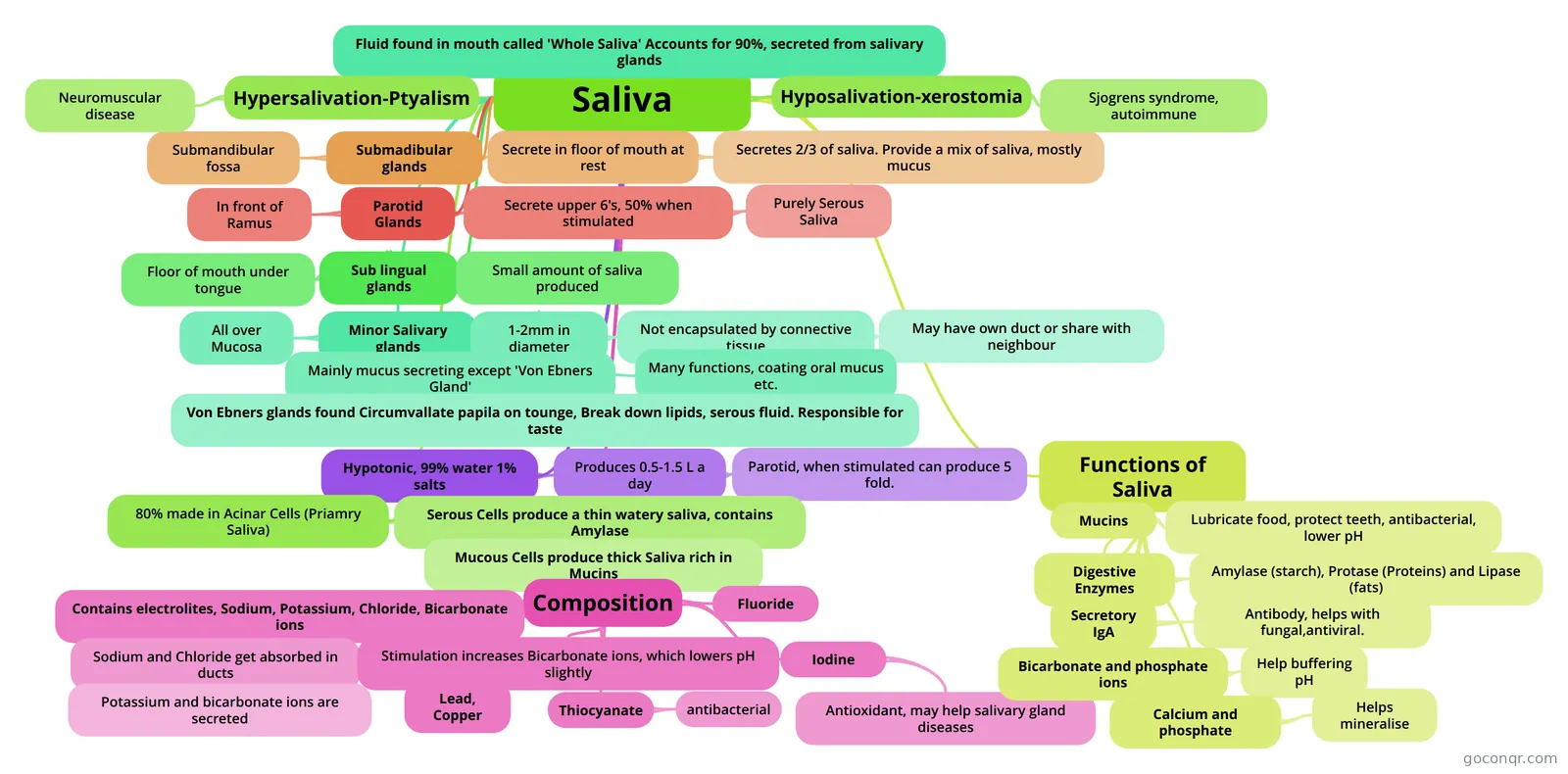
Mind map: Saliva
Contenido del mapa
Saliva
Fluid found in mouth called 'Whole Saliva' Accounts for 90%, secreted from salivary glands
Submadibular glands
- Secrete in floor of mouth at rest
- Secretes 2/3 of saliva. Provide a mix of saliva, mostly mucus
- Submandibular fossa
- Secrete in floor of mouth at rest
Parotid Glands
- Secrete upper 6's, 50% when stimulated
- Purely Serous Saliva
- In front of Ramus
- Secrete upper 6's, 50% when stimulated
Sub lingual glands
- Small amount of saliva produced
- Floor of mouth under tongue
Minor Salivary glands
- All over Mucosa
- 1-2mm in diameter
- Not encapsulated by connective tissue
- May have own duct or share with neighbour
- Not encapsulated by connective tissue
- Mainly mucus secreting except 'Von Ebners Gland'
- Von Ebners glands found Circumvallate papila on tounge, Break down lipids, serous fluid. Responsible for taste
- Many functions, coating oral mucus etc.
Hypotonic, 99% water 1% salts
- Produces 0.5-1.5 L a day
- Parotid, when stimulated can produce 5 fold.
- Produces 0.5-1.5 L a day
Hyposalivation-xerostomia
- Sjogrens syndrome, autoimmune
Hypersalivation-Ptyalism
- Neuromuscular disease
80% made in Acinar Cells (Priamry Saliva)
- Serous Cells produce a thin watery saliva, contains Amylase
- Mucous Cells produce thick Saliva rich in Mucins
- Serous Cells produce a thin watery saliva, contains Amylase
Composition
- Contains electrolites, Sodium, Potassium, Chloride, Bicarbonate ions
- Sodium and Chloride get absorbed in ducts
- Potassium and bicarbonate ions are secreted
- Sodium and Chloride get absorbed in ducts
- Stimulation increases Bicarbonate ions, which lowers pH slightly
- Fluoride
- Thiocyanate
- antibacterial
- Lead, Copper
- Iodine
- Antioxidant, may help salivary gland diseases
- Contains electrolites, Sodium, Potassium, Chloride, Bicarbonate ions
Functions of Saliva
- Mucins
- Lubricate food, protect teeth, antibacterial, lower pH
- Digestive Enzymes
- Amylase (starch), Protase (Proteins) and Lipase (fats)
- Secretory IgA
- Antibody, helps with fungal,antiviral.
- Bicarbonate and phosphate ions
- Help buffering pH
- Calcium and phosphate
- Helps mineralise
- Mucins
Información
- Descripción
- bacalaureat Oral Physiology Mapa Mental sobre Saliva, creado por Caroline Oxford el 27/05/2013.
- Creado por
- Caroline Oxford
- Visitas
- 66
- Etiquetas
- Valoración