
Mapa mental
Social Constructivism
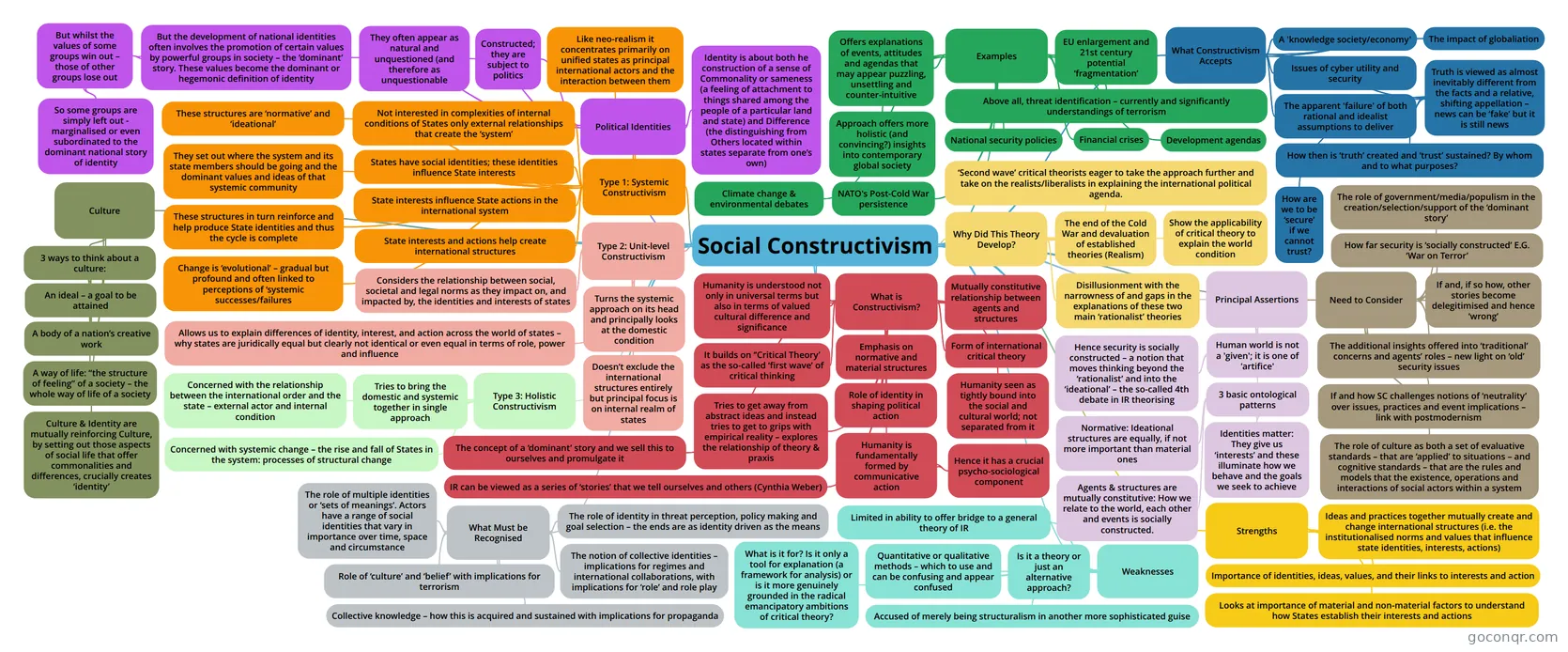
Mind map: Social constructivism
Contenido del mapa
Social Constructivism
What is Constructivism?
- Emphasis on normative and material structures
- Role of identity in shaping political action
- Mutually constitutive relationship between agents and structures
- Form of international critical theory
- Humanity seen as tightly bound into the social and cultural world; not separated from it
- Humanity is fundamentally formed by communicative action
- Hence it has a crucial psycho-sociological component
- Humanity is understood not only in universal terms but also in terms of valued cultural difference and significance
- It builds on ‘’Critical Theory’ as the so-called ‘first wave’ of critical thinking
- Tries to get away from abstract ideas and instead tries to get to grips with empirical reality – explores the relationship of theory & praxis
- IR can be viewed as a series of ‘stories’ that we tell ourselves and others (Cynthia Weber)
- The concept of a ‘dominant’ story and we sell this to ourselves and promulgate it
Why Did This Theory Develop?
- The end of the Cold War and devaluation of established theories (Realism)
- Disillusionment with the narrowness of and gaps in the explanations of these two main ‘rationalist’ theories
- Show the applicability of critical theory to explain the world condition
- ‘Second wave’ critical theorists eager to take the approach further and take on the realists/liberalists in explaining the international political agenda.
Principal Assertions
- Human world is not a 'given'; it is one of 'artifice'
- Hence security is socially constructed – a notion that moves thinking beyond the ‘rationalist’ and into the ‘ideational’ – the so-called 4th debate in IR theorising
- 3 basic ontological patterns
- Normative: Ideational structures are equally, if not more important than material ones
- Identities matter: They give us ‘interests’ and these illuminate how we behave and the goals we seek to achieve
- Agents & structures are mutually constitutive: How we relate to the world, each other and events is socially constructed.
- Human world is not a 'given'; it is one of 'artifice'
Examples
- Approach offers more holistic (and convincing?) insights into contemporary global society
- Offers explanations of events, attitudes and agendas that may appear puzzling, unsettling and counter-intuitive
- NATO's Post-Cold War persistence
- EU enlargement and 21st century potential ‘fragmentation’
- National security policies
- Financial crises
- Development agendas
- Climate change & environmental debates
- Above all, threat identification – currently and significantly understandings of terrorism
Type 1: Systemic Constructivism
- Like neo-realism it concentrates primarily on unified states as principal international actors and the interaction between them
- Not interested in complexities of internal conditions of States only external relationships that create the ‘system’
- States have social identities; these identities influence State interests
- State interests influence State actions in the international system
- State interests and actions help create international structures
- These structures are ‘normative’ and ‘ideational’
- They set out where the system and its state members should be going and the dominant values and ideas of that systemic community
- These structures in turn reinforce and help produce State identities and thus the cycle is complete
- Change is ‘evolutional’ – gradual but profound and often linked to perceptions of ‘systemic successes/failures
Type 2: Unit-level Constructivism
- Turns the systemic approach on its head and principally looks at the domestic condition
- Considers the relationship between social, societal and legal norms as they impact on, and impacted by, the identities and interests of states
- Doesn’t exclude the international structures entirely but principal focus is on internal realm of states
- Allows us to explain differences of identity, interest, and action across the world of states – why states are juridically equal but clearly not identical or even equal in terms of role, power and influence
Type 3: Holistic Constructivism
- Tries to bring the domestic and systemic together in single approach
- Concerned with the relationship between the international order and the state – external actor and internal condition
- Concerned with systemic change – the rise and fall of States in the system: processes of structural change
What Constructivism Accepts
- A 'knowledge society/economy'
- Issues of cyber utility and security
- The impact of globaliation
- The apparent 'failure' of both rational and idealist assumptions to deliver
- Truth is viewed as almost inevitably different from the facts and a relative, shifting appellation – news can be ‘fake’ but it is still news
- How then is ‘truth’ created and ‘trust’ sustained? By whom and to what purposes?
- How are we to be ‘secure’ if we cannot trust?
Need to Consider
- How far security is ‘socially constructed’ E.G. ‘War on Terror’
- The role of government/media/populism in the creation/selection/support of the ‘dominant story’
- If and, if so how, other stories become delegitimised and hence ‘wrong’
- The additional insights offered into ‘traditional’ concerns and agents’ roles – new light on ‘old’ security issues
- If and how SC challenges notions of ‘neutrality’ over issues, practices and event implications – link with postmodernism
- The role of culture as both a set of evaluative standards – that are ‘applied’ to situations – and cognitive standards – that are the rules and models that the existence, operations and interactions of social actors within a system
Strengths
- Looks at importance of material and non-material factors to understand how States establish their interests and actions
- Importance of identities, ideas, values, and their links to interests and action
- Ideas and practices together mutually create and change international structures (i.e. the institutionalised norms and values that influence state identities, interests, actions)
Weaknesses
- Accused of merely being structuralism in another more sophisticated guise
- Limited in ability to offer bridge to a general theory of IR
- Is it a theory or just an alternative approach?
- Quantitative or qualitative methods – which to use and can be confusing and appear confused
- What is it for? Is it only a tool for explanation (a framework for analysis) or is it more genuinely grounded in the radical emancipatory ambitions of critical theory?
What Must be Recognised
- The role of identity in threat perception, policy making and goal selection – the ends are as identity driven as the means
- The role of multiple identities or ‘sets of meanings’. Actors have a range of social identities that vary in importance over time, space and circumstance
- The notion of collective identities – implications for regimes and international collaborations, with implications for ‘role’ and role play
- Collective knowledge – how this is acquired and sustained with implications for propaganda
- Role of ‘culture’ and ‘belief’ with implications for terrorism
Political Identities
- Identity is about both he construction of a sense of Commonality or sameness (a feeling of attachment to things shared among the people of a particular land and state) and Difference (the distinguishing from Others located within states separate from one’s own)
- Constructed; they are subject to politics
- They often appear as natural and unquestioned (and therefore as unquestionable
- But the development of national identities often involves the promotion of certain values by powerful groups in society – the ‘dominant’ story. These values become the dominant or hegemonic definition of identity
- But whilst the values of some groups win out – those of other groups lose out
- So some groups are simply left out - marginalised or even subordinated to the dominant national story of identity
- But whilst the values of some groups win out – those of other groups lose out
Culture
- 3 ways to think about a culture:
- An ideal – a goal to be attained
- A body of a nation’s creative work
- A way of life: “the structure of feeling” of a society – the whole way of life of a society
- Culture & Identity are mutually reinforcing Culture, by setting out those aspects of social life that offer commonalities and differences, crucially creates ‘identity’
- 3 ways to think about a culture:
Información
- Descripción
- Mapa Mental sobre Social Constructivism, creado por Luigi Botrugno el 27/10/2017.
- Creado por
- Luigi Botrugno
- Visitas
- 0
- Valoración
Más sobre Constructivism in International Relations