
Mapa mental
INTRODUCTION
Contenido del mapa
INTRODUCTION
DEFINING INTELLIGENCE
- no commonly accepted definition
- different, specific forms of intelligence
- The everyday notion of "human intelligence"is used as the starting point of AI
- Indirect goal of AI:
- computational precision of this everyday notion
- This resulted in a multidisciplinary field dealing with the design, analysis and application of computer-based systems which deserve to be said to be intelligent
- computational precision of this everyday notion
- Indirect goal of AI:
- Turing test
- Operational definition of Intelligence
- Computer program is intelligent if it is indistinguishable from human intelligence when asked questions
- Motivations behind:
- visionary
- build artefacts that produce intelligent behaviour in the manner of humans (or animals)
- pragmatic
- build artefacts that show behaviour being comparable to human (natural) intelligent behaviour
- visionary
- Operational definition of Intelligence
Historical Perspectives on AI
- Knowledge-based AI
- since 1956
- Guiding model: individual human
- Guiding assumptions:
- - intelligence is knowledge representation and processing
- - von Neumann computer is the perfect model of the human "cognitive apparatus"
- - intelligence is knowledge representation and processing
- Symbol-system hypothesis: ability to produce and manipulate symbols is a NECESSARY AND SUFFICIENT condition for intelligence
- Top-down design of intelligence: start with the high-level concepts at the knowledge level and break them down into smaller, programmable units
- Major problem: Symbol grounding - or how does all this relate to the real worls
- Behaviour-based AI
- since about 1985
- Guiding model: individual human, individual animal
- Guiding assumptions:
- - intelligence is built upon elementary behavioural activities (e.g. moving along a wall, grasping an object)
- - senso-motoring coupling is essential
- - intelligence is built upon elementary behavioural activities (e.g. moving along a wall, grasping an object)
- Physical grounding hypothesis: rooting of symbols into the real world (in which the artefact acts) is a necessary condition for intelligence
- no rooting -> no meaning -> no intelligent behaviour
- Bottom-up design of intelligence: related to the field known as Artificial Life (concerned with creating computational artifacts that deserve to be called alive)
- Connectionism: ANNs
- since about 1950-1965, and again now
- Guiding model: (human) brain
- Guiding assumption: processing of information through very simple but many interconnected units (neurons) that interact at a low (signal-processing) level
- Key characteristics: parallel, distributed and sub-symbolic information processing
- Distributed AI
- since about 1980
- Guiding model: group of humans, human society
- Guiding assumptions
- intelligent beings do interact, to act together is a characteristic for intelligent beings
- "no intelligence without interaction"
- in contrast to connectionism, the interacting units operate on knowledge (rather than signal) level
- "no intelligence without interaction"
- intelligent beings do interact, to act together is a characteristic for intelligent beings
- Key issues: communication, coordination, cooperation, negotiation, organisation(al structure), etc
- Why deal with this?
- some problems can only be solved on the basis of high-level interaction among intelligent entities
- parallelism, scalability, robustness
- close relationship between intelligence and interaction
- intuitively clear approach to complex applications
- close relationship between intelligence and interaction
- parallelism, scalability, robustness
- some problems can only be solved on the basis of high-level interaction among intelligent entities
- Why deal with this?
- Knowledge-based AI
The Agent concept
- No commonly accepted definition of "agent"
- applied differently by different people and in different contexts
- often based on intuitive understanding and used in everyday life
- Emerging standard view:
- An agent is a (computational) entity that is situated in some environment and tht is capable of flexible, autonomous activity - action and interaction - in order to meet its design objectives
- applied differently by different people and in different contexts
- Minimally intelligent agent
- Pro-activeness: taking the initiative to satisfy their (delegated) needs
- Reactivity: perceive and respond (timely) to the environment
- Social ability: capable of interacting with other agents and humans; includes cooperation, negotiation, ...
- Difficulties
- Goal-directed systems can be simple - functional systems that are externally activated
- Reactive systems can be simple - "fly towards the light"
- Balancing goal-directedness with reactivity can be very complex - must react to new situations while focusing on getting things done
- Reactive systems can be simple - "fly towards the light"
- Goal-directed systems can be simple - functional systems that are externally activated
- Types of agent enviroments
- Accessible
- vs
- Inaccessible
- which level of information does the agent get about its environment?
- vs
- Deterministic
- vs
- Nondeterministic
- is there a guaranteed effect for actions?
- is there uncertainty about the next state?
- sufficiently complex determinism is just as bad as nondeterminism
- is there uncertainty about the next state?
- vs
- Episodic
- vs
- Nonepisodic
- independent stages of behaviour
- The shorter the episode the easier
- vs
- Static
- vs
- Dynamic
- Is the influence of the agent the only cause for change?
- vs
- Discrete
- vs
- Continuous
- Is there a fixed number of actions and percepts?
- vs
- Accessible
- No commonly accepted definition of "agent"
Agent Architectures
- Logic-based agents
- symbolic or knowledge-based AI view
- Intelligent behaviour is a result of a symbolic representation of the environment combined with logical deduction or theorem proving. Behaviour is the result of logical deduction and reasoning.
- Conceptually nice idea: agent behaviour is influenced by application model, while reasoning and deduction is independent
- Components
- Theory of agency ρ: describes how intelligent agents behave in an executable way
- Δ⊢ρ Φ : means that Φ can be derived from Δ using the rules of ρ
- Belief database Δ: information the agent has about the environment, i.e. facts
- Theory of agency ρ: describes how intelligent agents behave in an executable way
- Problems
- Symbol grounding: coupling perception with symbolic facts
- Solution: Deep Learning for vision
- Reasoning takes (too much) time. Representing and reasoning with temporal information is HARD
- Solution: Hardware is getting ridiculously fast and there are tasks that aren't time critical
- Building a sufficiently complex environment is very hard
- Solution: Logical policies can be learned => Relational Reinforcement Learning
- Building a sufficiently complex environment is very hard
- Solution: Hardware is getting ridiculously fast and there are tasks that aren't time critical
- Reasoning takes (too much) time. Representing and reasoning with temporal information is HARD
- Solution: Deep Learning for vision
- Symbol grounding: coupling perception with symbolic facts
- Example: Planning Agents
- Planning is all about using an environmental model to determine the best actions to take Many planning algorithms have been proposed and the theory of planning has been well developed. Major success stories, e.g. MCTS
- Reactive Agents
- = behavioural, situated
- Intelligence emerges from the interaction between simple behaviours and the environment . Intelligence cannot be disembodied, i.e. result from only thinking/reasoning about things. The idea of reactive agents comes from simple behaviours e.g. ants
- Subsumtption architecture
- Decision making is established through a set of behaviours. Each behaviour accomplishes some (sub)task. No complex symbolic representations, no symbolic reasoning. There is a subsumption hierarchy for when multiple behaviours choose conflicting actions
- situation -> action
- Advantages
- Simplicity
- Computational tracktability
- Robustness against failure
- Can be quite elegant
- Robustness against failure
- Computational tracktability
- Simplicity
- Disadvantages
- Only local information is used, no model of environment
- Short term view is inherent
- Emergence can be hard to predict
- Dynamics of interactions can become too complex to design
- Emergence can be hard to predict
- Short term view is inherent
- Only local information is used, no model of environment
- Decision making is established through a set of behaviours. Each behaviour accomplishes some (sub)task. No complex symbolic representations, no symbolic reasoning. There is a subsumption hierarchy for when multiple behaviours choose conflicting actions
- Reinforcement Learning in MPDs
- Learns a reactive policy. Environment is assumed to be Markovian. Global optimality through local decisions is possible through a value function.
- Value = sum of discounted future rewards
- Learns a reactive policy. Environment is assumed to be Markovian. Global optimality through local decisions is possible through a value function.
- = behavioural, situated
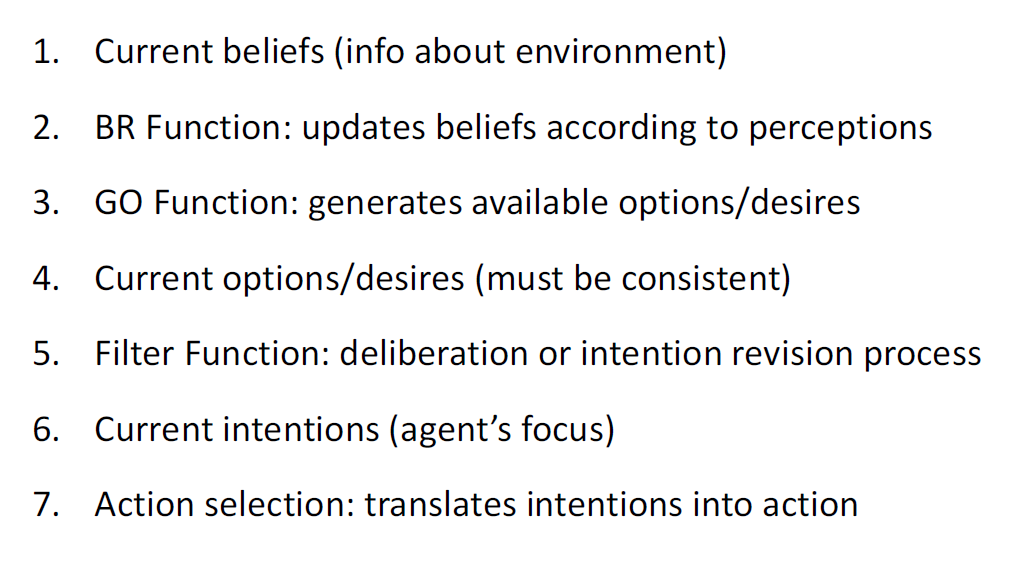
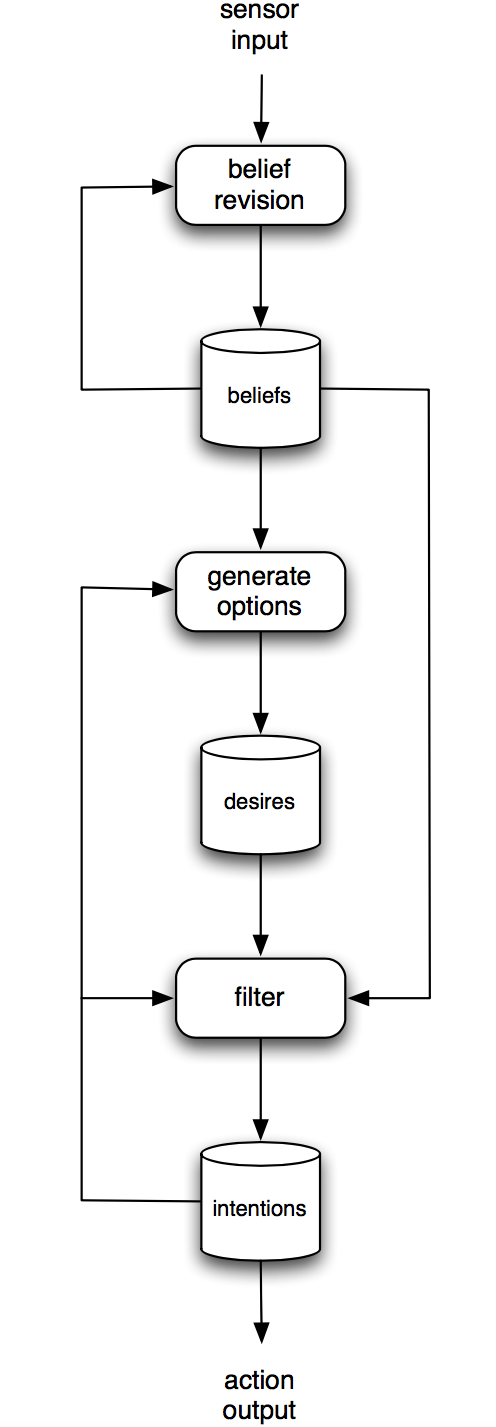
- Beliefs-Desires-Intentions Agents
- Practical reasoning
- 1. Deliberation - What are the goals we want to achieve?
- 2. Means-ends reasoning - How are we going to achieve these goals?
- 1. Deliberation - What are the goals we want to achieve?
- Components
- Intentions
- drive means-ends reasoning, lead to actions
- constrain future deliberation, restrict reasoning
- influence beliefs for future reasoning
- constrain future deliberation, restrict reasoning
- drive means-ends reasoning, lead to actions
- Intentions
- Bold agents never reconsider
- Cautious agents constantly stop to reconsider
- BDI components
- Practical reasoning
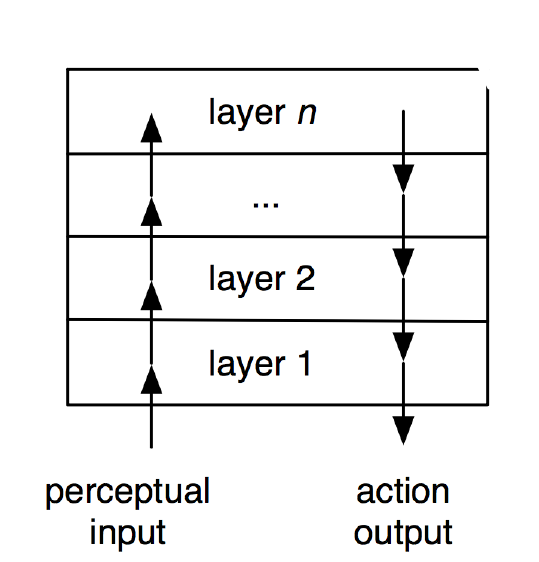
- Layered Architetures
- Need for both pro-active and reactive behaviour. Planning for goals depending on current conditions. Responding to changes in environment. Leads to multiple interacting layers of hierarchically organised behaviours
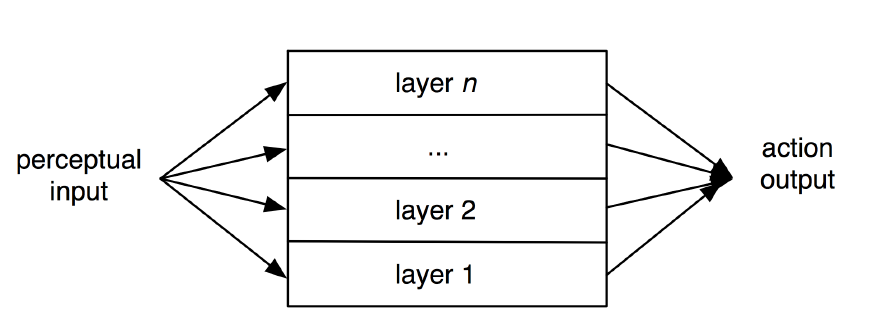
- Horizontal Layered Architecture
- # desired behaviours = # layers
- Might need mediator function if actions contradict. Central control can create bottleneck if complex.
- # desired behaviours = # layers
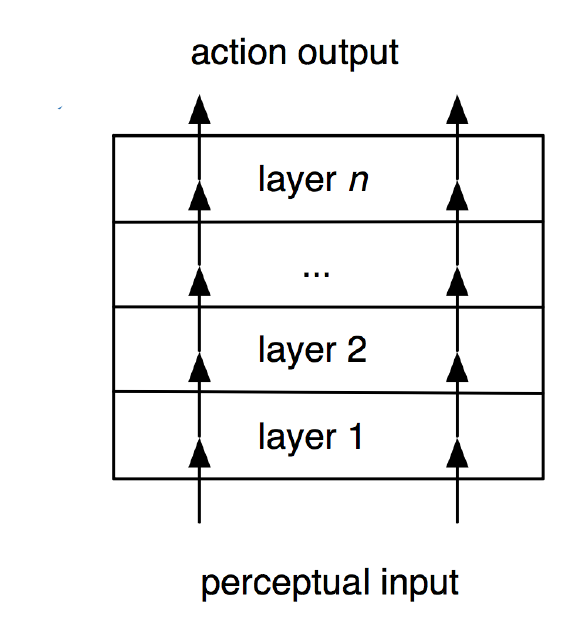
- Vertically Layered Architecture
- One-pass
- Two-pass
- One-pass
- Logic-based agents
Imágenes y archivos del mapa
Información
- Descripción
- Mapa Mental sobre INTRODUCTION, creado por Evelina Masliankova el 28/03/2018.
- Creado por
- Evelina Masliankova
- Visitas
- 1
- Valoración