
Mapa mental
The nature of dreams
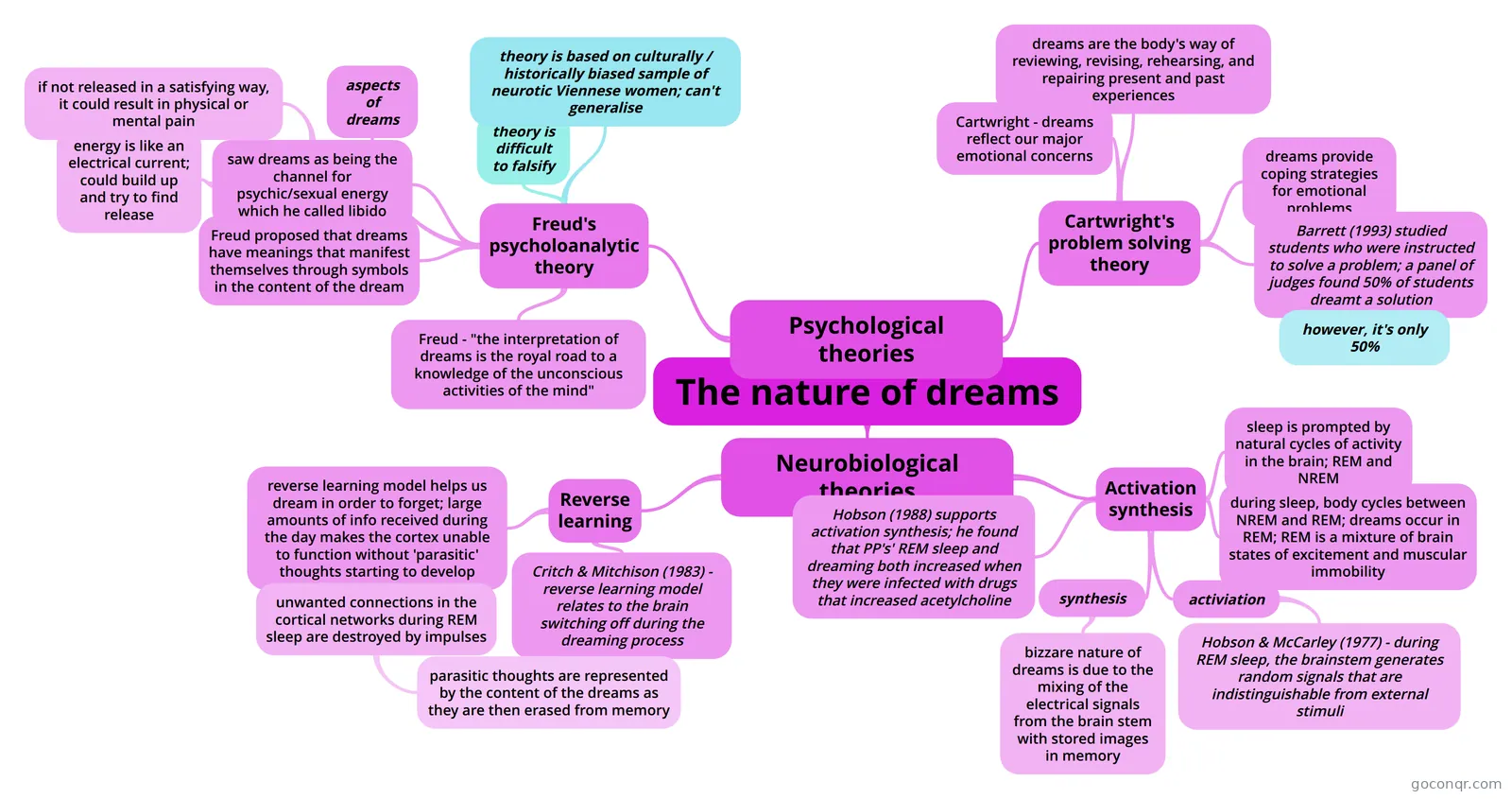
Mind map: the nature of dreams
Contenido del mapa
The nature of dreams
Psychological theories
- Freud's psycholoanalytic theory
- Freud - "the interpretation of dreams is the royal road to a knowledge of the unconscious activities of the mind"
- Freud proposed that dreams have meanings that manifest themselves through symbols in the content of the dream
- saw dreams as being the channel for psychic/sexual energy which he called libido
- energy is like an electrical current; could build up and try to find release
- if not released in a satisfying way, it could result in physical or mental pain
- aspects of dreams
- Wish fulfilment - a dream may be seen as an expression of unconscious wishes; if the desire for something is socially / personally prohibited, it may present itself in a dream, Dreamwork - dreams often symbolically represent something that is prohibited, Manifest content - what can be remember and reported, Latent content - hidden part of the dream; often found in symbols, Condensation - 2 or more ideas may be represented by one object, word or situation, Displacement - in the dream, a person / object is replaced with another, Representation - thoughts are changed into images,
- theory is difficult to falsify
- theory is based on culturally / historically biased sample of neurotic Viennese women; can't generalise
- Cartwright's problem solving theory
- Cartwright - dreams reflect our major emotional concerns
- dreams are the body's way of reviewing, revising, rehearsing, and repairing present and past experiences
- dreams provide coping strategies for emotional problems
- Barrett (1993) studied students who were instructed to solve a problem; a panel of judges found 50% of students dreamt a solution
- however, it's only 50%
- Freud's psycholoanalytic theory
Neurobiological theories
- Activation synthesis
- sleep is prompted by natural cycles of activity in the brain; REM and NREM
- during sleep, body cycles between NREM and REM; dreams occur in REM; REM is a mixture of brain states of excitement and muscular immobility
- activiation
- Hobson & McCarley (1977) - during REM sleep, the brainstem generates random signals that are indistinguishable from external stimuli
- synthesis
- bizzare nature of dreams is due to the mixing of the electrical signals from the brain stem with stored images in memory
- Hobson (1988) supports activation synthesis; he found that PP's' REM sleep and dreaming both increased when they were infected with drugs that increased acetylcholine
- Reverse learning
- Critch & Mitchison (1983) - reverse learning model relates to the brain switching off during the dreaming process
- reverse learning model helps us dream in order to forget; large amounts of info received during the day makes the cortex unable to function without 'parasitic' thoughts starting to develop
- unwanted connections in the cortical networks during REM sleep are destroyed by impulses
- parasitic thoughts are represented by the content of the dreams as they are then erased from memory
- unwanted connections in the cortical networks during REM sleep are destroyed by impulses
- Activation synthesis
Información
- Descripción
- A-Levels (Levels of Consciousness) PY4 Mapa Mental sobre The nature of dreams, creado por Hayd23 el 16/06/2013.
- Creado por
- Hayd23
- Visitas
- 131
- Etiquetas
- Valoración