
Mapa mental
Bonding
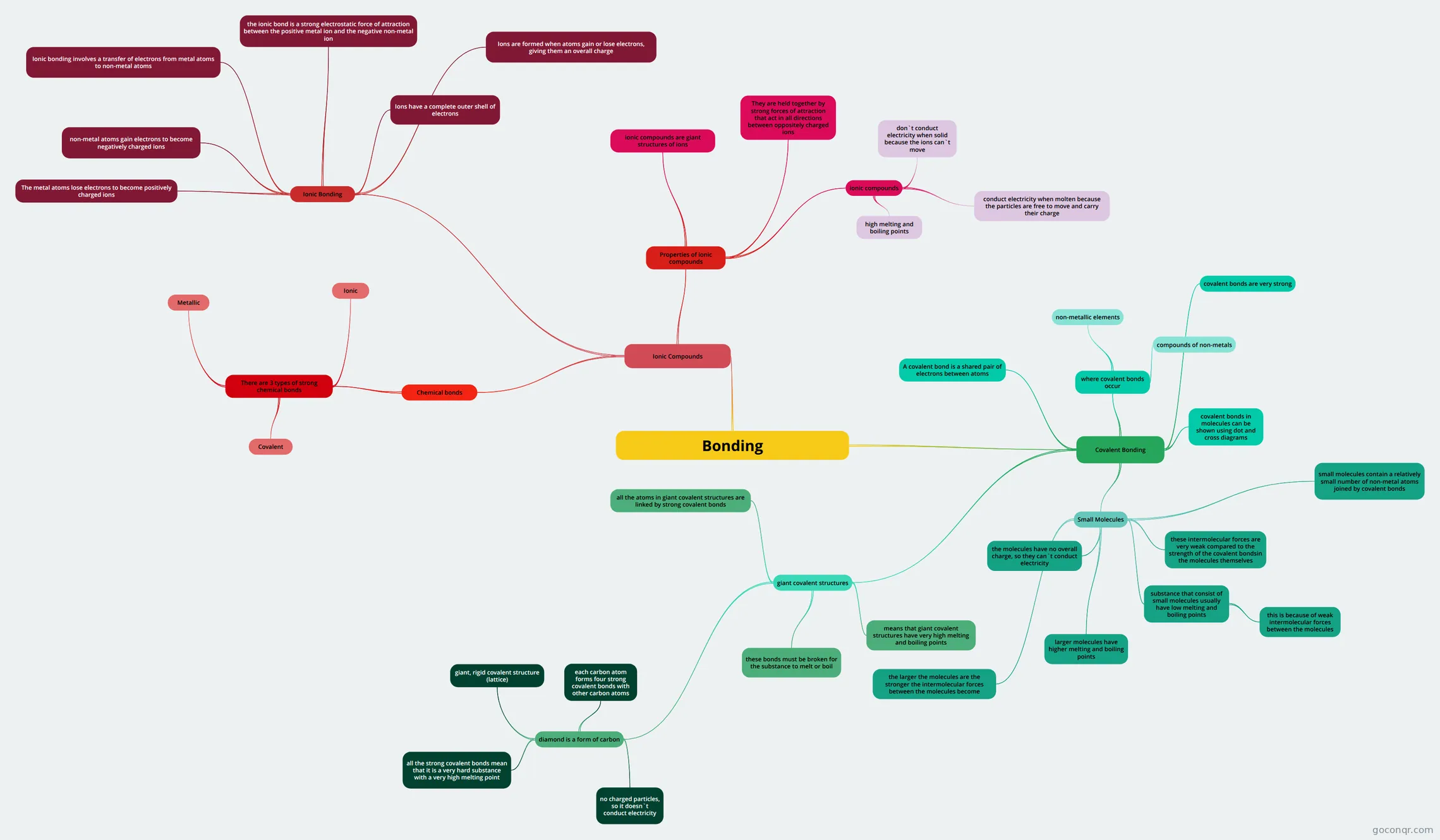
Mind map: Bonding
Contenido del mapa
Bonding
Ionic Compounds
- Chemical bonds
- There are 3 types of strong chemical bonds
- Ionic
- Metallic
- Covalent
- There are 3 types of strong chemical bonds
- Ionic Bonding
- Ions are formed when atoms gain or lose electrons, giving them an overall charge
- Ions have a complete outer shell of electrons
- Ionic bonding involves a transfer of electrons from metal atoms to non-metal atoms
- The metal atoms lose electrons to become positively charged ions
- non-metal atoms gain electrons to become negatively charged ions
- the ionic bond is a strong electrostatic force of attraction between the positive metal ion and the negative non-metal ion
- Properties of ionic compounds
- ionic compounds are giant structures of ions
- They are held together by strong forces of attraction that act in all directions between oppositely charged ions
- ionic compounds
- high melting and boiling points
- don`t conduct electricity when solid because the ions can`t move
- conduct electricity when molten because the particles are free to move and carry their charge
- Chemical bonds
Covalent Bonding
- A covalent bond is a shared pair of electrons between atoms
- where covalent bonds occur
- non-metallic elements
- compounds of non-metals
- covalent bonds in molecules can be shown using dot and cross diagrams
- covalent bonds are very strong
- Small Molecules
- small molecules contain a relatively small number of non-metal atoms joined by covalent bonds
- the molecules have no overall charge, so they can`t conduct electricity
- substance that consist of small molecules usually have low melting and boiling points
- this is because of weak intermolecular forces between the molecules
- these intermolecular forces are very weak compared to the strength of the covalent bondsin the molecules themselves
- the larger the molecules are the stronger the intermolecular forces between the molecules become
- larger molecules have higher melting and boiling points
- giant covalent structures
- all the atoms in giant covalent structures are linked by strong covalent bonds
- these bonds must be broken for the substance to melt or boil
- means that giant covalent structures have very high melting and boiling points
- diamond is a form of carbon
- giant, rigid covalent structure (lattice)
- each carbon atom forms four strong covalent bonds with other carbon atoms
- all the strong covalent bonds mean that it is a very hard substance with a very high melting point
- no charged particles, so it doesn`t conduct electricity
Información
- Descripción
- Year 10 Chemistry Mapa Mental sobre Bonding, creado por Paige Louise el 10/05/2018.
- Creado por
- Paige Louise
- Visitas
- 121
- Etiquetas
- Valoración