
Mapa mental
Atoms combining
Contenido del mapa
Atoms combining
Describe the formation of ions by electron loss or gain
- If an atom contains more electrons than protons the atom has a negative charge. If the atom contains fewer electrons than the protons the atom has a positive charge. Ions are a group of atoms that carry a positive or negative charge.
Describe the formation of ionic bonds between elements from Groups I and VII
Explain the formation of ionic bonds between metallic and non-metallic elements
- Ionic bonds are the bonds that form between opposite charges. A metal reacts with non-metal to form an ionic-compound.The metal ions lose electron. The non-metal gain them. The ions form a lattice. The compound has no over all charge.
State that non-metallic elements form non-ionic compounds using a different type of bonding called covalent bonding
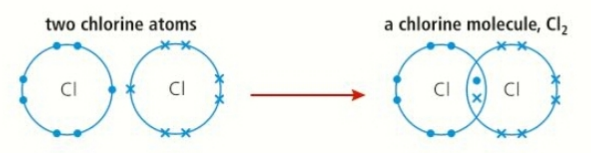
- Same nuclei attract the shared electrons -this a strong force of attraction hold the 2 atoms together. The force of attraction is called covalent bonds.
Draw dot and cross diagrams to represent the sharing of electron pairs to form single covalent bonds
- Single bonds
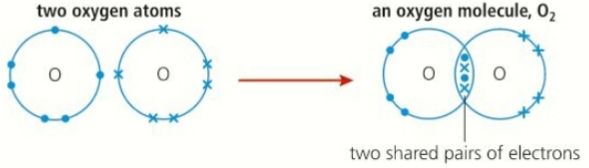
Draw dot and cross diagrams to represent the multiple bonding
Describe the differences in volatility, solubility and electrical conductivity between ionic and covalent compounds
- Volatility
- Ionic bonds have high melting and boiling points.
- Covalent bonds have low melting and boiling points.
- Solubility
- Ionic bonds tend to be soluble in water.
- Covalent bonds tend to be insoluble.
- Electrical Conductivity
- Ionic bonds conduct electricity when melted or dissolved in water.
- Covalent bonds do not conduct electricity.
- Volatility
Describe the giant covalent structures of graphite and diamond
- Graphite
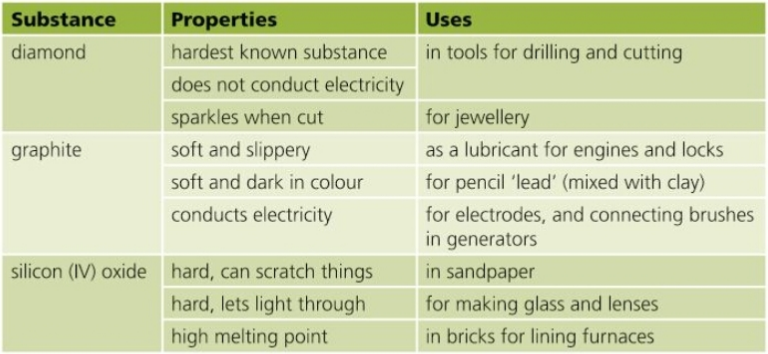
- ~Each carbon attached to three other carbon atoms ~Hexagonal ring layered lattice structure ~Delocalised electrons within each layer ~Weak intermolecular forces between the layers.
- Daimond
- ~Each carbon forms four covalent bonds with other carbon atoms ~Each carbon has a tetrahedral arrangement ~All electrons are localised in covalent bonds.
- Graphite
Relate their structures to the use of graphite as a lubricant and of diamond in cutting
- DIamond
- ~Each atom is held place by 4 strong covalent bonds. It has a high melting point.It also cannot conduct electricity.
- Graphite
- ~Each atom is held in place by 3 strong covalent bonds. It has a low melting points. It also can conduct electricity.
- DIamond
Describe the structure of silicon(IV) oxide (silicon dioxide)
- Silicon is similar to diamond. Each silicon atom bonds covalently with 4 oxygen atoms. Each oxygen atoms bonds covalently with 4 silicon atoms and the result is a very hard matarial with a high melting point.
Imágenes y archivos del mapa
Información
- Descripción
- Chemistry Mapa Mental sobre Atoms combining, creado por Shravani Chingre el 09/06/2018.
- Creado por
- Shravani Chingre
- Visitas
- 38
- Valoración