
Mapa mental
Employee Status
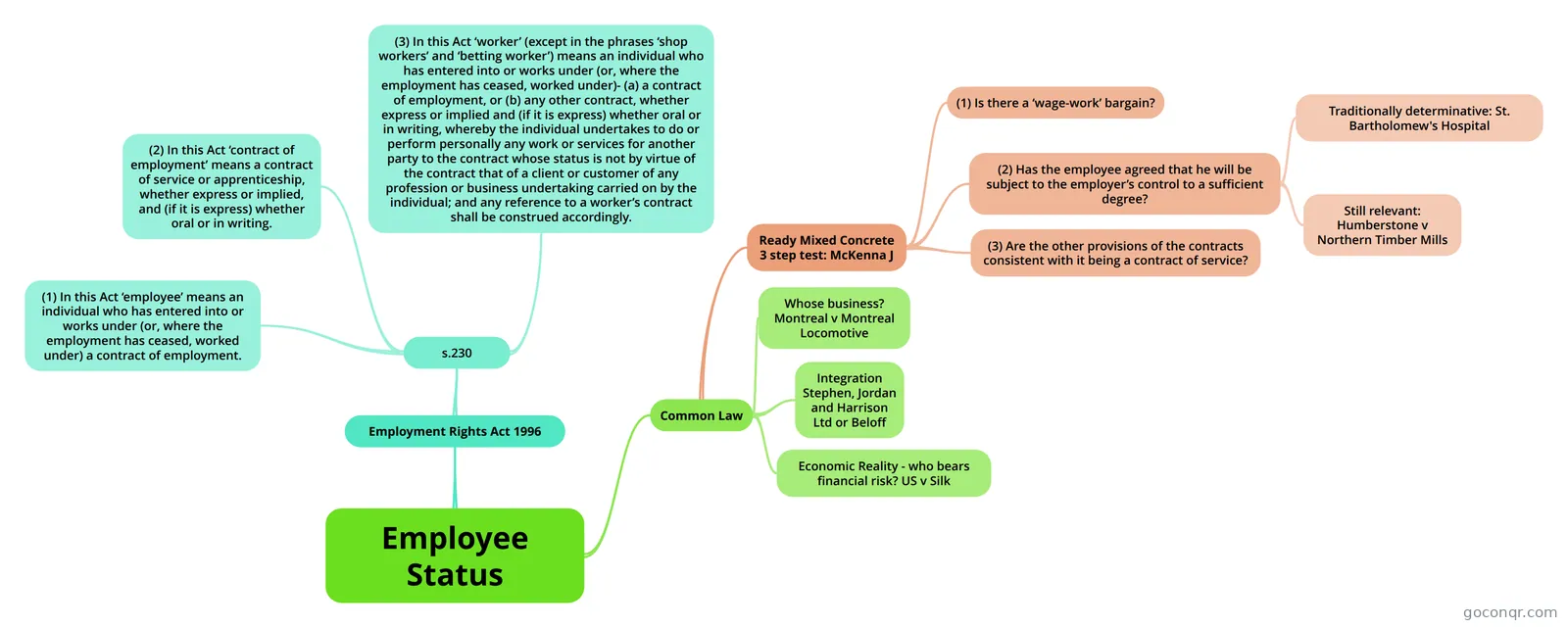
Mind map: Employee status
Contenido del mapa
Employee Status
Employment Rights Act 1996
- s.230
- (1) In this Act ‘employee’ means an individual who has entered into or works under (or, where the employment has ceased, worked under) a contract of employment.
- (2) In this Act ‘contract of employment’ means a contract of service or apprenticeship, whether express or implied, and (if it is express) whether oral or in writing.
- (3) In this Act ‘worker’ (except in the phrases ‘shop workers’ and ‘betting worker’) means an individual who has entered into or works under (or, where the employment has ceased, worked under)- (a) a contract of employment, or (b) any other contract, whether express or implied and (if it is express) whether oral or in writing, whereby the individual undertakes to do or perform personally any work or services for another party to the contract whose status is not by virtue of the contract that of a client or customer of any profession or business undertaking carried on by the individual; and any reference to a worker’s contract shall be construed accordingly.
- s.230
Common Law
- Difference of ‘contract of service’; as opposed to a contract for services.
- Ready Mixed Concrete 3 step test: McKenna J
- Ready Mixed Concrete (South East) Ltd v Minister for Pensions and National Insurance [1968] 2 QB 497; [1968] 1 All ER 433 (QBD) Issue: Whether Mr. Latimer, a truck driver delivering concrete for the ready mixed concrete company, was an employee for purposes of social security contributions. For Employment: 'Whenever and Wherever’ clause re availability Couldn’t use truck for any other purpose Must wear uniform Company strict control over maintenance of vehicle. Against Employment: Ownership of assets Result-based remuneration. Mr. Latimer was paid on a mileage basis, per amount of concrete delivered. System for appointing substitute driver, administered by owner drivers directly. Mr. Latimer’s freedom to choose where to buy fuel. Held: Mr. Latimer was an independent contractor. The contract was a contract of carriage, rather than of employment.
- (1) Is there a ‘wage-work’ bargain?
- (2) Has the employee agreed that he will be subject to the employer’s control to a sufficient degree?
- Traditionally determinative: St. Bartholomew's Hospital
- Hillyer v Governors of St Bartholomew’s Hospital [1909]
- Still relevant: Humberstone v Northern Timber Mills
- Humberstone v Northern Timber Mills (1949) 79 CLR 389, per Dixon J: “The question is not hether in practice the work was in fact done subject to a direction and control exercised by an actual supervision or whether any actual supervision was possible but whether ultimate authority over the man in the performance of his work resided in the employer so that he was subject to the latter's order and directions.”
- Traditionally determinative: St. Bartholomew's Hospital
- (3) Are the other provisions of the contracts consistent with it being a contract of service?
- Whose business? Montreal v Montreal Locomotive
- [1947] 1DLR161 (PC), dicta by Lord Wright.
- Integration Stephen, Jordan and Harrison Ltd or Beloff
- Stevenson, Jordan and Harrison Ltd v Macdonald and Evans [1952] 1 TLR 101, dicta by Denning LJ. Beloff v Pressdram Ltd [1973] 1 All ER 241
- Economic Reality - who bears financial risk? US v Silk
- US v Silk (1947) 331 U.S. 704 (US Supreme Court).
Información
- Descripción
- LLB Employment Law Mapa Mental sobre Employee Status, creado por scrubsizmint el 09/07/2013.
- Creado por
- scrubsizmint
- Visitas
- 104
- Etiquetas
- Valoración