
Mapa mental
Microbiology part 3
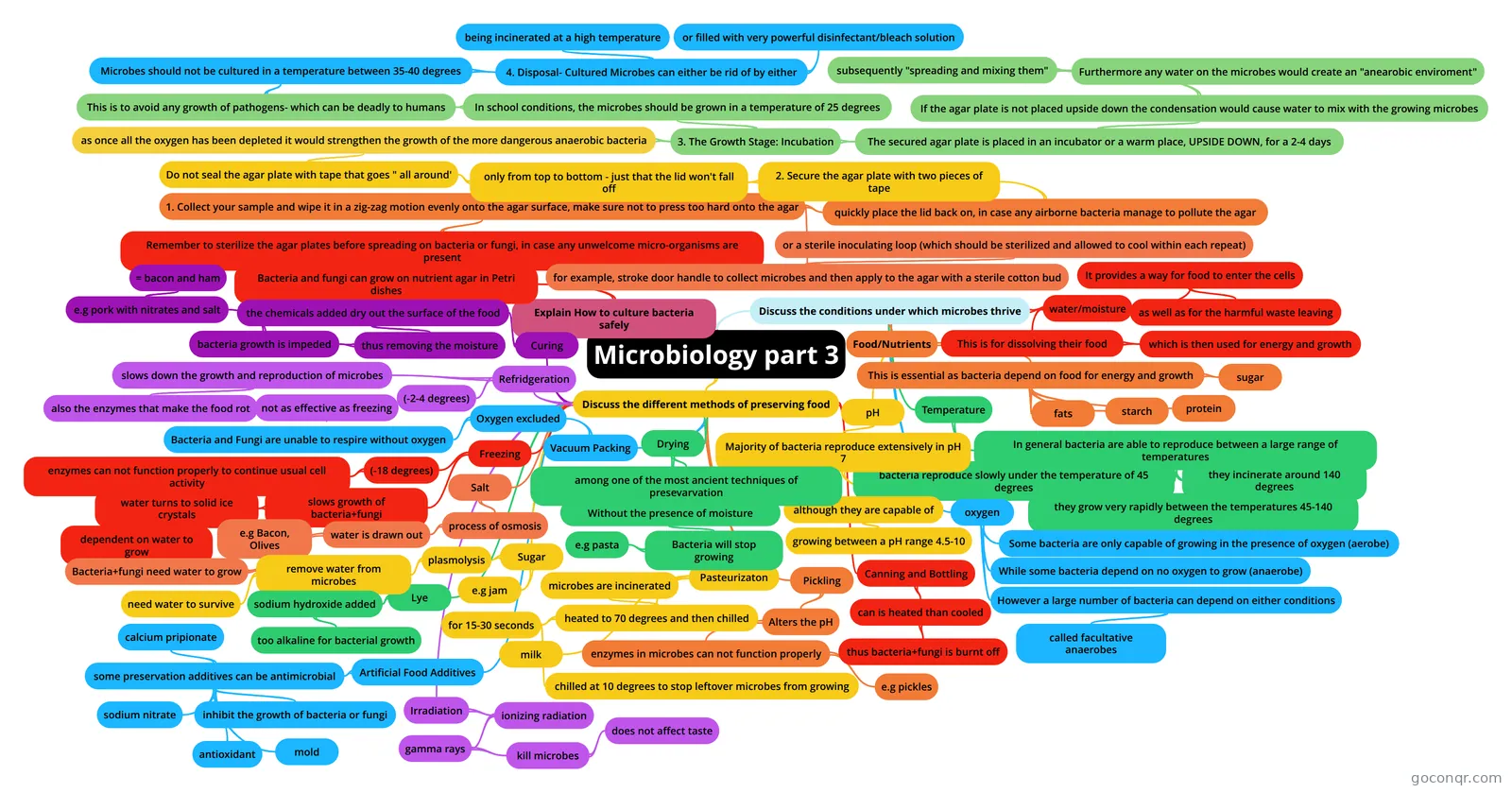
Mind map: Microbiology part 3
Contenido del mapa
Microbiology part 3
Explain How to culture bacteria safely
- Bacteria and fungi can grow on nutrient agar in Petri dishes
- Remember to sterilize the agar plates before spreading on bacteria or fungi, in case any unwelcome micro-organisms are present
- 1. Collect your sample and wipe it in a zig-zag motion evenly onto the agar surface, make sure not to press too hard onto the agar
- for example, stroke door handle to collect microbes and then apply to the agar with a sterile cotton bud
- or a sterile inoculating loop (which should be sterilized and allowed to cool within each repeat)
- quickly place the lid back on, in case any airborne bacteria manage to pollute the agar
- 2. Secure the agar plate with two pieces of tape
- only from top to bottom - just that the lid won't fall off
- Do not seal the agar plate with tape that goes " all around'
- as once all the oxygen has been depleted it would strengthen the growth of the more dangerous anaerobic bacteria
- 3. The Growth Stage: Incubation
- The secured agar plate is placed in an incubator or a warm place, UPSIDE DOWN, for a 2-4 days
- If the agar plate is not placed upside down the condensation would cause water to mix with the growing microbes
- subsequently "spreading and mixing them"
- Furthermore any water on the microbes would create an "anearobic enviroment"
- subsequently "spreading and mixing them"
- If the agar plate is not placed upside down the condensation would cause water to mix with the growing microbes
- In school conditions, the microbes should be grown in a temperature of 25 degrees
- This is to avoid any growth of pathogens- which can be deadly to humans
- Microbes should not be cultured in a temperature between 35-40 degrees
- 4. Disposal- Cultured Microbes can either be rid of by either
- being incinerated at a high temperature
- or filled with very powerful disinfectant/bleach solution
- 4. Disposal- Cultured Microbes can either be rid of by either
- Microbes should not be cultured in a temperature between 35-40 degrees
- This is to avoid any growth of pathogens- which can be deadly to humans
- The secured agar plate is placed in an incubator or a warm place, UPSIDE DOWN, for a 2-4 days
- 3. The Growth Stage: Incubation
- as once all the oxygen has been depleted it would strengthen the growth of the more dangerous anaerobic bacteria
- Do not seal the agar plate with tape that goes " all around'
- only from top to bottom - just that the lid won't fall off
- 2. Secure the agar plate with two pieces of tape
- for example, stroke door handle to collect microbes and then apply to the agar with a sterile cotton bud
- 1. Collect your sample and wipe it in a zig-zag motion evenly onto the agar surface, make sure not to press too hard onto the agar
- Remember to sterilize the agar plates before spreading on bacteria or fungi, in case any unwelcome micro-organisms are present
- Bacteria and fungi can grow on nutrient agar in Petri dishes
Discuss the conditions under which microbes thrive
- http://www.foodsafetysite.com/educators/competencies/general/bacteria/bac2.html
- water/moisture
- This is for dissolving their food
- which is then used for energy and growth
- It provides a way for food to enter the cells
- as well as for the harmful waste leaving
- This is for dissolving their food
- Food/Nutrients
- This is essential as bacteria depend on food for energy and growth
- sugar
- starch
- protein
- fats
- This is essential as bacteria depend on food for energy and growth
- Temperature
- In general bacteria are able to reproduce between a large range of temperatures
- bacteria reproduce slowly under the temperature of 45 degrees
- they incinerate around 140 degrees
- they grow very rapidly between the temperatures 45-140 degrees
- In general bacteria are able to reproduce between a large range of temperatures
- oxygen
- Some bacteria are only capable of growing in the presence of oxygen (aerobe)
- While some bacteria depend on no oxygen to grow (anaerobe)
- However a large number of bacteria can depend on either conditions
- called facultative anaerobes
- pH
- Majority of bacteria reproduce extensively in pH 7
- although they are capable of
- growing between a pH range 4.5-10
- although they are capable of
- Majority of bacteria reproduce extensively in pH 7
Discuss the different methods of preserving food
- Drying
- Without the presence of moisture
- Bacteria will stop growing
- e.g pasta
- Bacteria will stop growing
- among one of the most ancient techniques of presevarvation
- Without the presence of moisture
- Refridgeration
- (-2-4 degrees)
- slows down the growth and reproduction of microbes
- also the enzymes that make the food rot
- not as effective as freezing
- also the enzymes that make the food rot
- Freezing
- (-18 degrees)
- enzymes can not function properly to continue usual cell activity
- slows growth of bacteria+fungi
- water turns to solid ice crystals
- dependent on water to grow
- water turns to solid ice crystals
- (-18 degrees)
- Salt
- process of osmosis
- water is drawn out
- Bacteria+fungi need water to grow
- e.g Bacon, Olives
- Bacteria+fungi need water to grow
- water is drawn out
- process of osmosis
- Sugar
- plasmolysis
- remove water from microbes
- need water to survive
- remove water from microbes
- e.g jam
- plasmolysis
- Pickling
- Alters the pH
- enzymes in microbes can not function properly
- e.g pickles
- enzymes in microbes can not function properly
- Alters the pH
- Canning and Bottling
- can is heated than cooled
- thus bacteria+fungi is burnt off
- can is heated than cooled
- Vacuum Packing
- Oxygen excluded
- Bacteria and Fungi are unable to respire without oxygen
- Oxygen excluded
- Pasteurizaton
- heated to 70 degrees and then chilled
- microbes are incinerated
- for 15-30 seconds
- chilled at 10 degrees to stop leftover microbes from growing
- milk
- heated to 70 degrees and then chilled
- Artificial Food Additives
- some preservation additives can be antimicrobial
- inhibit the growth of bacteria or fungi
- mold
- antioxidant
- sodium nitrate
- calcium pripionate
- some preservation additives can be antimicrobial
- Curing
- the chemicals added dry out the surface of the food
- thus removing the moisture
- bacteria growth is impeded
- e.g pork with nitrates and salt
- = bacon and ham
- e.g pork with nitrates and salt
- bacteria growth is impeded
- thus removing the moisture
- the chemicals added dry out the surface of the food
- Lye
- sodium hydroxide added
- too alkaline for bacterial growth
- sodium hydroxide added
- Irradiation
- ionizing radiation
- gamma rays
- kill microbes
- does not affect taste
- kill microbes
- gamma rays
- ionizing radiation
- Drying
Información
- Descripción
- Mapa Mental sobre Microbiology part 3, creado por Lavinia Hayde el 24/10/2014.
- Creado por
- Lavinia Hayde
- Visitas
- 158
- Etiquetas
- Valoración