
Mapa mental
Week 11
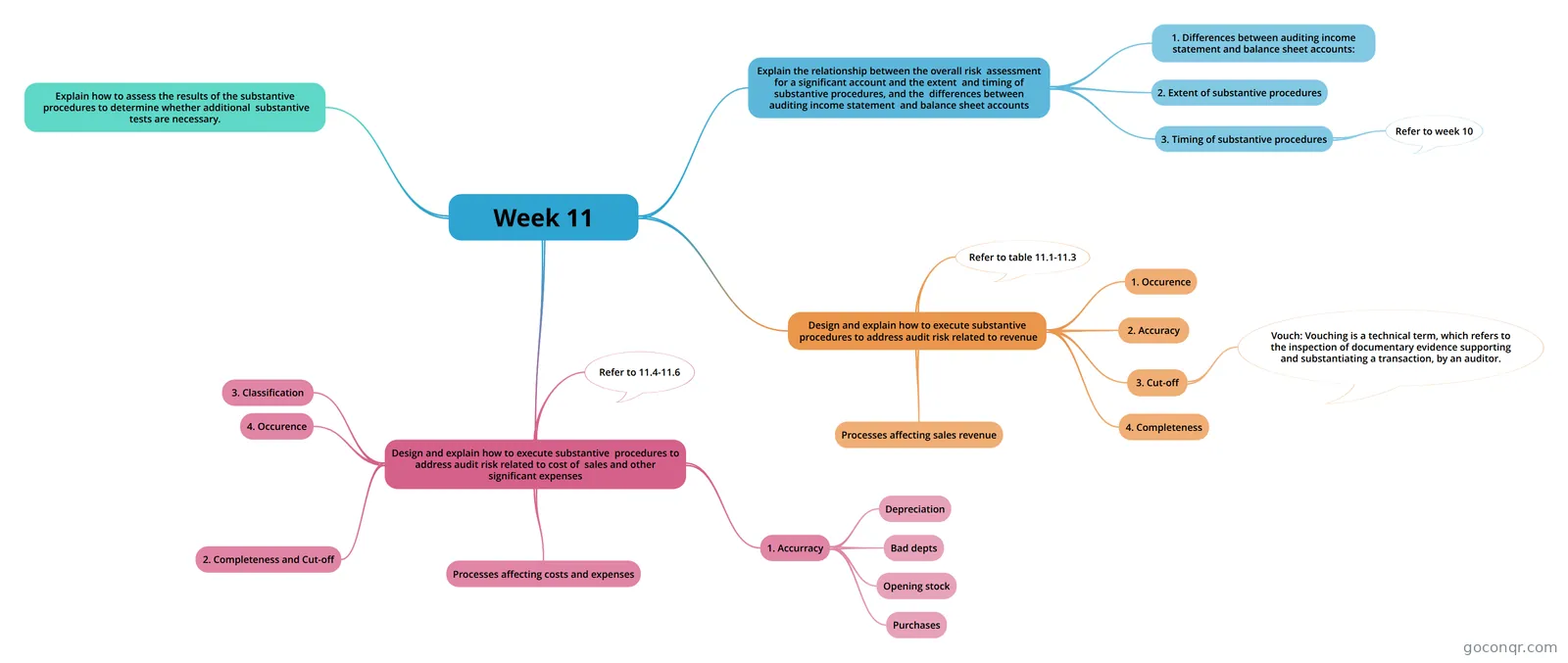
Mind map: Week 11
Contenido del mapa
Week 11
Explain the relationship between the overall risk assessment for a significant account and the extent and timing of substantive procedures, and the differences between auditing income statement and balance sheet accounts
- 1. Differences between auditing income statement and balance sheet accounts:
- – Balance sheet accounts typically represent only recent or one-off transactions. –Income statement accounts reflect sum of entire reporting period transactions. –Testing balance sheet accounts does not provide much assurance about income statement accounts.
- The nature of the tests required to audit income statement accounts is different to those required to audit balance sheet accounts. Instead of using techniques such as confirmations, the auditor will ordinarily use substantive analytical procedures. Analytical Procedures coupled with tests of details (such as vouching back to supporting documentation) and verification of expense classification. These analytical procedures allow techniques such as trend analysis and the analysis of relationships compared to expectations to be used to obtain audit assurance over 12 months of transaction flows.
- 3. Timing of substantive procedures
- The timing of substantive testing is dependent on the risk assessment of the significant account in question. Apart from the risk assessment of the significant account, there are additional opportunities for influencing the timing of the work performed. These include performing procedures on events that have occurred prior to year-end, performing procedures on activities in the period to date, performing general audit procedures prior to year-end and leveraging off internal audit.
- Refer to week 10
- 2. Extent of substantive procedures
- Extent of testing determined by risk assessment for each significant account or disclosure. - When IR & CR are high = no controls tested or relied upon and therefore the amount of substantive testing required to reduce the detection risk to an acceptable level is significant. - When IR & CR are low = there are lots of controls that have been tested and found to be effective, therefore allowing relianceto be placed on them to ensure that material misstatements do not occur. - When IR & CR is medium = there is some audit evidence obtained from tests ofcontrols (or controls testing) and some from substantive testing.
- 1. Differences between auditing income statement and balance sheet accounts:
Design and explain how to execute substantive procedures to address audit risk related to revenue
- Sales revenue is generally a significant account for an entity. Sales revenue is typically significant due to the size, the volume of transactions that flow through the account, and the overall high inherent risk associated with revenue. Because of this, the business might manipulate sales revenue to meet profit targets expected by shareholders. Because of this increased risk, auditors will either audit the account balance by using only substantive testing techniques (such as tests of details and sophisticated analytical procedures) or by using a controls testing approach supplemented with some substantive procedures including analytical procedures (such as comparing last year’s sales revenue by month to the current year’s sales revenue andbudgeted sales revenue).
- There are 3 audit assertions that are important to ensure the auditor has gained sufficient and appropriate audit evidence for sales revenue, which are: 1. Occurence 2. Accuracy 3. Cut-off
- 1. Occurence
- Testing needs to ensure that the sales recorded in the general ledger are in fact bona fide sales and have ‘occurred’.
- 2. Accuracy
- Substantive tests focus on ensuring that the sales have been recorded at the correct amount (or value) and have not been overstated.
- 3. Cut-off
- Cut-off is important because there is a risk that an entity will record sales that occur after year-end in the year being audited. The pressure to achieve sales targets and budgets can lead to companies recording sales that occur after year-end in the results prior to year-end. As a result, procedures are designed to test material transactions either side of year-end or all sales in the last period before year-end to ensure that all sales are recorded in the correct period.
- A simple way of testing which period a sale should be recorded in is to vouch the sale to the delivery documentation for the sale of goods. - If the delivery date (out of the client’s warehouse and to the customer) is before year-end, it should be included in sales. - If the delivery occurred after year-end, it is unlikely it should be recorded as a sale.
- Vouch: Vouching is a technical term, which refers to the inspection of documentary evidence supporting and substantiating a transaction, by an auditor.
- 4. Completeness
- Completeness is generally not a significant assertion as the risk with sales revenue is that the client has overstated the balance. Completeness testing focuses on ensuring all sales revenue that occurred has been recorded to ensure sales revenue has not been understated. For example: If an industry meets its revenue, it might transfer some excess revenue to next period, giving that period a headt start, therefore understating the current period.
- Refer to table 11.1-11.3
- Processes affecting sales revenue
- The two significant accounting processes that affect the sales revenue balance are: 1. sales 2.sales returns and allowances These procedures would only be considered when the auditor has beenunable to test and rely upon controls (controls are ineffective) or has determined that it is more efficientto test the balance substantively.
Design and explain how to execute substantive procedures to address audit risk related to cost of sales and other significant expenses
- Cost of sales and expenses (‘costs and expenses’) are generally significant accounts in an entity’s income statement and key audit assertions are: 1. Accuracy 2. Completeness and Cut-off.
- 1. Accurracy
- Accuracy is verified by vouching recorded amounts to supporting (third-party) documentation (for example, supplier invoices) or by reference to the significant account that has determined the expense.
- Depreciation
- For example, depreciation is tested as part of the testing of the valuation of property, plant and equipment in the balance sheet.
- Bad depts
- Bad debts expense is ordinarily tested as part of the testing of the valuation of trade receivables.
- Opening stock
- Opening stock is tested as part of inventory valuation testing in the prior year, purchases are tested as part of the testing of inventory and payables, and closing stock is tested as part of inventory valuation at year-end.
- Purchases
- Purchases tend to be the part of total cost of sales subject to additional testing over and above testing already performed as part of balance sheet testing. Purchases testing is performed most efficiently via the use of controls testing. When this testing is not able to be performed or relied upon, a large number of purchases are vouched back to supplier documentation unless other sophisticated or predictive analytical procedures can be used.
- 2. Completeness and Cut-off
- Completeness and cut-off are important to ensure that the client has not understated its costs and expenses by deferring costs into the period after year-end.
- 3. Classification
- Classification may be important because of specific disclosure requirements related to certain costs and expenses. For example: depreciation; loss on sale of property, plant and equipment; superannuation costs; and interest expense (borrowing costs) are all required to be disclosed in accordance with International Financial Reporting Standards (IFRSs).
- 4. Occurence
- Occurrence is not typically a significant assertion as the primary objective in testing for occurrence is to ensure that costs and expenses are not overstated.
- Refer to 11.4-11.6
- Processes affecting costs and expenses
- There are two important types of transactions that affect the costs and expenses balances: 1. Purchases 2. Payroll These procedures would onlybe considered when the auditors have been unable to test and rely upon controls (controls are ineffective)or have determined that it is more efficient to test the balance substantively.
Explain how to assess the results of the substantive procedures to determine whether additional substantive tests are necessary.
Información
- Descripción
- AUDITING Mapa Mental sobre Week 11, creado por Micky Marshall el 18/10/2018.
- Creado por
- Micky Marshall
- Visitas
- 0
- Valoración