
Mapa mental
Chapter 3: Agile Software Development (3705)
Contenido del mapa
Chapter 3: Agile Software Development (3705)
Agile methods
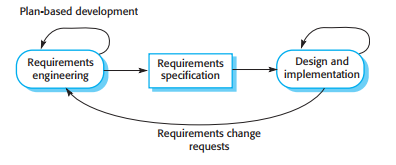
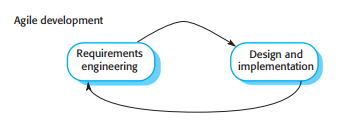
- Rapid software development became known as agile development or agile methods
- The processes of specification, design and implementation are interleaved. no detailed system specification, and design documentation is minimized
- The system is developed in a series of increments
- Extensive tool support is used to support the development process. automated testing tools, tools to support configuration management, and system integration
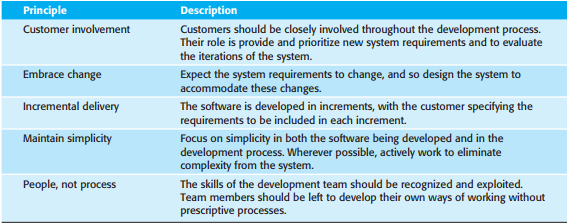
- Agile Manifesto
- Agile methods have been particularly successful for two kinds of system development.
- Product development where a software company is developing a small or medium-sized product for sale
- Custom system development within an organization, where there is a clear commitment from the customer
Agile development techniques
- XP
- Extreme Programming as originally proposed has proved to be more difficult than anticipated
- cannot be readily integrated with the management practices and culture of most businesses
- they are used in conjunction with a management focused agile method such as Scrum
- In XP, requirements are expressed as scenarios (called user stories),
- several new versions of a system may be developed by different programmers, integrated, and tested in a day.
- most significant contribution is probably the set of agile development practices that it introduced to the community
- User Stories
- the idea of “user stories” was developed where a user story is a scenario of use that might be experienced by a system user.
- User stories may be used in planning system iterations
- estimates the effort and resources required for implementing each task.
- identify useful functionality that can be implemented in about two weeks, when the next release of the system is made available to the customer.
- The principal problem with user stories is completeness. Have there been enough stories to cover the functionality of the system
- Refactoring
- Design for change is a traditional software principle
- Extreme programming, however, has discarded this principle on the basis that designing for change is often wasted effort
- Refactoring (Fowler et al. 1999) means that the programming team look for possible improvements to the software and implements them immediately
- Refactoring improves the software structure and readability and so avoids the structural deterioration that naturally occurs when software is changed.
- refactoring is part of the development process, the software should always be easy to understand and change as new requirements are proposed.
- Design for change is a traditional software principle
- Test-first development
- incremental development have a very informal testing process, in comparison with plan-driven testing
- Extreme Programming developed a new approach to program testing to address the difficulties of testing without a specification.
- The key features of testing in XP are:
- test-first development,
- . Test-first development requires there to be a clear relationship between system requirements and the code implementing the corresponding requirements.
- relationship is clear because the story cards representing the requirements are broken down into tasks and the tasks are the principal unit of implementation
- it also avoids the problem of “test-lag.”. Developer produces code faster than tester producing tests. Leads to tests being skipped
- incremental test development from scenarios,
- user involvement in the test development and validation,
- the use of automated testing frameworks.
- Test automation is essential for test-first development
- test-driven development techniques
- write the tests before you write the code
- run the test as the code is being written and discover problems during development.
- write the tests before you write the code
- test-first development,
- there are problems in ensuring that test coverage is complete:
- Programmers prefer programming to testing, and sometimes they take shortcuts when writing tests. may write incomplete tests that do not check for all possible exceptions that may occur.
- Some tests can be very difficult to write incrementally
- incremental development have a very informal testing process, in comparison with plan-driven testing
- Pair programming
- programmers work in pairs to develop the software.
- Pair programming has a number of advantages.
- It supports the idea of collective ownership and responsibility for the system
- It acts as an informal review process because each line of code is looked at by at least two people.
- effective in discovering a high percentage of software errors
- It encourages refactoring to improve the software structure.
- Junior programmer benefits from this and produce better code. Experienced programmers show inefficiency
- In a given time, a pair of developers would produce half as much code as two individuals working alone.
- Often rejected because of this by organisations
- User Stories
- Extreme Programming as originally proposed has proved to be more difficult than anticipated
- XP
Agile project management
- agile development has to be managed so that the best use is made of the time and resources available
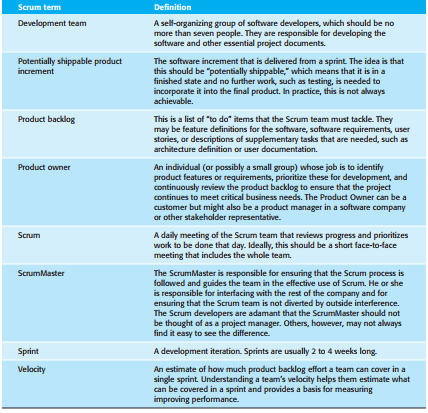
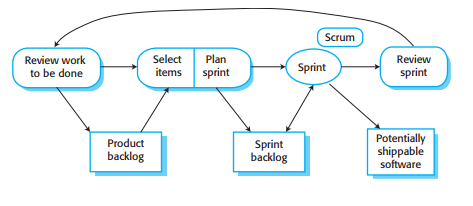
- the Scrum agile method was developed (Schwaber and Beedle 2001; Rubin 2013) to provide a framework for organizing agile projects and, to some extent at least, provide external visibility of what is going on
- does not mandate the use of specific development practices such as pair programming and test-first development
- follows the principles from the agile manifesto
- Scrum Process
- The starting point for the Scrum sprint cycle is the product backlog
- the things that users like about the Scrum method are:
- The product is broken down into a set of manageable and understandable chunks that stakeholders can relate to.
- Unstable requirements do not hold up progress
- The whole team has visibility of everything, and consequently team communication and morale are improved
- Customers see on-time delivery of increments and gain feedback on how the product works
- Trust between customers and developers is established,
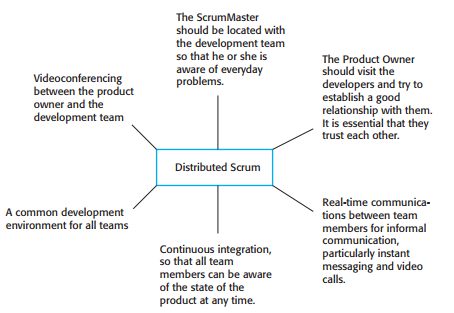
- Distributed Scrum
- agile development has to be managed so that the best use is made of the time and resources available
Scaling agile methods
- Scaling agile methods has closely related facets:
- Scaling UP these methods to handle the development of large systems that are too big to be developed by a single small team.
- Scaling OUT these methods from specialized development teams to more widespread use in a large company that has many years of software development experience
- organization moving to agile methods can expect to see productivity improvement across the organization of about 15% over 3 years, with similar reductions in the number of product defects
- Practical problems with agile methods
- For large, long-lifetime systems, agile methods presents problems
- The informality of agile development is incompatible with the legal approach to contract definition that is commonly used in large companies
- Agile methods are most appropriate for new software development rather than for software maintenance
- Agile methods are designed for small co-located teams, yet much software development now involves worldwide distributed teams.
- Three types of problems can arise in maintaining a custom system:
- lack of product documentation
- keeping customers involved
- development team continuity
- For large, long-lifetime systems, agile methods presents problems
- Agile and plan-driven methods
- A fundamental requirement of scaling agile methods is to integrate them with plandriven approaches.
- Agile methods for large systems
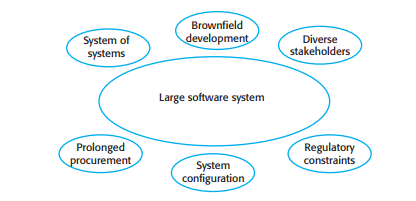
- Agile methods have to evolve to be used for large-scale software development. The fundamental reason for this is that large-scale software systems are much more complex and difficult to understand and manage relative to small systems
- Six principal factors (Figure 3.13) contribute to this complexity:
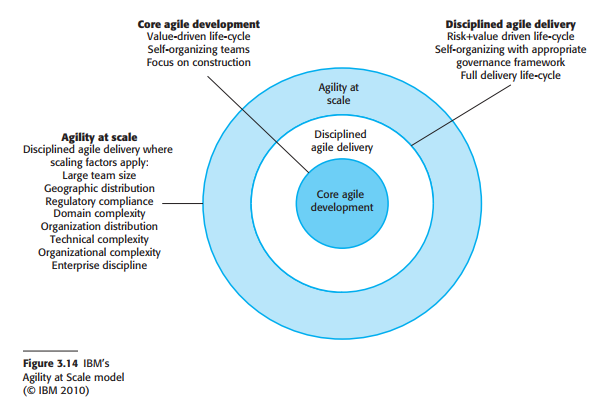
- IBM has also developed a framework for the large-scale use of agile methods called the Agile Scaling Model (ASM).
- There is no one model fits all. Requirements and composition changes per prject
- approaches to scaling agile methods have a number of things in common:
- A completely incremental approach to requirements engineering is impossible
- Some early work on initial software requirements is essential.
- requirements should not normally be specified in detail; details are best developed incrementally.
- There cannot be a single product owner or customer representative
- It is not possible to focus only on the code of the system. You need to do more up-front design and system documentation. Architectural and schema design
- Cross-team communication mechanisms have to be designed and used
- Continuous integration, where the whole system is built every time any developer checks in a change, is practically impossible
- However, it is essential to maintain frequent system builds and regular releases of the system.
- A completely incremental approach to requirements engineering is impossible
- approaches to scaling agile methods have a number of things in common:
- There is no one model fits all. Requirements and composition changes per prject
- Scrum has been adapted for large-scale development.
- Role replication -> Each team has a Product Owner for its work component and Scrum Master
- Product architects -> Each team chooses a product architect, and these architects collaborate
- Release alignment -> The dates of product releases from each team are aligned
- Scrum of Scrums There is a daily Scrum of Scrums where representatives from each team meet to discuss progress, identify problems, and plan the work
- Agile methods have to evolve to be used for large-scale software development. The fundamental reason for this is that large-scale software systems are much more complex and difficult to understand and manage relative to small systems
- Agile methods across organizations
- It can be difficult to introduce agile methods into large companies for a number of reasons:
- Project managers who do not have experience of agile methods may be reluctant to accept the risk of a new approach,
- Large organizations often have quality procedures and standards that all projects are expected to follow
- Agile methods seem to work best when team members have a relatively high skill level.
- There may be cultural resistance to agile methods
- It can be difficult to introduce agile methods into large companies for a number of reasons:
- Scaling agile methods has closely related facets:
important differences between incremental development and plan-driven development is in the way that the system is tested.
Imágenes y archivos del mapa
Información
- Descripción
- Computer Science Mapa Mental sobre Chapter 3: Agile Software Development (3705), creado por Gideon Van el 14/01/2019.
- Creado por
- Gideon Van · ene 2019
- Actualizado
- 5 may 2019
- Visitas
- 1
- Valoración