
Mapa mental
Atomic structure and the Periodic table
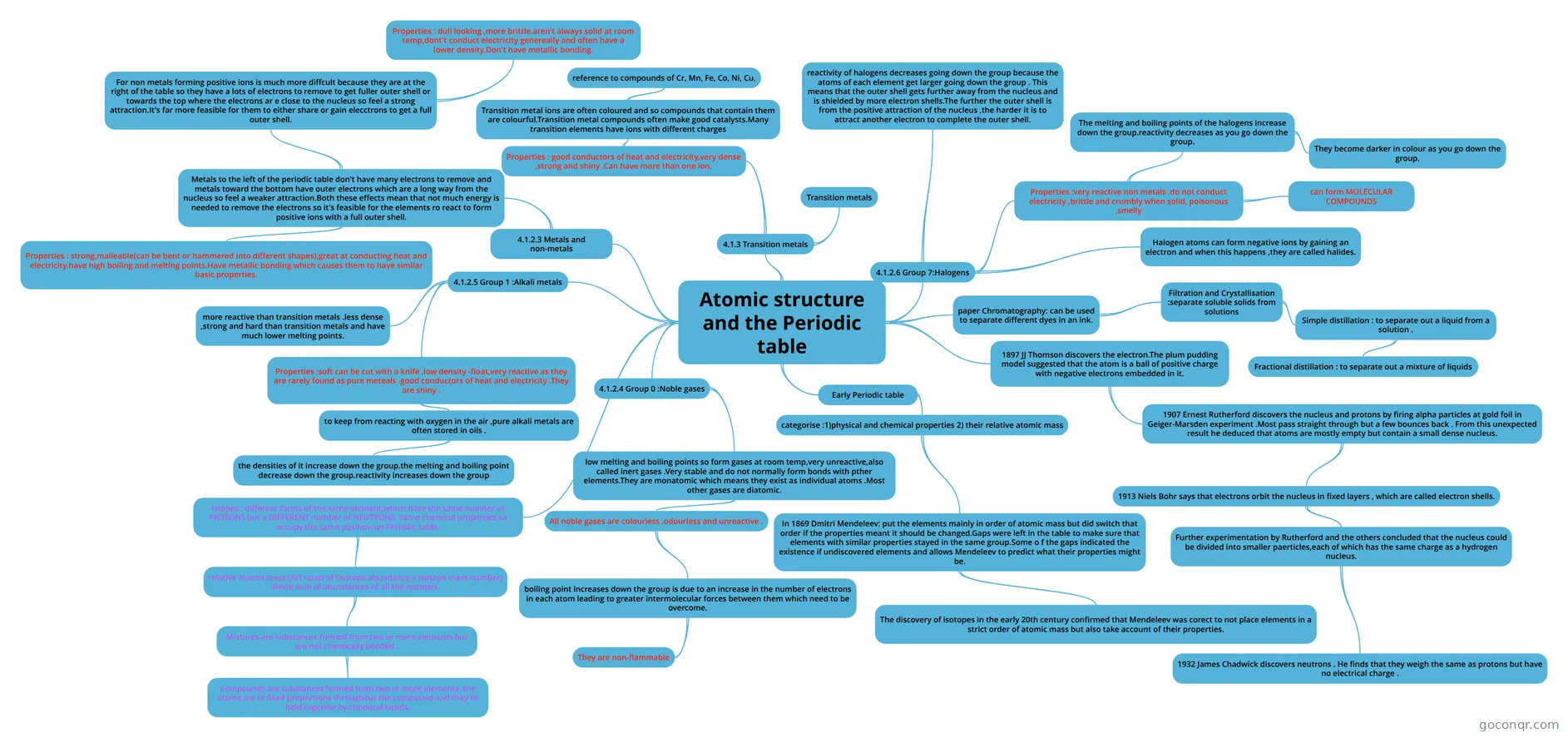
Mind map: Atomic structure and the Periodic table
Contenido del mapa
Atomic structure and the Periodic table
1897 JJ Thomson discovers the electron.The plum pudding model suggested that the atom is a ball of positive charge with negative electrons embedded in it.
- 1907 Ernest Rutherford discovers the nucleus and protons by firing alpha particles at gold foil in Geiger-Marsden experiment .Most pass straight through but a few bounces back . From this unexpected result he deduced that atoms are mostly empty but contain a small dense nucleus.
- 1913 Niels Bohr says that electrons orbit the nucleus in fixed layers , which are called electron shells.
- Further experimentation by Rutherford and the others concluded that the nucleus could be divided into smaller paerticles,each of which has the same charge as a hydrogen nucleus.
- 1932 James Chadwick discovers neutrons . He finds that they weigh the same as protons but have no electrical charge .
- Further experimentation by Rutherford and the others concluded that the nucleus could be divided into smaller paerticles,each of which has the same charge as a hydrogen nucleus.
- 1913 Niels Bohr says that electrons orbit the nucleus in fixed layers , which are called electron shells.
- 1907 Ernest Rutherford discovers the nucleus and protons by firing alpha particles at gold foil in Geiger-Marsden experiment .Most pass straight through but a few bounces back . From this unexpected result he deduced that atoms are mostly empty but contain a small dense nucleus.
4.1.2.4 Group 0 :Noble gases
- low melting and boiling points so form gases at room temp,very unreactive,also called inert gases .Very stable and do not normally form bonds with pther elements.They are monatomic which means they exist as individual atoms .Most other gases are diatomic.
- All noble gases are colourless ,odourless and unreactive .
- boiling point increases down the group is due to an increase in the number of electrons in each atom leading to greater intermolecular forces between them which need to be overcome.
- They are non-flammable
- boiling point increases down the group is due to an increase in the number of electrons in each atom leading to greater intermolecular forces between them which need to be overcome.
- All noble gases are colourless ,odourless and unreactive .
- low melting and boiling points so form gases at room temp,very unreactive,also called inert gases .Very stable and do not normally form bonds with pther elements.They are monatomic which means they exist as individual atoms .Most other gases are diatomic.
4.1.2.5 Group 1 :Alkali metals
- Properties :soft can be cut with a knife ,low density -float,very reactive as they are rarely found as pure meteals .good conductors of heat and electricity .They are shiny .
- to keep from reacting with oxygen in the air ,pure alkali metals are often stored in oils .
- the densities of it increase down the group.the melting and boiling point decrease down the group.reactivity increases down the group
- to keep from reacting with oxygen in the air ,pure alkali metals are often stored in oils .
- more reactive than transition metals .less dense ,strong and hard than transition metals and have much lower melting points.
- Properties :soft can be cut with a knife ,low density -float,very reactive as they are rarely found as pure meteals .good conductors of heat and electricity .They are shiny .
4.1.2.6 Group 7:Halogens
- Properties :very reactive non metals ,do not conduct electricity ,brittle and crumbly when solid, poisonous ,smelly
- The melting and boiling points of the halogens increase down the group.reactivity decreases as you go down the group.
- They become darker in colour as you go down the group.
- can form MOLECULAR COMPOUNDS
- The melting and boiling points of the halogens increase down the group.reactivity decreases as you go down the group.
- Halogen atoms can form negative ions by gaining an electron and when this happens ,they are called halides.
- reactivity of halogens decreases going down the group because the atoms of each element get larger going down the group . This means that the outer shell gets further away from the nucleus and is shielded by more electron shells.The further the outer shell is from the positive attraction of the nucleus ,the harder it is to attract another electron to complete the outer shell.
- Properties :very reactive non metals ,do not conduct electricity ,brittle and crumbly when solid, poisonous ,smelly
4.1.3 Transition metals
- Properties : good conductors of heat and electricity,very dense ,strong and shiny .Can have more than one ion.
- Transition metal ions are often coloured and so compounds that contain them are colourful.Transition metal compounds often make good catalysts.Many transition elements have ions with different charges
- reference to compounds of Cr, Mn, Fe, Co, Ni, Cu.
- Transition metal ions are often coloured and so compounds that contain them are colourful.Transition metal compounds often make good catalysts.Many transition elements have ions with different charges
- Transition metals
- Properties : good conductors of heat and electricity,very dense ,strong and shiny .Can have more than one ion.
Istopes : different forms of the same element,which have the same number of PROTONS but a DIFFERENT number of NEUTRONS. Same chemical properties so occupy the same position on Periodic table.
- relative atomis mass (Ar) =sum of (isotope abundance x isotope mass number) divide sum of abundances of all the isotopes.
- Mixtures are substances formed from two or more elements but are not chemically bonded .
- Compounds are substances formed from two or more elements ,the atoms are in fixed proportions throughout the compound and they're held together by chemical bonds.
- Mixtures are substances formed from two or more elements but are not chemically bonded .
- relative atomis mass (Ar) =sum of (isotope abundance x isotope mass number) divide sum of abundances of all the isotopes.
paper Chromatography: can be used to separate different dyes in an ink.
- Filtration and Crystallisation :separate soluble solids from solutions
- Simple distillation : to separate out a liquid from a solution .
- Fractional distillation : to separate out a mixture of liquids
- Simple distillation : to separate out a liquid from a solution .
- Filtration and Crystallisation :separate soluble solids from solutions
Early Periodic table
- categorise :1)physical and chemical properties 2) their relative atomic mass
- In 1869 Dmitri Mendeleev: put the elements mainly in order of atomic mass but did switch that order if the properties meant it should be changed.Gaps were left in the table to make sure that elements with similar properties stayed in the same group.Some o f the gaps indicated the existence if undiscovered elements and allows Mendeleev to predict what their properties might be.
- The discovery of isotopes in the early 20th century confirmed that Mendeleev was corect to not place elements in a strict order of atomic mass but also take account of their properties.
- In 1869 Dmitri Mendeleev: put the elements mainly in order of atomic mass but did switch that order if the properties meant it should be changed.Gaps were left in the table to make sure that elements with similar properties stayed in the same group.Some o f the gaps indicated the existence if undiscovered elements and allows Mendeleev to predict what their properties might be.
- categorise :1)physical and chemical properties 2) their relative atomic mass
4.1.2.3 Metals and non-metals
- Metals to the left of the periodic table don't have many electrons to remove and metals toward the bottom have outer electrons which are a long way from the nucleus so feel a weaker attraction.Both these effects mean that not much energy is needed to remove the electrons so it's feasible for the elements ro react to form positive ions with a full outer shell.
- For non metals forming positive ions is much more diffcult because they are at the right of the table so they have a lots of electrons to remove to get fuller outer shell or towards the top where the electrons ar e close to the nucleus so feel a strong attraction.It's far more feasible for them to either share or gain elecctrons to get a full outer shell.
- Properties : dull looking ,more brittle.aren't always solid at room temp,dont't conduct electricity genereally and often have a lower density.Don't have metallic bonding.
- Properties : strong,malleable(can be bent or hammered into different shapes),great at conducting heat and electricity.have high boiling and melting points.Have metallic bonding which causes them to have similar basic properties.
- For non metals forming positive ions is much more diffcult because they are at the right of the table so they have a lots of electrons to remove to get fuller outer shell or towards the top where the electrons ar e close to the nucleus so feel a strong attraction.It's far more feasible for them to either share or gain elecctrons to get a full outer shell.
- Metals to the left of the periodic table don't have many electrons to remove and metals toward the bottom have outer electrons which are a long way from the nucleus so feel a weaker attraction.Both these effects mean that not much energy is needed to remove the electrons so it's feasible for the elements ro react to form positive ions with a full outer shell.
Información
- Descripción
- Year 10 Chemistry Mapa Mental sobre Atomic structure and the Periodic table, creado por Kelly Wang el 21/02/2019.
- Creado por
- Kelly Wang
- Visitas
- 2
- Valoración