
Mapa mental
C1
Contenido del mapa
C1
Fundamental ideas
- Periodic table
- Show elements
- An element is a substance made from one kind of atom.
- Vertical column known as 'group'
- Elements in groups have similar properties and the same number of electrons on the outer shell.
- Horizontal rows known as 'periods'
- Show elements
- Atoms
- Atoms make up everything around us
- Made up of PROTONS, NEUTRONS and ELECTRONS
- Protons are found in the nucleus, have a positive charge and a mass of 1
- Neutrons are found in the nucleus, have a neutral charge and a mass of 1.
- Elections are found on the outer shells of atoms, have a negative charge and a mass of 0.
- No. of protons=No. of electrons
- Mass number= sum of protons and electrons
- Electronic structure
- 1st shell can only hold 2 electrons
- 2nd shell can hold up to 8 electrons
- 3rd shell can hold up to 8 electrons
- Number of electrons in outer shell shows reactivity.
- Elements such as Lithium, Sodium and Potassium have 1 electron on their outer shell meaning they are VERY reactive.
- Elements such as Helium, Neon and Argon have full outer shells and are VERY unreactive.
- Compounds and bonding
- A compound is a substance made from more than one elements chemically combined.
- A mixture is a substance made from elements or compounds not bonded together.
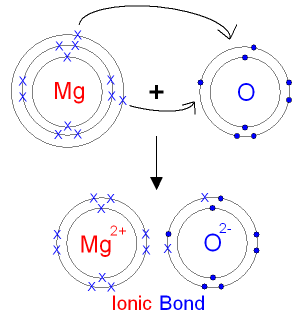
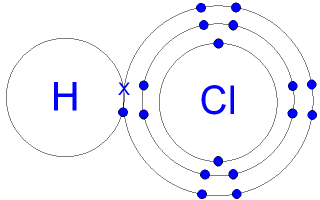
- All atoms want a full outer shell of electrons.
- They can do this by...
- Gaining or losing electrons (Ionic bonding)
- Occurs between metals and non metals
- Sharing electrons (Covalent bonding)
- Occurs between non metals only
- Gaining or losing electrons (Ionic bonding)
- They can do this by...
- Periodic table
Limestone
- Cycle
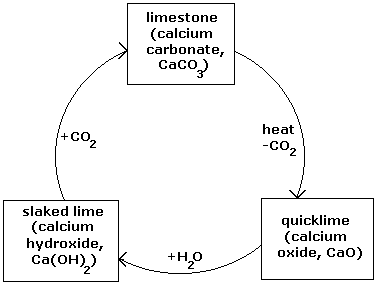
- Calcium Carbonate (Limestone) thermally decomposes to form Calcium Oxide (Quick lime)
- Sym eq. CaCO3->CaO+CO2
- Calcium oxide reacts with water to form Calcium Hydroxide (Slaked lime)
- Sym eq. CaO+H2O->Ca(OH)2
- Carbon Hydroxide reacts with more water to form Carbon Hydroxide solution, used to test for CO2
- When CO2 is added to solution, Calcium Carbonate is made
- Sym eq. Ca(OH)2+CO2->CaCO3+H2O
- When CO2 is added to solution, Calcium Carbonate is made
- Calcium Carbonate (Limestone) thermally decomposes to form Calcium Oxide (Quick lime)
- When Calcium Carbonate is heated, it thermally decomposes to produce Calcium oxide.
- This happens with other metal carbonates when heated
- Metal carbonate->Metal oxide+carbon dioxide
- This happens with other metal carbonates when heated
- Symbols:
- CaCO3=Calcium Carbonate
- CaO=Calcium Oxide
- Ca(OH)2=Calcium hydroxide
- Thermal decomposition is when a substance is heated and produces new substances.
- Quarrying
- Negatives of quarrying
- Produces dust
- Noisy
- Creates traffic
- Destroys landscapes
- Destroys habitats
- Positives of quarrying
- Creates local jobs
- Boosts local economy
- Provides building materials
- Negatives of quarrying
- Building materials made from Limestone
- Cement - heating powdered limestone with powdered clay in a kiln
- Mortar - cement mixed with sand, water and sometimes Calcium Hydroxide
- Concrete - cement mixed with sand and aggregate (water and gravel)
- Cycle
Metals
- Displacement is a reaction where an atom, radical or molecule replaces another in a compound.
- Reduction is the loss of oxygen from a substance
- Extraction of metals
- Bioleaching is the extraction of metals from their ores with bacteria
- Phytomining is the extraction of a substance using plants and trees.
Imágenes y archivos del mapa
Información
- Descripción
- (Revision) Chemistry Mapa Mental sobre C1, creado por chlo123456 el 25/11/2014.
- Creado por
- chlo123456
- Visitas
- 8
- Valoración