
Mapa mental
Evol. Lecture 6 - Phylogenies and Systematics
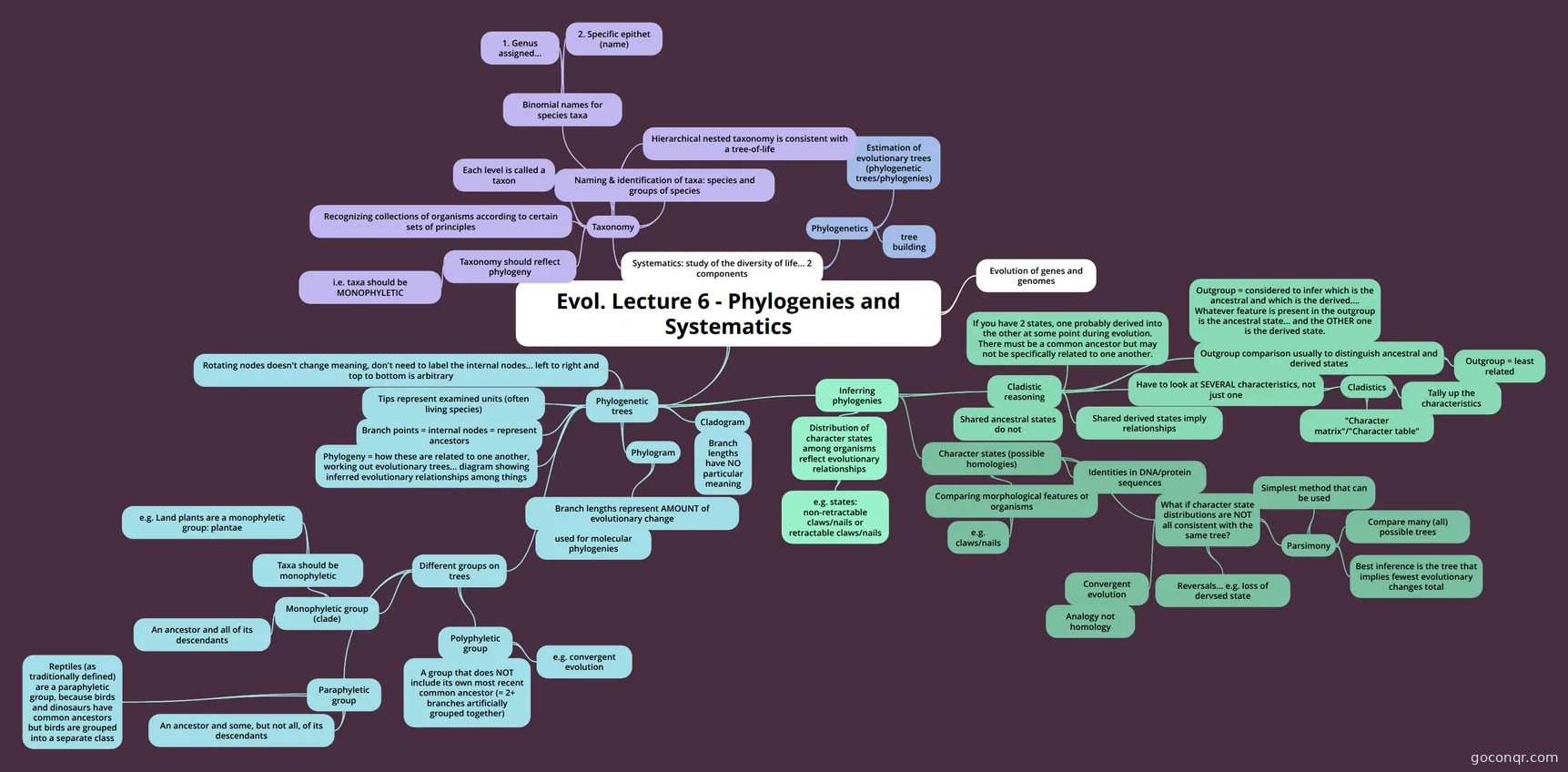
Mind map: Phylogenies and systematics
Contenido del mapa
Evol. Lecture 6 - Phylogenies and Systematics
Phylogenetic trees
- Tips represent examined units (often living species)
- Branch points = internal nodes = represent ancestors
- Phylogeny = how these are related to one another, working out evolutionary trees... diagram showing inferred evolutionary relationships among things
- Rotating nodes doesn't change meaning, don't need to label the internal nodes... left to right and top to bottom is arbitrary
- Cladogram
- Branch lengths have NO particular meaning
- Phylogram
- Branch lengths represent AMOUNT of evolutionary change
- used for molecular phylogenies
- Branch lengths represent AMOUNT of evolutionary change
- Different groups on trees
- Monophyletic group (clade)
- An ancestor and all of its descendants
- Taxa should be monophyletic
- e.g. Land plants are a monophyletic group: plantae
- Paraphyletic group
- An ancestor and some, but not all, of its descendants
- Reptiles (as traditionally defined) are a paraphyletic group, because birds and dinosaurs have common ancestors but birds are grouped into a separate class
- Polyphyletic group
- A group that does NOT include its own most recent common ancestor (= 2+ branches artificially grouped together)
- e.g. convergent evolution
- Monophyletic group (clade)
- Inferring phylogenies
- Character states (possible homologies)
- Comparing morphological features of organisms
- e.g. claws/nails
- Identities in DNA/protein sequences
- What if character state distributions are NOT all consistent with the same tree?
- Convergent evolution
- Analogy not homology
- Reversals... e.g. loss of dervsed state
- Parsimony
- Compare many (all) possible trees
- Simplest method that can be used
- Best inference is the tree that implies fewest evolutionary changes total
- Convergent evolution
- Comparing morphological features of organisms
- Distribution of character states among organisms reflect evolutionary relationships
- e.g. states: non-retractable claws/nails or retractable claws/nails
- Cladistic reasoning
- Shared derived states imply relationships
- Shared ancestral states do not
- Outgroup comparison usually to distinguish ancestral and derived states
- Outgroup = considered to infer which is the ancestral and which is the derived…. Whatever feature is present in the outgroup is the ancestral state… and the OTHER one is the derived state.
- Outgroup = least related
- If you have 2 states, one probably derived into the other at some point during evolution. There must be a common ancestor but may not be specifically related to one another.
- Have to look at SEVERAL characteristics, not just one
- Cladistics
- "Character matrix"/"Character table"
- Tally up the characteristics
- Cladistics
- Character states (possible homologies)
Evolution of genes and genomes
Systematics: study of the diversity of life... 2 components
- Taxonomy
- Naming & identification of taxa: species and groups of species
- Recognizing collections of organisms according to certain sets of principles
- Each level is called a taxon
- Binomial names for species taxa
- 1. Genus assigned...
- 2. Specific epithet (name)
- Taxonomy should reflect phylogeny
- i.e. taxa should be MONOPHYLETIC
- Hierarchical nested taxonomy is consistent with a tree-of-life
- Phylogenetics
- Estimation of evolutionary trees (phylogenetic trees/phylogenies)
- tree building
- Taxonomy
Información
- Descripción
- Mapa Mental sobre Evol. Lecture 6 - Phylogenies and Systematics, creado por julia guk el 25/11/2014.
- Creado por
- julia guk
- Visitas
- 13
- Valoración