
Mapa mental
PAST MODALS + v3
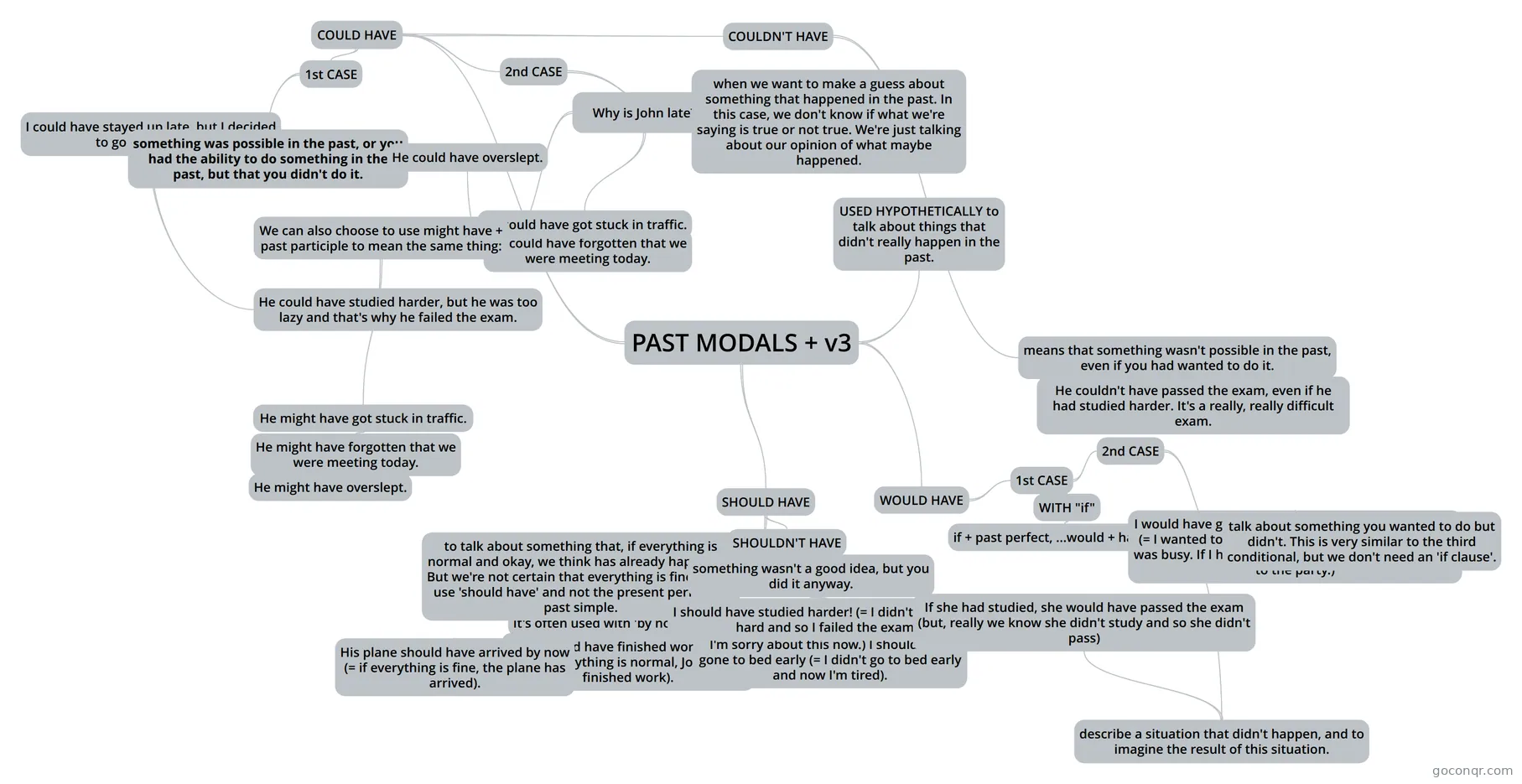
Mind map: Past modals
Contenido del mapa
PAST MODALS + v3
COULD HAVE
- 1st CASE
- something was possible in the past, or you had the ability to do something in the past, but that you didn't do it.
- I could have stayed up late, but I decided to go to bed early.
- He could have studied harder, but he was too lazy and that's why he failed the exam.
- I could have stayed up late, but I decided to go to bed early.
- something was possible in the past, or you had the ability to do something in the past, but that you didn't do it.
- 2nd CASE
- when we want to make a guess about something that happened in the past. In this case, we don't know if what we're saying is true or not true. We're just talking about our opinion of what maybe happened.
- Why is John late?
- He could have got stuck in traffic.
- He could have forgotten that we were meeting today.
- He could have overslept.
- He could have forgotten that we were meeting today.
- We can also choose to use might have + past participle to mean the same thing:
- He might have got stuck in traffic.
- He might have forgotten that we were meeting today.
- He might have overslept.
- He might have forgotten that we were meeting today.
- He might have got stuck in traffic.
- He could have got stuck in traffic.
- Why is John late?
- when we want to make a guess about something that happened in the past. In this case, we don't know if what we're saying is true or not true. We're just talking about our opinion of what maybe happened.
- COULDN'T HAVE
- means that something wasn't possible in the past, even if you had wanted to do it.
- He couldn't have passed the exam, even if he had studied harder. It's a really, really difficult exam.
- means that something wasn't possible in the past, even if you had wanted to do it.
- 1st CASE
SHOULD HAVE
- to talk about something that, if everything is normal and okay, we think has already happened. But we're not certain that everything is fine, so we use 'should have' and not the present perfect or past simple.
- It's often used with 'by now'.
- His plane should have arrived by now (= if everything is fine, the plane has arrived).
- John should have finished work by now (= if everything is normal, John has finished work).
- His plane should have arrived by now (= if everything is fine, the plane has arrived).
- It's often used with 'by now'.
- SHOULDN'T HAVE
- something wasn't a good idea, but you did it anyway.
- I should have studied harder! (= I didn't study very hard and so I failed the exam.
- I'm sorry about this now.) I should have gone to bed early (= I didn't go to bed early and now I'm tired).
- I should have studied harder! (= I didn't study very hard and so I failed the exam.
- something wasn't a good idea, but you did it anyway.
- to talk about something that, if everything is normal and okay, we think has already happened. But we're not certain that everything is fine, so we use 'should have' and not the present perfect or past simple.
WOULD HAVE
- 1st CASE
- WITH "if"
- if + past perfect, ...would + have + v3
- describe a situation that didn't happen, and to imagine the result of this situation.
- If she had studied, she would have passed the exam (but, really we know she didn't study and so she didn't pass)
- describe a situation that didn't happen, and to imagine the result of this situation.
- if + past perfect, ...would + have + v3
- 2nd CASE
- talk about something you wanted to do but didn't. This is very similar to the third conditional, but we don't need an 'if clause'.
- I would have gone to the party, but I was really busy. (= I wanted to go to the party, but I didn't because I was busy. If I hadn't been so busy, I would have gone to the party.)
- talk about something you wanted to do but didn't. This is very similar to the third conditional, but we don't need an 'if clause'.
- WITH "if"
- 1st CASE
USED HYPOTHETICALLY to talk about things that didn't really happen in the past.
Información
- Descripción
- PAST MODALS Mapa Mental sobre PAST MODALS + v3, creado por Cxr Digiworld el 12/03/2019.
- Creado por
- Cxr Digiworld
- Visitas
- 0
- Historial
-
- Creado por Cxr Digiworld · 12 mar 2019
- Copiado por Cxr Digiworld · 12 mar 2019
- Valoración
Más sobre Past Modals and Modal Perfects