
Mapa mental
Chapter 9 - MANAGING INVENTORY IN THE SUPPLY CHAIN
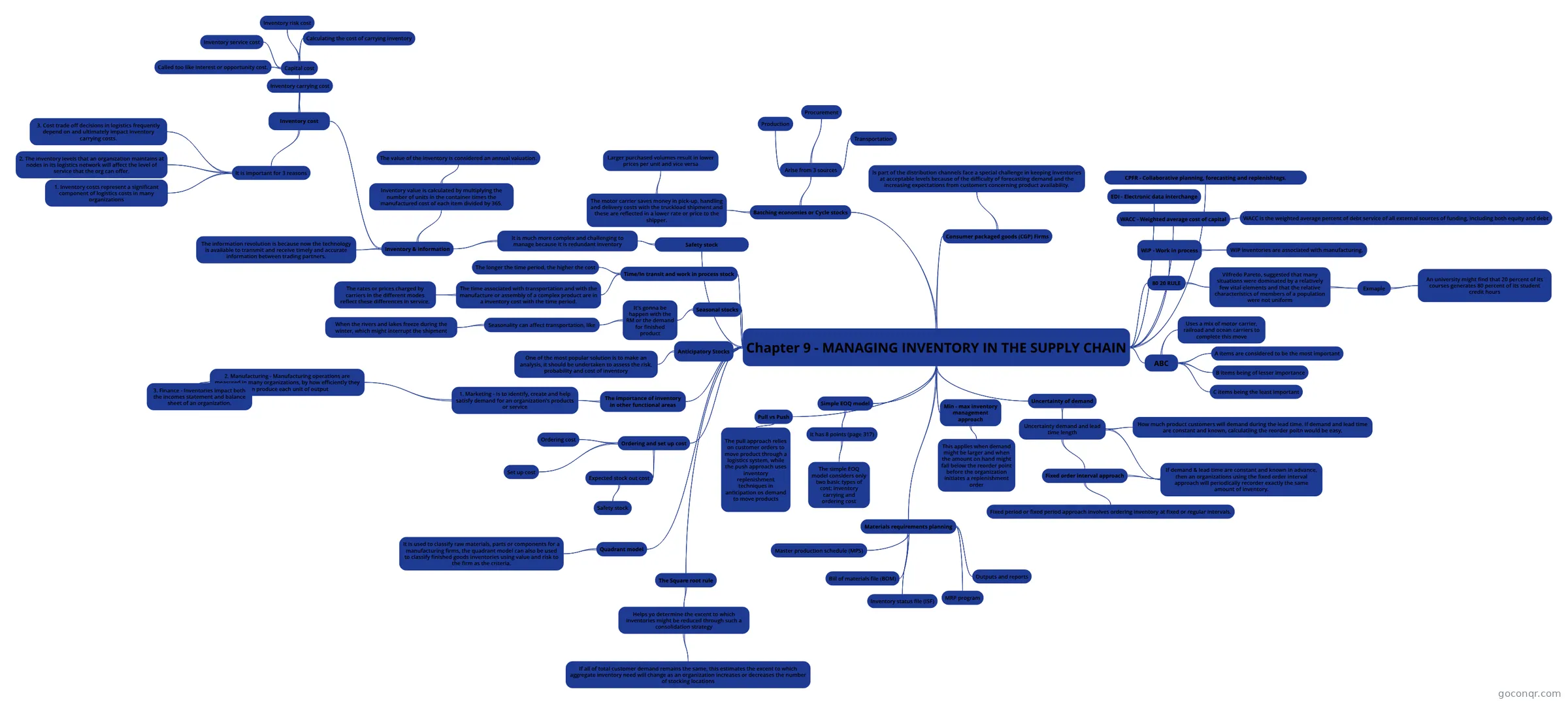
Mind map: managing inventory in the supply chain
Contenido del mapa
Chapter 9 - MANAGING INVENTORY IN THE SUPPLY CHAIN
Consumer packaged goods (CGP) Firms
- Is part of the distribution channels face a special challenge in keeping inventories at acceptable levels because of the difficulty of forecasting demand and the increasing expectations from customers concerning product availability.
CPFR - Collaborative planning, forecasting and replenishtags.
Batching economies or Cycle stocks
- Arise from 3 sources
- Procurement
- Production
- Transportation
- The motor carrier saves money in pick-up, handling and delivery costs with the truckload shipment and these are reflected in a lower rate or price to the shipper.
- Larger purchased volumes result in lower prices per unit and vice versa
- Arise from 3 sources
Safety stock
- It is much more complex and challenging to manage because it is redundant inventory
- Inventory & information
- The information revolution is because now the technology is available to transmit and receive timely and accurate information between trading partners.
- Inventory value is calculated by multiplying the number of units in the container times the manufactured cost of each item divided by 365.
- The value of the inventory is considered an annual valuation.
- Inventory cost
- It is important for 3 reasons
- 1. Inventory costs represent a significant component of logistics costs in many organizations
- 2. The inventory levels that an organization maintains at nodes in its logistics network will affect the level of service that the org can offer.
- 3. Cost trade off decisions in logistics frequently depend on and ultimately impact inventory carrying costs.
- Inventory carrying cost
- Capital cost
- Called too like interest or opportunity cost.
- Inventory service cost
- Inventory risk cost
- Calculating the cost of carrying inventory
- It is important for 3 reasons
- Inventory & information
- It is much more complex and challenging to manage because it is redundant inventory
Time/In transit and work in process stock
- The longer the time period, the higher the cost
- The time associated with transportation and with the manufacture or assembly of a complex product are in a inventory cost with the time period.
- The rates or prices charged by carriers in the different modes reflect these differences in service.
EDI - Electronic data interchange
WIP - Work in process
- WIP inventories are associated with manufacturing.
Seasonal stocks
- It's gonna be happen with the RM or the demand for finished product
- Seasonality can affect transportation, like
- When the rivers and lakes freeze during the winter, which might interrupt the shipment
- Seasonality can affect transportation, like
- It's gonna be happen with the RM or the demand for finished product
ABC
- Uses a mix of motor carrier, railroad and ocean carriers to complete this move
- A items are considered to be the most important
- B items being of lesser importance
- C items being the least important
Anticipatory Stocks
- One of the most popular solution is to make an analysis, it should be undertaken to assess the risk, probability and cost of inventory
The importance of inventory in other functional areas
- 1. Marketing - Is to identify, create and help satisfy demand for an organization's products or service
- 2. Manufacturing - Manufacturing operations are measured in many organizations, by how efficiently they can produce each unit of output
- 3. Finance - Inventories impact both the incomes statement and balance sheet of an organization.
- 2. Manufacturing - Manufacturing operations are measured in many organizations, by how efficiently they can produce each unit of output
- 1. Marketing - Is to identify, create and help satisfy demand for an organization's products or service
WACC - Weighted average cost of capital
- WACC is the weighted average percent of debt service of all external sources of funding, including both equity and debt
Ordering and set up cost
- Ordering cost
- Set up cost
- Expected stock out cost
- Safety stock
Pull vs Push
- The pull approach relies on customer orders to move product through a logistics system, while the push approach uses inventory replenishment techniques in anticipation os demand to move products
Simple EOQ model
- It has 8 points (page 317)
- The simple EOQ model considers only two basic types of cost: inventory carrying and ordering cost
- It has 8 points (page 317)
Min - max inventory management approach
- This applies when demand might be larger and when the amount on hand might fall below the reorder point before the organization initiates a replenishment order
Uncertainty of demand
- Uncertainty demand and lead time length
- How much product customers will demand during the lead time. If demand and lead time are constant and known, calculatiing the reorder poitn would be easy.
- Fixed order interval approach
- Fixed period or fixed period approach involves ordering inventory at fixed or regular intervals.
- If demand & lead time are constant and known in advance, then an organizations using the fixed order interval approach will periodically recorder exactly the same amount of inventory.
- Uncertainty demand and lead time length
Materials requirements planning
- Master production schedule (MPS)
- Bill of materials file (BOM)
- Inventory status file (ISF)
- MRP program
- Outputs and reports
80 20 RULE
- Vilfredo Pareto, suggested that many situations were dominated by a relatively few vital elements and that the relative characteristics of members of a population were not uniform
- Exmaple
- An university might find that 20 percent of its courses generates 80 percent of its student credit hours
- Exmaple
- Vilfredo Pareto, suggested that many situations were dominated by a relatively few vital elements and that the relative characteristics of members of a population were not uniform
Quadrant model
- It is used to classify raw materials, parts or components for a manufacturing firms, the quadrant model can also be used to classify finished goods inventories using value and risk to the firm as the criteria.
The Square root rule
- Helps yo determine the excent to which inventories might be reduced through such a consolidation strategy
- If all of total customer demand remains the same, this estimates the excent to which aggregate inventory need will change as an organization increases or decreases the number of stocking locations
- Helps yo determine the excent to which inventories might be reduced through such a consolidation strategy