
Mapa mental
Trigonometry
Contenido del mapa
Trigonometry
The Unit Circle
- terminal side of angle θ
- segment between the origin and the point
- coterminal angles
- two angles with the same terminal side
- if we add any integer multiple of 360 to an angle θ
- obtain an angle co-terminal to θ1
- θ1 +360=θ2
- obtain an angle co-terminal to θ1
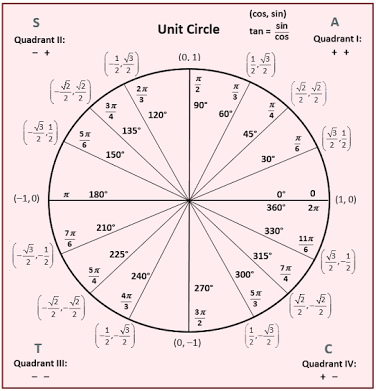
- π/3
- 5π/3
- 4π/3
- 2π/3
- 4π/3
- cos x is 1/2 but differ positive or negatives depending on quadrant
- 5π/3
- cos x is √3/2 but differ positive or negative depending on quadrant
- π/6
- 5π/6
- 7π/6
- 11π/6
- 7π/6
- 5π/6
- π/6
- radians and degrees increase counterclockwise
- the 4 ends circle
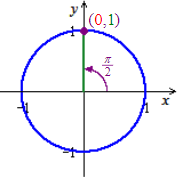
- top π/2
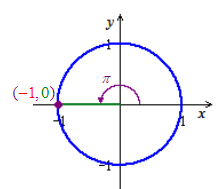
- left side π
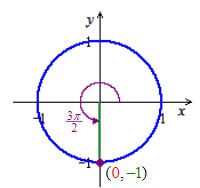
- bottom 3π/2
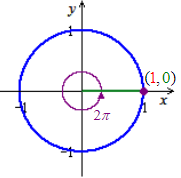
- right side 2π
- bottom 3π/2
- left side π
- top would be y = 1 since high up
- left side x=-1 since negative side
- bottom would be y=-1 since lowest point
- right would be x=1 since on the positive side
- bottom would be y=-1 since lowest point
- left side x=-1 since negative side
- all of the coordinates are joined with a 0 for the missing coordinate
- top π/2
- the 4 ends circle
- Radians
- 2π radians = 360 degrees
- full rotation
- π radians = 180 degrees
- π/2 radians= 90 degrees
- right angle
- straight line
- π/2 radians= 90 degrees
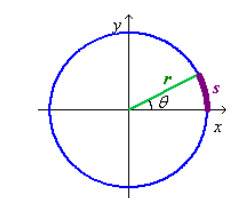
- circumference = 2πr
- number of arcs= 2π
- convert radians into degrees
- multiply the radians by 360/2π
- convert degrees into radians
- multiply the angle measure by 2π/360
- arc length formula
- s=r|θ|
- 2π radians = 360 degrees
- cos x is √2/2
- same for the sin y
- just differs positive or negative depending on quadrant
- π/4
- 3π/4
- 5π/4
- 7π/4
- 5π/4
- 3π/4
- π/4
- just differs positive or negative depending on quadrant
- same for the sin y
- terminal side of angle θ
Periodic Functions
- a function f is periodic if its values repeat on regular intervals
- f is periodic if there exists some constant c
- f(t+c) =f(t)
- the period
- the smallest value |c|
- the midline
- the horizontal line midway between the function's minimum and maximum values
- y=(fmax+fmin)/2
- the horizontal line midway between the function's minimum and maximum values
- the amplitude
- distance between the function's maximum and the midline
- or minimum and the midline
- distance between the function's maximum and the midline
- f is periodic if there exists some constant c
- a function f is periodic if its values repeat on regular intervals
trigonometric functions
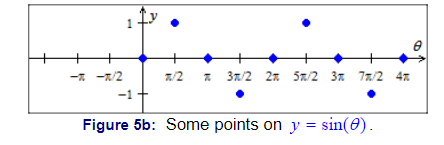
- sin(θ)
- vertical coordinate
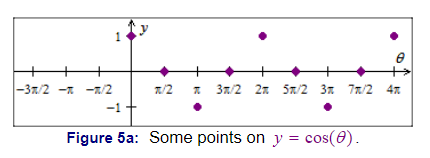
- cos(θ)
- horizontal coordinate
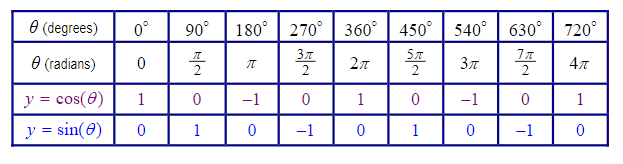
- θ= 270 degrees
- θ=3π/2 radians
- cos(3π/2)=0
- sin(3π/2)=-1
- cos(3π/2)=0
- θ=3π/2 radians
- θ=360 degrees
- θ=2π radians
- cos(2π)=1
- sin(2π)=0
- θ= 270 degrees
- horizontal coordinate
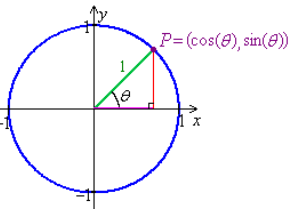
- (x, y) = (cos(θ), sin(θ))
- θ=90 degrees
- θ=π/2 radians
- cos(π/2)=0
- sin(π/2)=1
- θ=180 degrees
- θ=π radians
- cos(π)=-1
- sin(π)=0
- cos(π)=-1
- θ=π radians
- θ=90 degrees
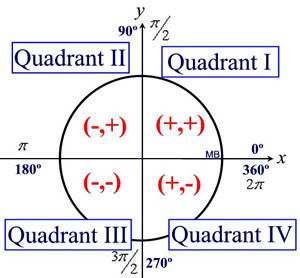
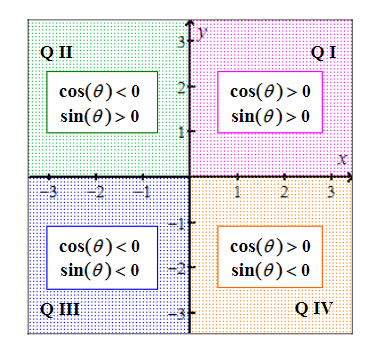
- when the terminal side of angle θ is in Quadrant I
- both x and y are positive
- when the terminal side of angle θ is in Quadrant II
- x negative, y positive
- when the terminal side of angle θ is in Quadrant III
- both x and y negative
- when the terminal side of angle θ is in Quadrant IV
- x positive, y negative
- tan(θ)=sin(θ)/cos(θ)
- cot(θ)=1/tan(θ)
- sec(θ)=1/cos(θ)
- csc(θ)=1/sin(θ)
- sin(θ)
angles of measure 2π radians and 0 radians specify the same point (1, 0)
- cos(2π)=cos(0)=1
- sin(2π)=sin(0)=0
- since any angle θ and θ + 2π specify the same point on the unit circle
- the sine and cosine values of θ and θ + 2π are the same
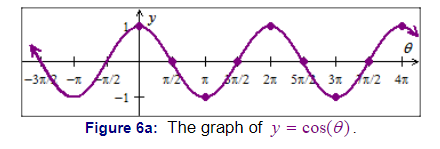
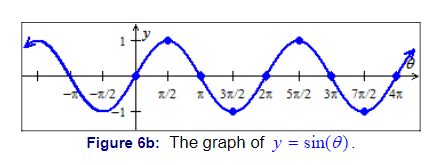
- the period of the sine and cosine functions is 2π
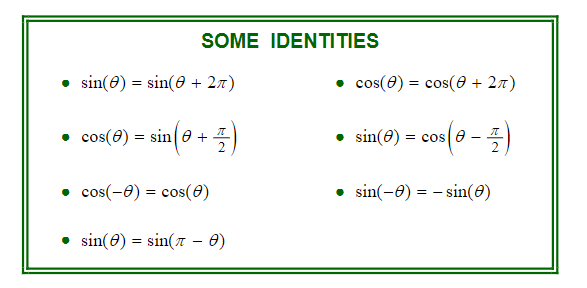
- sin(θ)=sin(θ + 2π)
- cos(θ)=cos(θ + 2π)
- both periods = 2π raadians
- s(θ)=sin(θ)
- c(θ)=cos(θ)
- both periods = 2π raadians
- cos(θ)=cos(θ + 2π)
- sin(θ)=sin(θ + 2π)
- the period of the sine and cosine functions is 2π
- the sine and cosine values of θ and θ + 2π are the same
- since any angle θ and θ + 2π specify the same point on the unit circle
- sin(2π)=sin(0)=0
- the difference
- between y=cos(θ) and y=sin(θ)
- shift y=sin(θ) to the left π/2 units and you get the cos(θ) graph
- or shift cos(θ) graph to the right π/2 units and you get the sin(θ) graph
- shift y=sin(θ) to the left π/2 units and you get the cos(θ) graph
- between y=cos(θ) and y=sin(θ)
- cos(2π)=cos(0)=1
identities
- one identity sin(θ) =sin(π-θ)
- focus on the θ-values between 0 and π/2
- the graphs are the same because of the symmetry of the sine function between 0 and π
- focus on the θ-values between 0 and π/2
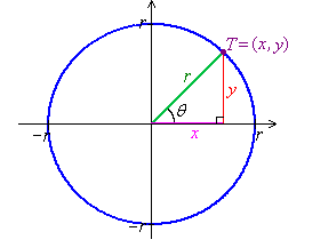
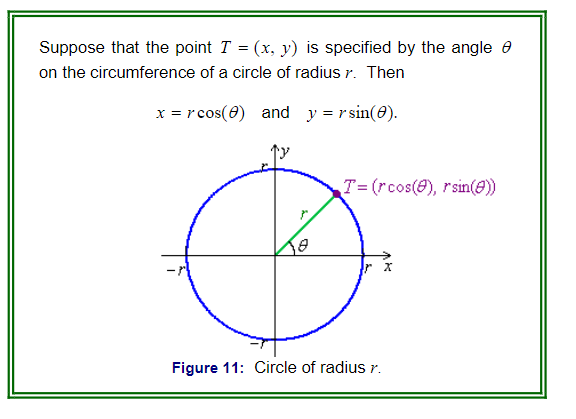
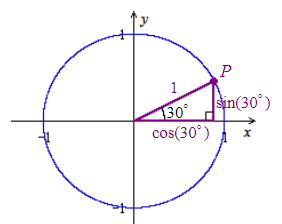
- we can use sine and cosine to find the coordinates of a point on the circumference of any circle
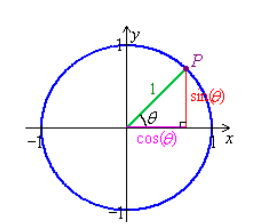
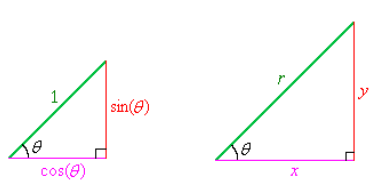
- construct a right triangle using terminal side of angle θ and the horizontal and vertical components of the point p
- this right triangle has a hypotenuse of length 1 unit since this is radius
- a horizontal component of length cos(θ)
- vertical component of length sin(θ)
- similar triangles ratio of side-lengths is constant
- since similar we can obtain the following equations
- cos(θ)/1 = x/r
- x=rcos(θ)
- sin(θ)/1 = y/r
- y=rsin(θ)
- cos(θ)/1 = x/r
- since similar we can obtain the following equations
- similar triangles ratio of side-lengths is constant
- vertical component of length sin(θ)
- a horizontal component of length cos(θ)
- this right triangle has a hypotenuse of length 1 unit since this is radius
- construct a right triangle using terminal side of angle θ and the horizontal and vertical components of the point p
- one identity sin(θ) =sin(π-θ)
Pythagorean Identity
- algebraic equation of a unit circle centered at the origin is x^2+y^2=1
- any point (x, y) on the circumference of a unit circle centered at the origin satisfies the equation
- (x, y) = (cos(θ), sin(θ))
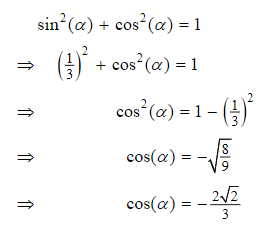
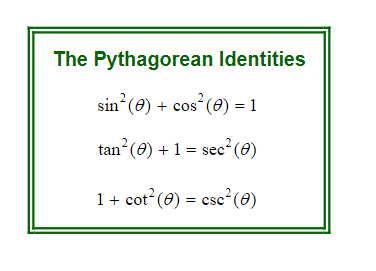
- sin^2(θ) + cos^2(θ) = 1
- example
- if sin(a)=1/3 and π/2 < a < π
- we choose the negative square root since cosine is negative in quadrant II
- if sin(a)=1/3 and π/2 < a < π
- example
- sin^2(θ) + cos^2(θ) = 1
- (x, y) = (cos(θ), sin(θ))
- any point (x, y) on the circumference of a unit circle centered at the origin satisfies the equation
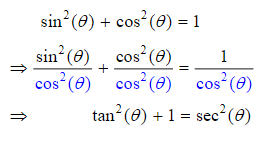
- by dividing both sides by cos^2(θ) we can find another identity
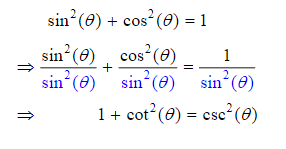
- and this one by sin^2(θ)
- algebraic equation of a unit circle centered at the origin is x^2+y^2=1
Using geometry for trigonometric functions
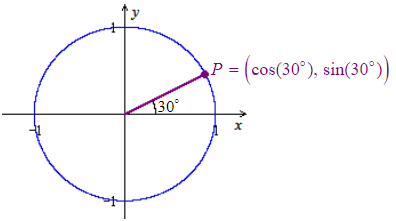
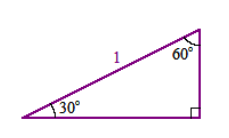
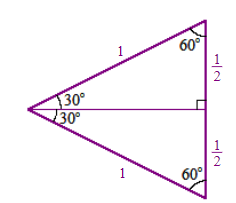
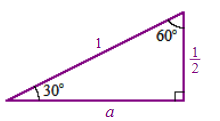
- since the angle is 30 it has to be a 30/60/90 triangle
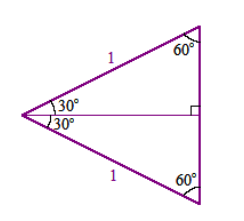
- to find the lengths of the sides the triangle has to be mirrored
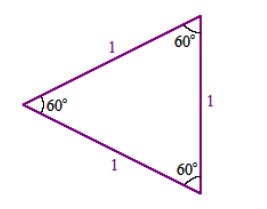
- the two halves make the triangle an equilateral triangle
- if we cut one of the sides in half, each part will be 1/2 of a unit
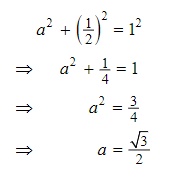
- then pythagorean theorem to find a
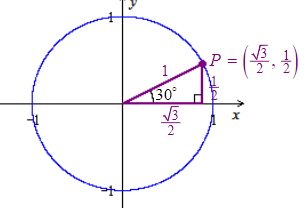
- sin(30)=1/2
- cos(30)=√3/2
- sin(30)=1/2
- then pythagorean theorem to find a
- if we cut one of the sides in half, each part will be 1/2 of a unit
- the two halves make the triangle an equilateral triangle
- to find the lengths of the sides the triangle has to be mirrored
- since the angle is 30 it has to be a 30/60/90 triangle
Imágenes y archivos del mapa
Información
- Descripción
- 12th grade (Trigonometry) Math Mapa Mental sobre Trigonometry, creado por unuaji k el 03/06/2019.
- Creado por
- unuaji k
- Visitas
- 2
- Valoración