
Mapa mental
CANVAS
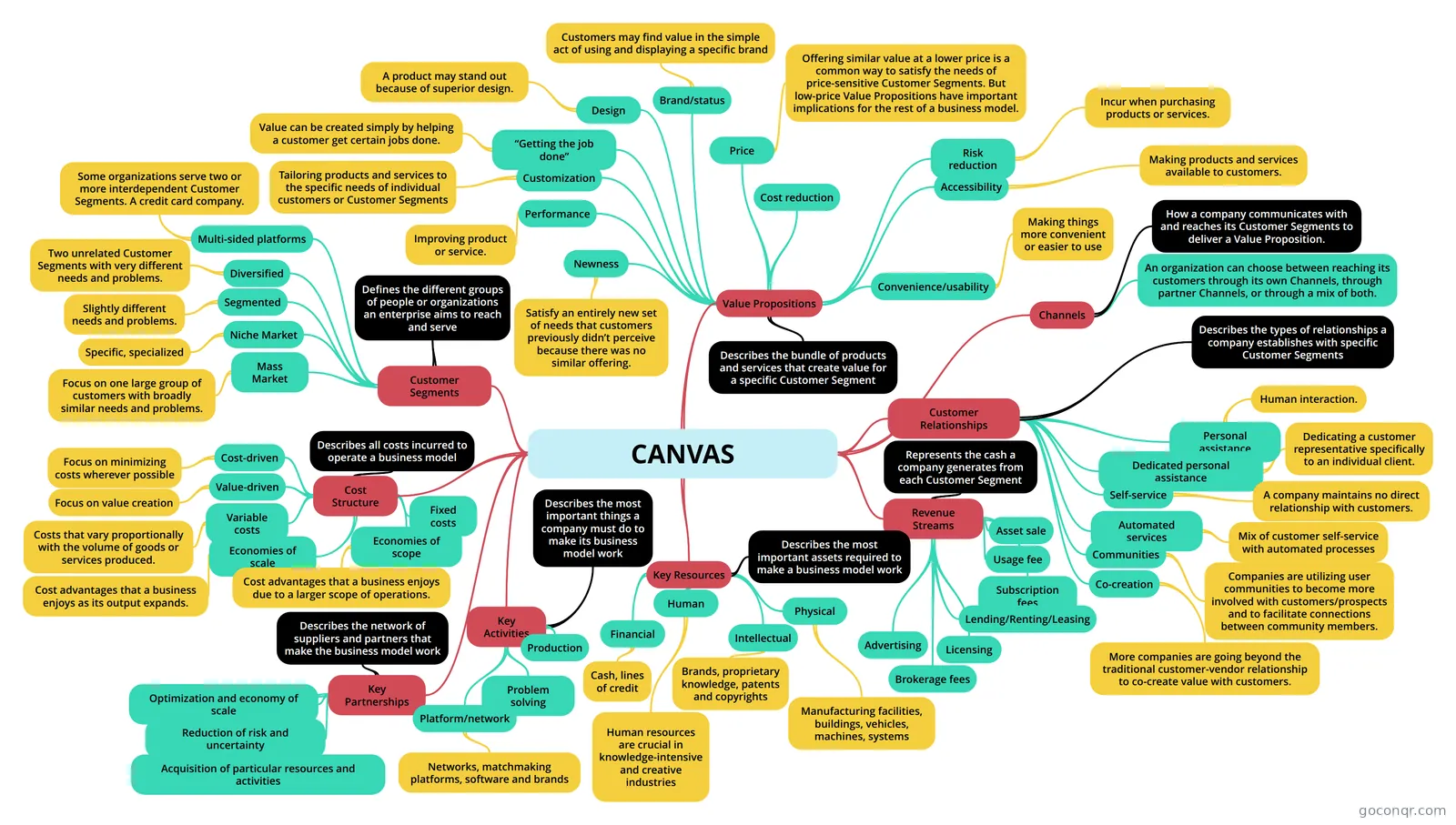
Mind map: Business Model Canvas
Contenido del mapa
CANVAS
Customer Segments
- Mass Market
- Focus on one large group of customers with broadly similar needs and problems.
- Niche Market
- Specific, specialized
- Segmented
- Slightly different needs and problems.
- Diversified
- Two unrelated Customer Segments with very different needs and problems.
- Multi-sided platforms
- Some organizations serve two or more interdependent Customer Segments. A credit card company.
- Defines the different groups of people or organizations an enterprise aims to reach and serve
- Mass Market
Value Propositions
- Newness
- Satisfy an entirely new set of needs that customers previously didn’t perceive because there was no similar offering.
- Performance
- Improving product or service.
- Customization
- Tailoring products and services to the specific needs of individual customers or Customer Segments
- “Getting the job done”
- Value can be created simply by helping a customer get certain jobs done.
- Design
- A product may stand out because of superior design.
- Brand/status
- Customers may find value in the simple act of using and displaying a specific brand
- Price
- Offering similar value at a lower price is a common way to satisfy the needs of price-sensitive Customer Segments. But low-price Value Propositions have important implications for the rest of a business model.
- Cost reduction
- Risk reduction
- Incur when purchasing products or services.
- Accessibility
- Making products and services available to customers.
- Convenience/usability
- Making things more convenient or easier to use
- Describes the bundle of products and services that create value for a specific Customer Segment
- Newness
Channels
- How a company communicates with and reaches its Customer Segments to deliver a Value Proposition.
- An organization can choose between reaching its customers through its own Channels, through partner Channels, or through a mix of both.
Customer Relationships
- Describes the types of relationships a company establishes with specific Customer Segments
- Personal assistance
- Human interaction.
- Dedicated personal assistance
- Dedicating a customer representative specifically to an individual client.
- Self-service
- A company maintains no direct relationship with customers.
- Automated services
- Mix of customer self-service with automated processes
- Communities
- Companies are utilizing user communities to become more involved with customers/prospects and to facilitate connections between community members.
- Co-creation
- More companies are going beyond the traditional customer-vendor relationship to co-create value with customers.
Revenue Streams
- Represents the cash a company generates from each Customer Segment
- Asset sale
- Usage fee
- Subscription fees
- Lending/Renting/Leasing
- Licensing
- Brokerage fees
- Advertising
Key Resources
- Describes the most important assets required to make a business model work
- Physical
- Manufacturing facilities, buildings, vehicles, machines, systems
- Intellectual
- Brands, proprietary knowledge, patents and copyrights
- Human
- Human resources are crucial in knowledge-intensive and creative industries
- Financial
- Cash, lines of credit
Key Activities
- Production
- Problem solving
- Platform/network
- Networks, matchmaking platforms, software and brands
- Describes the most important things a company must do to make its business model work
Key Partnerships
- Describes the network of suppliers and partners that make the business model work
- Optimization and economy of scale
- Reduction of risk and uncertainty
- Acquisition of particular resources and activities
Cost Structure
- Describes all costs incurred to operate a business model
- Cost-driven
- Focus on minimizing costs wherever possible
- Value-driven
- Focus on value creation
- Fixed costs
- Variable costs
- Costs that vary proportionally with the volume of goods or services produced.
- Economies of scale
- Cost advantages that a business enjoys as its output expands.
- Economies of scope
- Cost advantages that a business enjoys due to a larger scope of operations.
Información
- Descripción
- Mapa Mental sobre CANVAS, creado por artuwap9 el 04/02/2015.
- Creado por
- artuwap9
- Visitas
- 0
- Valoración
Más sobre Business Model Canvas