
Mapa mental
Paradox
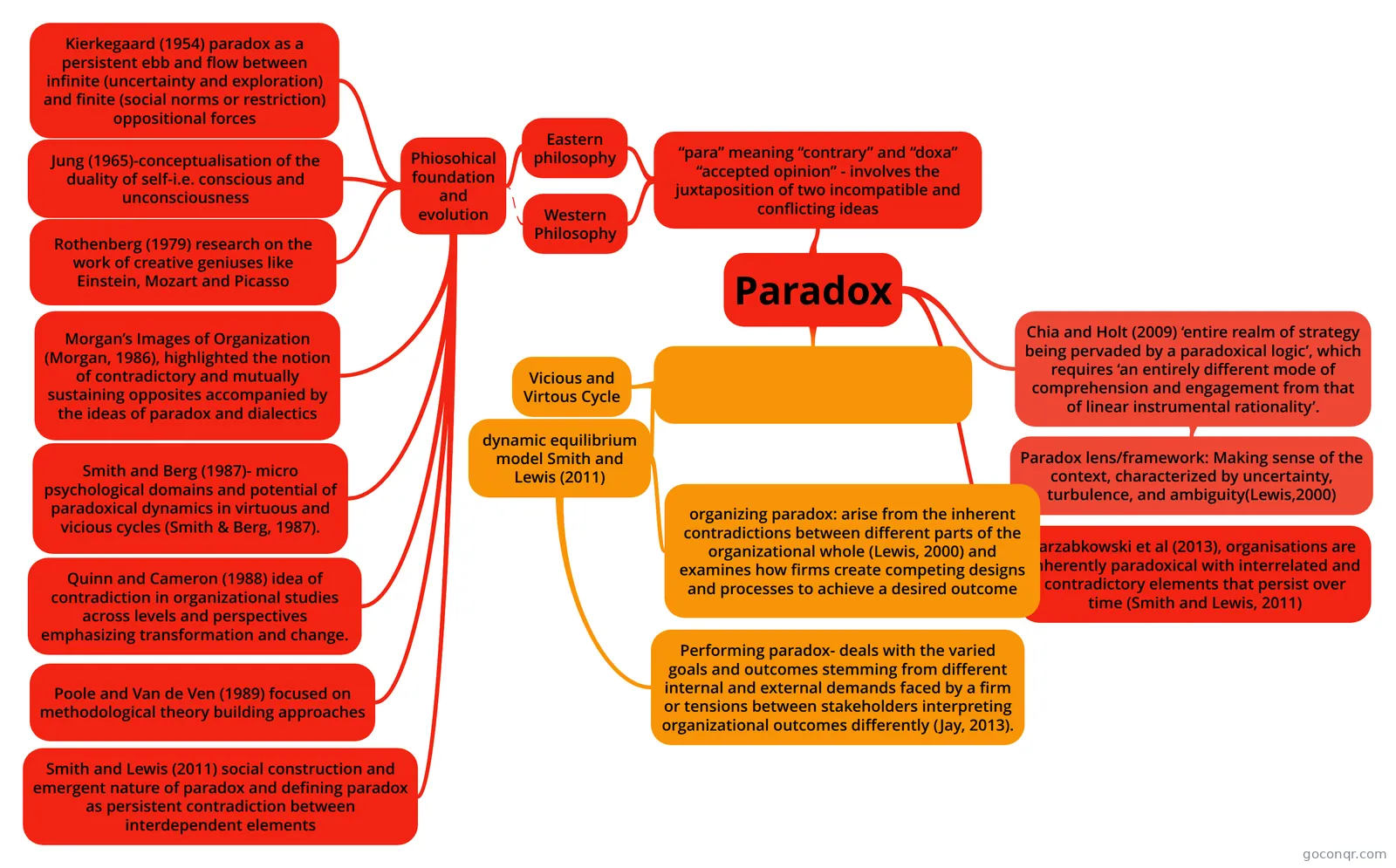
Mind map: Paradox
Contenido del mapa
Paradox
Chia and Holt (2009) ‘entire realm of strategy being pervaded by a paradoxical logic’, which requires ‘an entirely different mode of comprehension and engagement from that of linear instrumental rationality’.
- Paradox lens/framework: Making sense of the context, characterized by uncertainty, turbulence, and ambiguity(Lewis,2000)
Jarzabkowski et al (2013), organisations are inherently paradoxical with interrelated and contradictory elements that persist over time (Smith and Lewis, 2011)
“para” meaning “contrary” and “doxa” “accepted opinion” - involves the juxtaposition of two incompatible and conflicting ideas
- Eastern philosophy
- Phiosohical foundation and evolution
- Morgan’s Images of Organization (Morgan, 1986), highlighted the notion of contradictory and mutually sustaining opposites accompanied by the ideas of paradox and dialectics
- Kierkegaard (1954) paradox as a persistent ebb and flow between infinite (uncertainty and exploration) and finite (social norms or restriction) oppositional forces
- Jung (1965)-conceptualisation of the duality of self-i.e. conscious and unconsciousness
- Rothenberg (1979) research on the work of creative geniuses like Einstein, Mozart and Picasso
- Smith and Berg (1987)- micro psychological domains and potential of paradoxical dynamics in virtuous and vicious cycles (Smith & Berg, 1987).
- Quinn and Cameron (1988) idea of contradiction in organizational studies across levels and perspectives emphasizing transformation and change.
- Poole and Van de Ven (1989) focused on methodological theory building approaches
- Smith and Lewis (2011) social construction and emergent nature of paradox and defining paradox as persistent contradiction between interdependent elements
- Phiosohical foundation and evolution
- Western Philosophy
- Eastern philosophy
·
- Vicious and Virtous Cycle
- dynamic equilibrium model Smith and Lewis (2011)
- organizing paradox: arise from the inherent contradictions between different parts of the organizational whole (Lewis, 2000) and examines how firms create competing designs and processes to achieve a desired outcome
- Performing paradox- deals with the varied goals and outcomes stemming from different internal and external demands faced by a firm or tensions between stakeholders interpreting organizational outcomes differently (Jay, 2013).
Información
- Descripción
- strategy Mapa Mental sobre Paradox, creado por Anaim Latif el 06/10/2019.
- Creado por
- Anaim Latif
- Visitas
- 41
- Valoración