
Mapa mental
Atoms 2
Contenido del mapa
Atoms 2
Distillation
- Used to seperate pure liquid from mixture of liquids/solids.Works when liquids have different boiling points
- heating-evaporating-cooling-condensing
- Simple distillation
- seperate liquids that have at least 25 degrees Celsius difference in their boiling points
- liquid evaporates and condenses once.
- Fractional distillation
- mixtures less than 25 degrees Celsius
- Takes advantage of liquids having different boiling points
- seperates miscible liquids(liquids dissolved into each other mixing completely)
- Uses fractionating column which is coil inside tube that helps liquid boil+condense at different temperatures
- temp. of column is highest at bottom since closer to heat+cooler at top as vapour rises
- Substances with higher boiling points condense more readily on the cooler glass beads nearer bottom of column.Drip into flask,becoming purer as water vapour seperates where it says water out.Substances with lower boiling points continue rising+pass over into condenser where cool enough to turn back to liquid state+be collected
- liquid evaporates+condenses multiple times as different boiling points,highest boiling point would evaporate last lowest would evaporate first until everything has evaporated
- Substances with higher boiling points when ready to condense condense on the glass beads near the bottom of the fractionating column and drip back into the flask which has the fractionating column attached to it and then condenses again at bottom of fractionating column then drips back and process repeates multiple times
Chromotography
- Rf values=distance moved by substance/distance moved by solvent
- Paper chromotography
- 1.Spot of solution on to pencil line which is near bottom of chromotography paper
- 2.At top of paper wrap round stick+put secure with paper clip. Paperlowered into solvent(water)and only very tip in water
- 3.Relative solubility(how soluble)of component s making up solution rely on how far they travel up paper,further they travel,more soluble it is
- 2.At top of paper wrap round stick+put secure with paper clip. Paperlowered into solvent(water)and only very tip in water
- 4.Calculate Rf values
- Chromotogram-Paper record of seperation
- More soluble substance is,further up paper it's carried
- 1.Spot of solution on to pencil line which is near bottom of chromotography paper
- Seperates+identifies substances from mixtures in solution
- seperates mixturesof substances dissolved in a solvent
Hydrocarbons
- Only contain hydrogen and/or carbon
- carbon chain- no. of carbon atoms in the hydrocarbon
- Methane(CH4)-4 hydrogens,1 carbon
- Ethane(C2H6)-6 hydrogens,2 carbons
- Butane(C4H10)-10 hydrogens,4 carbons
- Propane(C3H8)-8 hydrogens,3 carbons
- Butane(C4H10)-10 hydrogens,4 carbons
- Ethane(C2H6)-6 hydrogens,2 carbons
- Only contain hydrogen and/or carbon
History of Atomic Theory
- Democritus(460 B.C.)-First person to come up with the atom.Thought the smallest thing in the world was the atom
- John Dalton(1766-1844)-All matter made from atom.All atoms of same element are identical+have same size,mass,chemical properties.Atoms of different elements are different.Atoms can't be divided into smaller particles/destroyed.Atoms combine in whole atoms not half atoms(whole atom or nothing)
- He thought an atom was a tiny solid ball that couldn't be broken up.
- JJ Thomson(1856-1940)-Broke atom into smaller particles.Discovered electrons proving Democritus+Dalton wrong.Cathode rays produced electrically charged particles.Found that the charged particles repelled negative side of machine he used(cathode ray tube was the machine).Cathode rays must be made of electrons as two like poles repel since both negatively charged repelled each other.
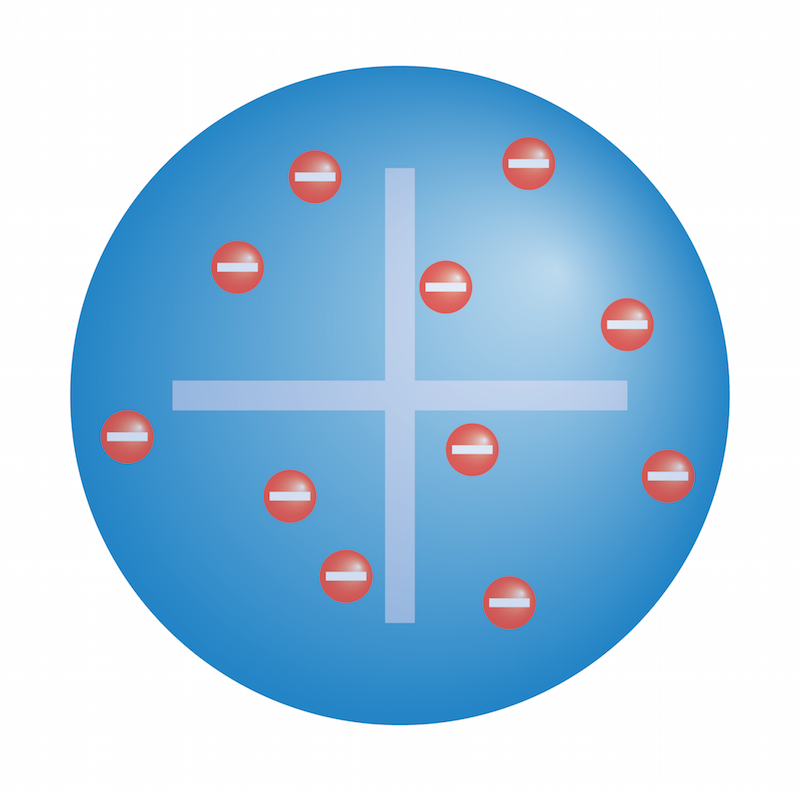
- Thomson's Plum Pudding Model(1904,electrons surround a positive nucleus)
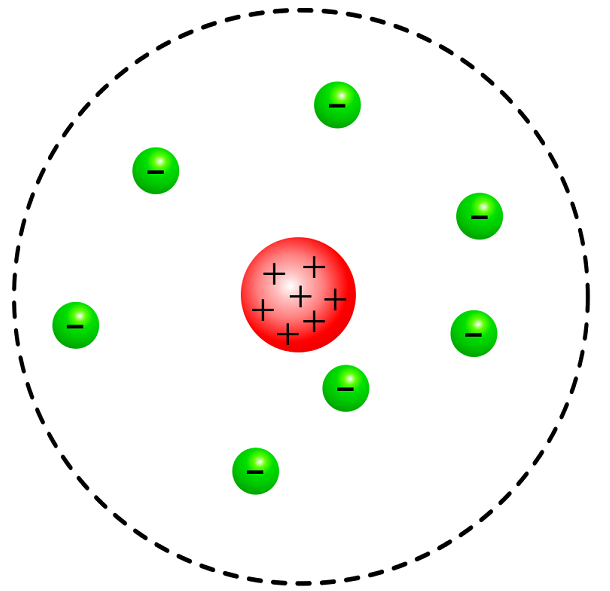
- Rutherford(1871-1937)-Fired Helium nuclei at a piece of gold foil whihc was a few atoms thick.Most of the toms passed through but 1 in 10,000 bounced back.Some bounced back as if something solid was blocking the wayFound nucleus was is middle and was surrounded by empty space(said all positive charge contained in the nucleus)..Discovered the positively charged nucleus.
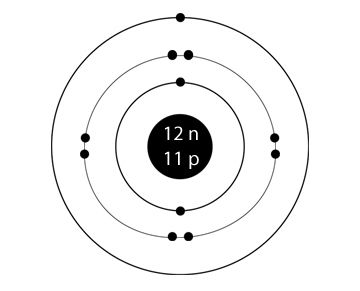
- Bohr(1885-1962)-The electrons move in definite orbits around positive nucleus (contains protons and neutrons and protons have charge of 1 and neutrons have a charge of 0 as they're neutral so the nucleus has an overall charge of 1 meaning it's positive).Energy levels located at certain distances from nucleus
- Bohr(1885-1962)-The electrons move in definite orbits around positive nucleus (contains protons and neutrons and protons have charge of 1 and neutrons have a charge of 0 as they're neutral so the nucleus has an overall charge of 1 meaning it's positive).Energy levels located at certain distances from nucleus
- Rutherford(1871-1937)-Fired Helium nuclei at a piece of gold foil whihc was a few atoms thick.Most of the toms passed through but 1 in 10,000 bounced back.Some bounced back as if something solid was blocking the wayFound nucleus was is middle and was surrounded by empty space(said all positive charge contained in the nucleus)..Discovered the positively charged nucleus.
- Thomson's Plum Pudding Model(1904,electrons surround a positive nucleus)
Isotopes
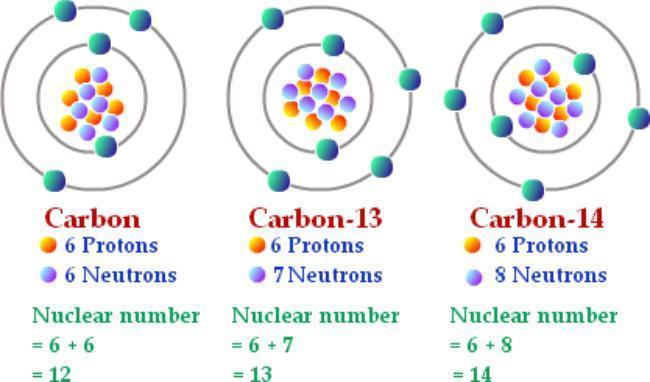
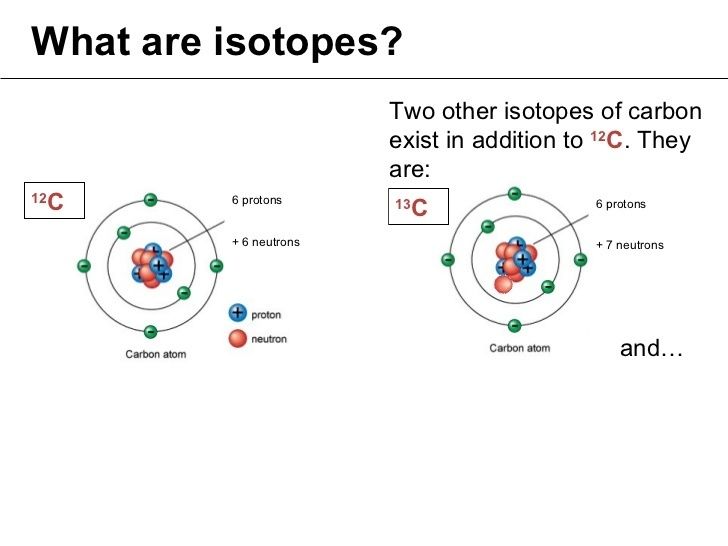
- An element with the same no. of protons but a different number of neutrons
- Isotopes always have the same chemical properties
- Atomic no. (smaller no.) is more important than relative mass no. as it tells you the place of the element on the periodic table(i.e. no. of protons stays the same)
- Ions
- When an atom gains/loses electrons
- If an atom gains an electrons,the atom becomes a negative ion, if loses an electron becomes positive ion.
- Ion-A charged atom(or group of atoms)
- An element with the same no. of protons but a different number of neutrons
Electron Configuration
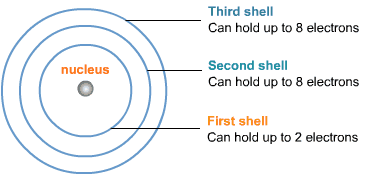
- For an element to be more stable it either has to have each shell at its max. capacity by gaining electrons or getting rid of the shell by losing electrons
- The group of an element on the periodic table determines the no. of electrons in the outer shell i.e. the 3rd shell
- E.g. sulphur is in group 6,therefore has 6 electrons on its outer shell
- The period of an element on the periodic table determines the no. of shells the element has
- E.g. Potassium is in period 4,therefore has 4 shells
- If it was P3− this means you add on 3 more electrons to the shell that's not at its full capacity(if shells empty start from te smallest one which is the first shell)
- If it was P2+ you lose 2 electrons(as protons can't move)
- E.g.
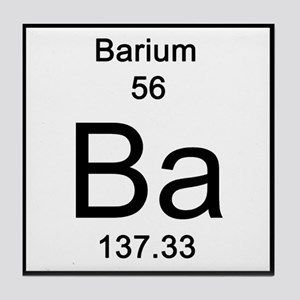
- Ba 2+
- Protions:56(atomic no.)
- Electrons:54(loses 2 electrons)
- Neutrons:81(137-56)
- no.of protons=no.of electrons
- Electrons:54(loses 2 electrons)
- The total no. of electrons in all the shells is equal to the no. of protons i.e.the atomic no.
- If only given the EC arrangement numbers, add them all together,which gives you the atomic no.which you can use to find out the element on the periodic table or from the top of your head
- The first number of the numbers of an element's E.C. will always be 2 as the first shell of any element can only hold 2 electrons. You then look at the period of the element which determines the no. of numbers in the E.C. and work out what you have to add to the two to get your other numbers,not forgetting that each shell has a max. capacity
- E.g.
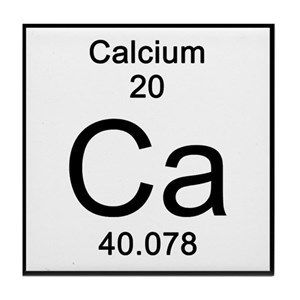
- 2,8,8,2
- As already said 2 is always the first number,then to get to 20(E.C. needs to add up to atomic no.) you need 18 but since it's in period 4, it has to have 4 shells so you spread it out so each shell is as full as possible, so it's 2,8,8 which is 18 and don't forget the atomic no. is 20 so you need an extra 2 on the fourth shell to make it 20
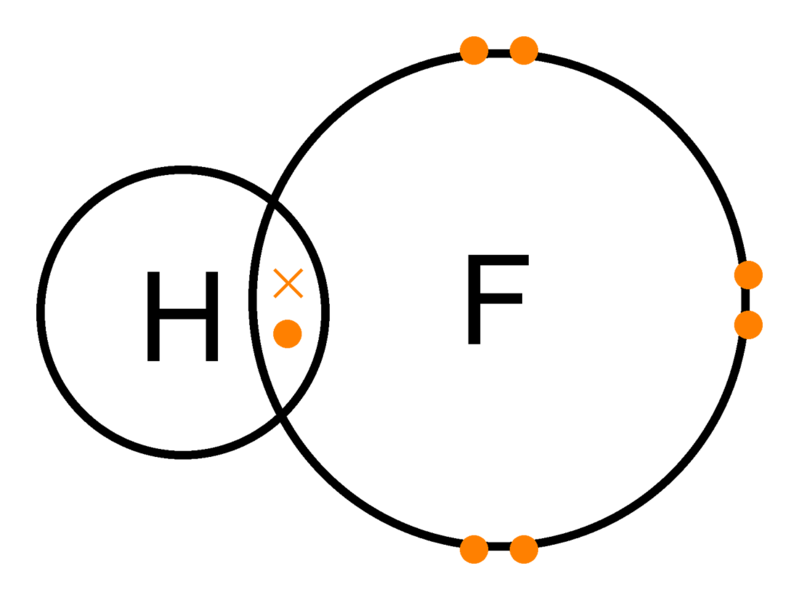
- This is a dot and cross diagram.The crosses represent the electrons present,and the dots represent the electron from another element.It shows the movement of electrons from a non-metal to a metal. In this diagram fluorine has gained an electron from hydrogen.
- As already said 2 is always the first number,then to get to 20(E.C. needs to add up to atomic no.) you need 18 but since it's in period 4, it has to have 4 shells so you spread it out so each shell is as full as possible, so it's 2,8,8 which is 18 and don't forget the atomic no. is 20 so you need an extra 2 on the fourth shell to make it 20
- 2,8,8,2
- E.g.
- Group 1 loses it's electron easily as it's easier for the element to lose 1 electron to become more stable than gain 7 electrons to become more stable
- As you go along the groups, group 2 loses 2 electrons,group 3 loses 3 electrons,group 4 loses 4 electrons,etc.until you get to group 5
- Groups 5-7 gain electrons because it's easier,for example,for group five elements to gain 3 electrons than to lose five , or for group 7 elements to gain 1 electron than lose 7
- Group 8 elements' shells are already full,therefore are unreactive
- Becomes negatively charged as more electrons=more negative charge,so becomes a negative ion
- As you go down group 7 the reactivity becomes weaker as when the elements in group 7 react their atoms gain an electron in their outer shell. As in group 1 the outer-shell electron moves further away from the positive nucleus meaning the electrostatic attraction becomes weaker , making it harder to attract and gain an electron.The outer-shell electron is again shielded by more inner shells also making the attraction weaker.The nuclear charge(what helps atoms gain an electron) is outweighed by the distance and the shielding by the inner electrons meaning that since the element needs more energy to gain an electron it's like it's getting 'tired'(becoming weaker)and so is less reactive,for e.g.chlorine is less reactive than fluorine as chlorine requires more energy to gain an electron as it's harder since the electrostatic attraction is weaker. Group 7 gains an electron as they are non-metals and when reacting with metals gain an electron
- Group 4 can gain or lose electrons since it would be gaining or losing by the same amount
- Groups 5-7 gain electrons because it's easier,for example,for group five elements to gain 3 electrons than to lose five , or for group 7 elements to gain 1 electron than lose 7
- Becomes positively charged,so becomes a positive ion
- As you go down group 1 the reactivity becomes stronger as the atoms get bigger moving down the group so the electrostatic attraction between the electron on the outer shell and the positive becomes weaker as the distance between them increases.There's also a shielding effect the outer-shell electron experiences from the positive nucleus which also reduces the attraction between the outer-shell electron and nucleus. This is why it's easier for group 1 elements to remove their outer-shell electron. The nuclear charge(what helps an atom gain an electron) is outweighed by the distance and shielding therefore making it easier to lose an electron
- As you go along the groups, group 2 loses 2 electrons,group 3 loses 3 electrons,group 4 loses 4 electrons,etc.until you get to group 5
Reactivity
- As you go down group 1 the reactivity becomes stronger as the atoms become larger so the electrostatic co
Imágenes y archivos del mapa
Información
- Descripción
- Year 9 (Chemistry revision) Chemistry Mapa Mental sobre Atoms 2, creado por Gbubemi Arenyeka el 10/10/2019.
- Creado por
- Gbubemi Arenyeka
- Visitas
- 5
- Valoración