
Mapa mental
NATURAL SELECTION 5
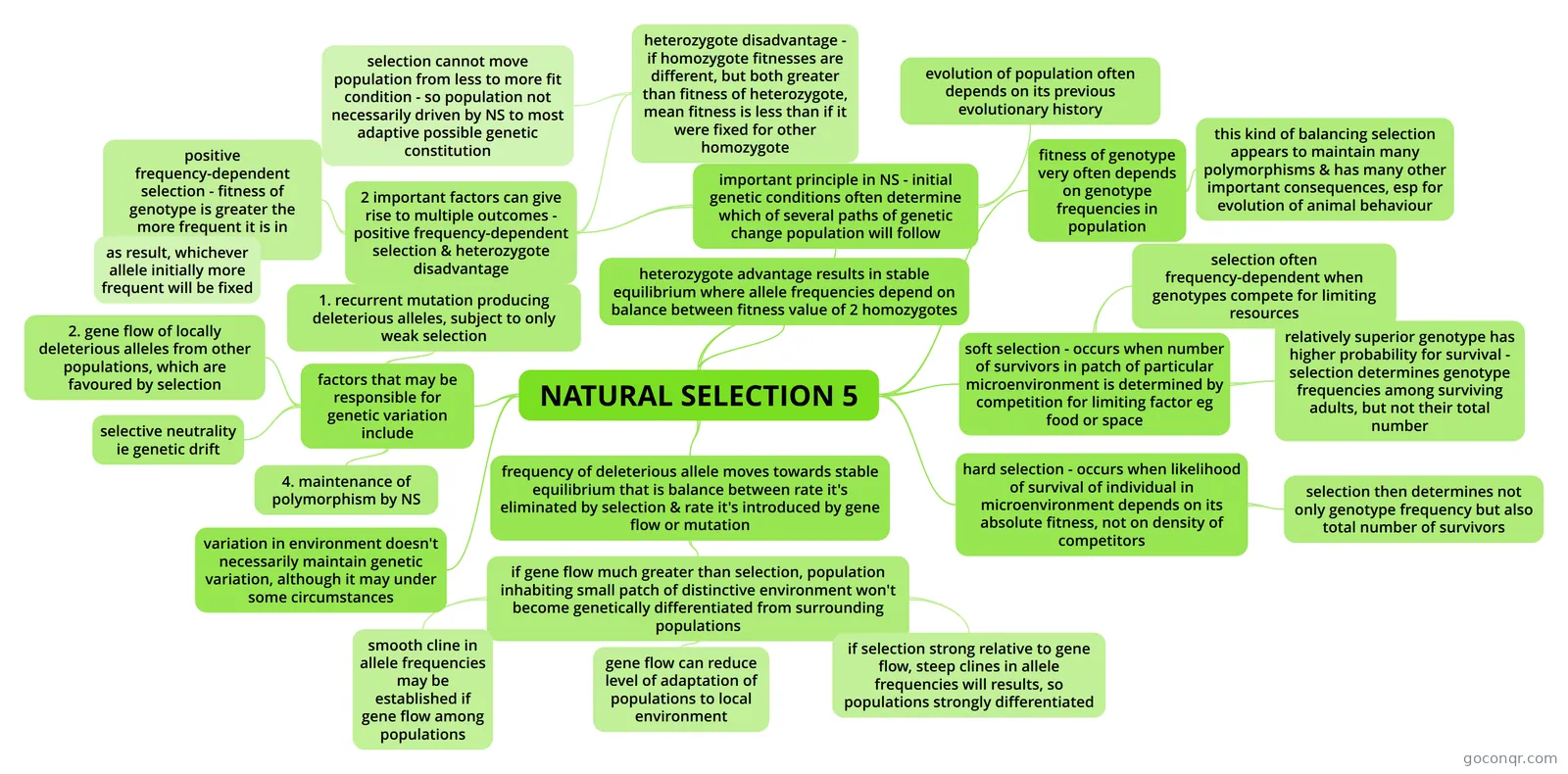
Mind map: natural selection
Contenido del mapa
NATURAL SELECTION 5
frequency of deleterious allele moves towards stable equilibrium that is balance between rate it's eliminated by selection & rate it's introduced by gene flow or mutation
- if gene flow much greater than selection, population inhabiting small patch of distinctive environment won't become genetically differentiated from surrounding populations
- smooth cline in allele frequencies may be established if gene flow among populations
- if selection strong relative to gene flow, steep clines in allele frequencies will results, so populations strongly differentiated
- gene flow can reduce level of adaptation of populations to local environment
- if gene flow much greater than selection, population inhabiting small patch of distinctive environment won't become genetically differentiated from surrounding populations
factors that may be responsible for genetic variation include
- 1. recurrent mutation producing deleterious alleles, subject to only weak selection
- 2. gene flow of locally deleterious alleles from other populations, which are favoured by selection
- selective neutrality ie genetic drift
- 4. maintenance of polymorphism by NS
heterozygote advantage results in stable equilibrium where allele frequencies depend on balance between fitness value of 2 homozygotes
variation in environment doesn't necessarily maintain genetic variation, although it may under some circumstances
soft selection - occurs when number of survivors in patch of particular microenvironment is determined by competition for limiting factor eg food or space
- relatively superior genotype has higher probability for survival - selection determines genotype frequencies among surviving adults, but not their total number
- selection often frequency-dependent when genotypes compete for limiting resources
hard selection - occurs when likelihood of survival of individual in microenvironment depends on its absolute fitness, not on density of competitors
- selection then determines not only genotype frequency but also total number of survivors
fitness of genotype very often depends on genotype frequencies in population
- this kind of balancing selection appears to maintain many polymorphisms & has many other important consequences, esp for evolution of animal behaviour
important principle in NS - initial genetic conditions often determine which of several paths of genetic change population will follow
- evolution of population often depends on its previous evolutionary history
- 2 important factors can give rise to multiple outcomes - positive frequency-dependent selection & heterozygote disadvantage
- positive frequency-dependent selection - fitness of genotype is greater the more frequent it is in population
- as result, whichever allele initially more frequent will be fixed
- heterozygote disadvantage - if homozygote fitnesses are different, but both greater than fitness of heterozygote, mean fitness is less than if it were fixed for other homozygote
- selection cannot move population from less to more fit condition - so population not necessarily driven by NS to most adaptive possible genetic constitution
- positive frequency-dependent selection - fitness of genotype is greater the more frequent it is in population
Información
- Descripción
- Mapa Mental sobre NATURAL SELECTION 5, creado por tomking304 el 09/09/2013.
- Creado por
- tomking304
- Visitas
- 52
- Valoración