
Mapa mental
ENERGY
Contenido del mapa
ENERGY
Energy Transfers
- Energy Stores
- Thermal(heat)-In an object of high temp.
- Magnetic-In magnetic forces between magnetic poles
- Electrostatic-In electrical forces between charges
- Kinetic energy(KE)-In a moving object
- Gravitational Potential(GP)-Used to describe the energy stored in an object because of its position above the Earth's surface due to the force of gravity acting on the object
- Elastic Potential(EP)-In stretchy,squashed,twisted objects
- Chemical-In food,fuels,batteries
- Nuclear-In immensely strong forces in atomic nuclei
- Chemical-In food,fuels,batteries
- Elastic Potential(EP)-In stretchy,squashed,twisted objects
- Gravitational Potential(GP)-Used to describe the energy stored in an object because of its position above the Earth's surface due to the force of gravity acting on the object
- Kinetic energy(KE)-In a moving object
- Electrostatic-In electrical forces between charges
- Magnetic-In magnetic forces between magnetic poles
- Thermal(heat)-In an object of high temp.
- The unit for energy is joules(J)/kilojoules(kJ)
- Efficiency-Measure of how good a device is at transferring energy usefully
- Calculation-Useful energy/total energy input.This can be multiplied by 100 to get the total energy efficiency
- How energy can be transferred from 1 store to another
- Mechanically-When a force acts and something moves
- Electrically-When a current flows
- Heating-Because of a temp. difference
- Radiation-Transferred in waves such as light,microwaves,sound
- Heating-Because of a temp. difference
- Electrically-When a current flows
- Mechanically-When a force acts and something moves
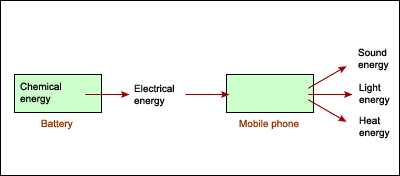
- Energy transfers from 1 store to another by following an energy pathway
- In an energy flow diagram,the energy stores are drawn as boxes and the energy pathways as arrows
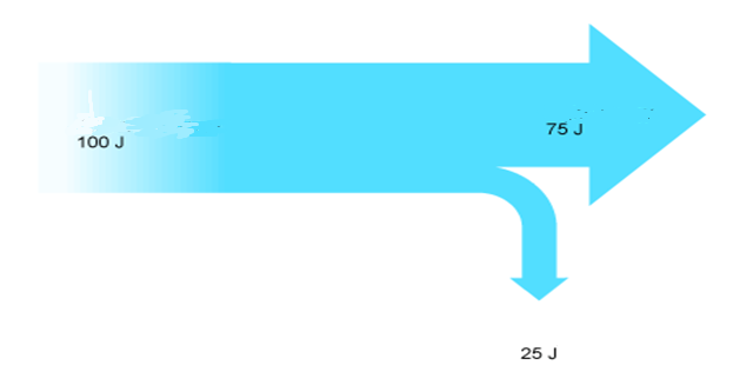
- Energy transfers are represented using a Sankey diagram.Useful energy transfers go straight through and wasted energy transfers are usually shown with an arrow pointing downwards
- Top arrow is the useful energy transfer
- Bottom arrow is wasted energy transfer
- When an object falls and gains speed,its store of GPE store decreases and its kinetic energy store increases due to the force of gravity acting on the object.
- When a falling object hits the ground without bouncing back,its kinetic energy store decreases and some/all of its energy is transferred to the surroundings The thermal energy store of the surroundings increases as the kinetic energy store transfers thermal energy to the thermal energy store in the surroundings which is an increase and the energy also transfers sound waves to its surroundings,which is why you hear a 'thud' noise when something drops and doesn't bounce back
- Summary:GPE decreases,kinetic energy increases which causes heating and sound on impact
- GPE-Gravitational Potential Energy
- Summary:GPE decreases,kinetic energy increases which causes heating and sound on impact
- When a falling object hits the ground without bouncing back,its kinetic energy store decreases and some/all of its energy is transferred to the surroundings The thermal energy store of the surroundings increases as the kinetic energy store transfers thermal energy to the thermal energy store in the surroundings which is an increase and the energy also transfers sound waves to its surroundings,which is why you hear a 'thud' noise when something drops and doesn't bounce back
- Energy Stores
Conservation of energy
- Energy cannot be created or destroyed
- Conservation of energy applies to all energy changes
- A closed system is a system in which no energy transfers take place out of or into the energy stores of the system i.e.no energy can enter or leave
- Energy can be transferred between energy stores within a closed system.The total energy of the system is always the same,before and after energy transfers to other energy stores within the closed system
- a system is an object or a group of objects
- The Law of Conservation of Energy-Energy can't be created or destroyed,but can be transferred or dissipated(wasted/disperse/fade away)
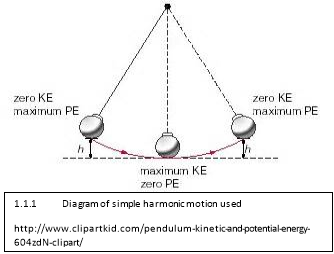
- KE-Kinetic energy, PE-Gravitational potential energy
- As pendulum swings there's friction in the fixed point(black dot),and friction as pendulum passes through air particles
- The friction causes the energy to be transferred to thermal energy
- The fixed point and air around the pendulum gradually get warmer
- These stores of energy are less useful.It's been dissipated(wasted)
- This causes the pendulum to gradually swing with less energy and eventually stop
- These stores of energy are less useful.It's been dissipated(wasted)
- The fixed point and air around the pendulum gradually get warmer
- The friction causes the energy to be transferred to thermal energy
- Reducing unwanted energy transfers
- We can reduce unwanted energy transfers by reducing friction
- Use a lubricant e.g.oil on the fixed point,which reduces friction
- Removing the air particles from around the pendulum as that prevents thermal energy
- Bungee jump
- At start of jump,all of the energy in system is store of GPE energy
- As jumper falls energy's transferred from GPE store to KE store
- As bungee rope just starts to tighten,KE store is now at its max.
- As rope's fully extended,KE is at 0 as jumper isn't moving+all energy has been transferred to EP energy store
- Bungee rope now recoils+EP energy store is transferred back to KE store
- During ascent,KE store transfers back to GPE store
- At top of ascent,all energy is back in GPE store
- During ascent,KE store transfers back to GPE store
- Bungee rope now recoils+EP energy store is transferred back to KE store
- As rope's fully extended,KE is at 0 as jumper isn't moving+all energy has been transferred to EP energy store
- As bungee rope just starts to tighten,KE store is now at its max.
- As jumper falls energy's transferred from GPE store to KE store
- Jumper never returns back to original position as energy is dissipated(wasted)as thermal energy,due to friction with hair particles as jumper passes through air. Energy also dissipated as thermal energy from stretching effects in bungee rope which isn't fully elastic,so some thermal energy is always dissipated during stretching and recoil
- At start of jump,all of the energy in system is store of GPE energy
Energy and work
- Work is done on an object when a force makes the object move
- Work-when energy is transferred do to a for being used to move an object
- Energy transferred=work done
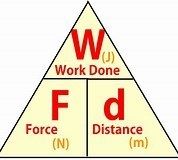
- Work done(W)=Fs, where the F is force applied and the s is the distance moved along the line of action of the force
- The force is measured in Newtons(N),the distance is measured in metres(m).Work is measured in joules(J) or newton-metres(Nm)
- E.g.A builder pushed a wheelbarrow a distance of 5.0m across flat ground with a force of 50N.How much work was done by the builder?
- The 5.0m across the flat ground is the distance moved along the line of action of the force,and the 50N is the force applied.You multiply them together(5.0mx50N)which is 250,so the work done by the builder is 250J
- The distance must be along the line of action of the force,for e.g.because weight acts vertically downwards,only the vertical distance is relevant not the horizontal or diagonal, etc.
- Whichever way you choose to keep fit,you have to apply force to move something.So the work you do causes a transfer of energy
- When a force of 1N moves an object by 1m,then 1J of work has been done
- 1 newton-metre of work=1J of work done
- The force of gravity acting on a person is the result of their weight
- Work done to overcome friction is transferred as energy to the thermal energy stores(by heating)of the object rubbing together with the surface it's moving along and the energy is also transferred to the thermal energy stores of the object's surroundings
- E.g.If you rub your hands together vigorously,your hands become warm.Your muscles fo work to overcome the friction between your hands.The work you do is transferred as energy that warms your hands
- An example of a description of energy transfers and changes to energy stores as a student pushes a box at a steady velocity(steady speed)across a level floor
- As the student moves the box along the floor, the chemical energy store in the student's muscles are transferred to the thermal energy store of the box. The student is also applying a forward force to the box but there is friction between the bottom of the box and the floor due to the bottom of the box and the floor rubbing together, which causes the temperature of the box to increase.
- Work is done on an object when a force makes the object move
Gravitational potential energy stores
- The GPE store of an object increases when it moves up and decreases when it moves down
- The GPE decrease when an object is moving down happens because work is done by the gravitational force acting on it
- The GPE increase happens because work is done on it by the lifting force to overcome the gravitational force on the object
- The GPE store of an object increases when it's lifted up because work is done on it to overcome the gravitational force
- The gravitational field strength at the surface of the Moon is less than on the Earth
- Change of GPE store(ΔEp)=mass(m)xgravitational field strength(g)xchange of height(Δh)
- The change of GPE store is measured in joules,J the mass is measured in kg the gravitational field strength is measured in newtons per kilogram,N/kg and change of height measured in metres,m. The gravitational field strength is the measure of the force of gravity.If it's for e.g.500g it has to be converted to kg and cm converted to m
- The Greek letter delta(Δ)is used to represent 'change in'.E.g.Δh can be used instead of 'change in height'
- E.g.A 2.0kg object is raised through a height of 0.4m.Calculate the increase in the GPE store of the object.The gravitational field strength of the Earth at its surface is 9.8N/kg.
- ΔEp= m g Δh=2.0kgx9.8N/kgx0.4m=7.8J
- The symbol for gravitational potential energy is Ep
- The force needed to lift an object at constant velocity is equal and opposite to the gravitational force on the object.For e.g.,you need a force of 80N to lift a box of weight 80N
- Using work done=force appliedxdistance moved in the direction of the force
- Change in object's GPE store=weightxchange of height
- GPE store measured in joules,J weight measured in newtons,N change of height measured in metres,m
- E.g.A student of weight 300N climbs on a platform that is 1.2m higher than the floor.Calculate the increase in her GPE store
- Increase of Ep=300Nx1.2m=360J
- Change in object's GPE store=weightxchange of height
- The work done on an object,moving up or down,depends on the change of height(how far it's moved vertically),and its weight
- The weight of an object in newtons=massxgravitational field strength
- Change in GPE store of an object:ΔEp=m g Δh
- The gravitational field strength of Earth at its surface is 9.8N/kg
- The difference between mass and weight is that mass is the amount of matter(what occupies the space) in a material, while weight is a measure of how the force of gravity acts upon that mass.
- Total energy gained is an increase of Ep and total energy lost is a decrease of Ep
- To work out the efficiency of an object,you divide the useful energy transfer by the total energy transferred and x by 100 to get the % which is the efficiency
- If the mass is in kg you ALWAYS multiply by gravitational field strength (9.8N/kg),as well as the Δh even if the field strength isn't given.
- The GPE store of an object increases when it moves up and decreases when it moves down
Imágenes y archivos del mapa
Información
- Descripción
- Year 9 (Physics revision) Physics Mapa Mental sobre ENERGY, creado por Gbubemi Arenyeka el 25/03/2020.
- Creado por
- Gbubemi Arenyeka
- Visitas
- 1
- Valoración