
Mapa mental
Evidence for evolution
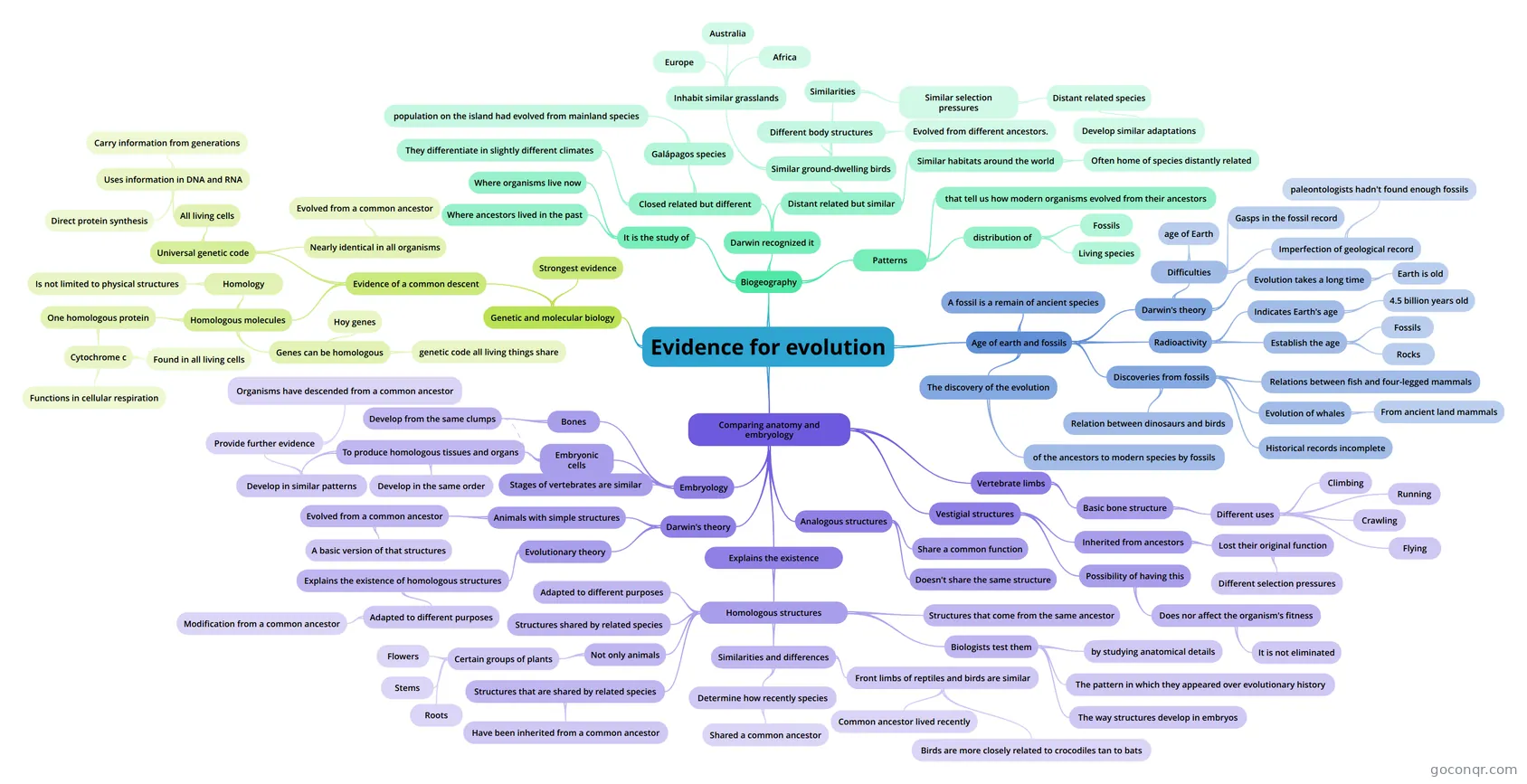
Mind map: Evidence for evolution
Contenido del mapa
Evidence for evolution
Biogeography
- It is the study of
- Where organisms live now
- Where ancestors lived in the past
- Darwin recognized it
- Closed related but different
- They differentiate in slightly different climates
- Galápagos species
- population on the island had evolved from mainland species
- Distant related but similar
- Similar habitats around the world
- Often home of species distantly related
- Similar ground-dwelling birds
- Inhabit similar grasslands
- Europe
- Australia
- Africa
- Different body structures
- Evolved from different ancestors.
- Similarities
- Similar selection pressures
- Distant related species
- Develop similar adaptations
- Distant related species
- Similar selection pressures
- Inhabit similar grasslands
- Similar habitats around the world
- Closed related but different
- Patterns
- that tell us how modern organisms evolved from their ancestors
- distribution of
- Living species
- Fossils
- It is the study of
Age of earth and fossils
- The discovery of the evolution
- of the ancestors to modern species by fossils
- A fossil is a remain of ancient species
- Darwin's theory
- Difficulties
- age of Earth
- Gasps in the fossil record
- Imperfection of geological record
- paleontologists hadn't found enough fossils
- Evolution takes a long time
- Earth is old
- Difficulties
- Radioactivity
- Establish the age
- Rocks
- Fossils
- Indicates Earth's age
- 4.5 billion years old
- Establish the age
- Discoveries from fossils
- Evolution of whales
- From ancient land mammals
- Relation between dinosaurs and birds
- Relations between fish and four-legged mammals
- Historical records incomplete
- Evolution of whales
- The discovery of the evolution
Comparing anatomy and embryology
- Explains the existence
- Homologous structures
- Adapted to different purposes
- Structures shared by related species
- Structures that come from the same ancestor
- Biologists test them
- by studying anatomical details
- The way structures develop in embryos
- The pattern in which they appeared over evolutionary history
- Structures that are shared by related species
- Have been inherited from a common ancestor
- Similarities and differences
- Determine how recently species
- Shared a common ancestor
- Front limbs of reptiles and birds are similar
- Common ancestor lived recently
- Birds are more closely related to crocodiles tan to bats
- Determine how recently species
- Not only animals
- Certain groups of plants
- Stems
- Roots
- Flowers
- Certain groups of plants
- Homologous structures
- Analogous structures
- Share a common function
- Doesn't share the same structure
- Vertebrate limbs
- Basic bone structure
- Different uses
- Crawling
- Climbing
- Running
- Flying
- Different uses
- Basic bone structure
- Darwin's theory
- Animals with simple structures
- Evolved from a common ancestor
- A basic version of that structures
- Evolved from a common ancestor
- Evolutionary theory
- Explains the existence of homologous structures
- Adapted to different purposes
- Modification from a common ancestor
- Adapted to different purposes
- Explains the existence of homologous structures
- Animals with simple structures
- Vestigial structures
- Inherited from ancestors
- Lost their original function
- Different selection pressures
- Lost their original function
- Possibility of having this
- Does nor affect the organism's fitness
- It is not eliminated
- Does nor affect the organism's fitness
- Inherited from ancestors
- Embryology
- Stages of vertebrates are similar
- Embryonic cells
- To produce homologous tissues and organs
- Develop in similar patterns
- Provide further evidence
- Organisms have descended from a common ancestor
- Provide further evidence
- Develop in the same order
- Develop in similar patterns
- To produce homologous tissues and organs
- Bones
- Develop from the same clumps
- Explains the existence
Genetic and molecular biology
- Strongest evidence
- Evidence of a common descent
- Universal genetic code
- All living cells
- Uses information in DNA and RNA
- Carry information from generations
- Direct protein synthesis
- Uses information in DNA and RNA
- Nearly identical in all organisms
- Evolved from a common ancestor
- All living cells
- Homologous molecules
- Homology
- Is not limited to physical structures
- One homologous protein
- Cytochrome c
- Found in all living cells
- Functions in cellular respiration
- Cytochrome c
- Genes can be homologous
- genetic code all living things share
- Hoy genes
- Homology
- Universal genetic code
Información
- Descripción
- Mapa Mental sobre Evidence for evolution, creado por Diana Marcela Arellano Dubón el 09/06/2020.
- Creado por
- Diana Marcela Arellano Dubón
- Visitas
- 0
- Valoración
Más sobre Evidence for Evolution