
Mapa mental
Mary Warren
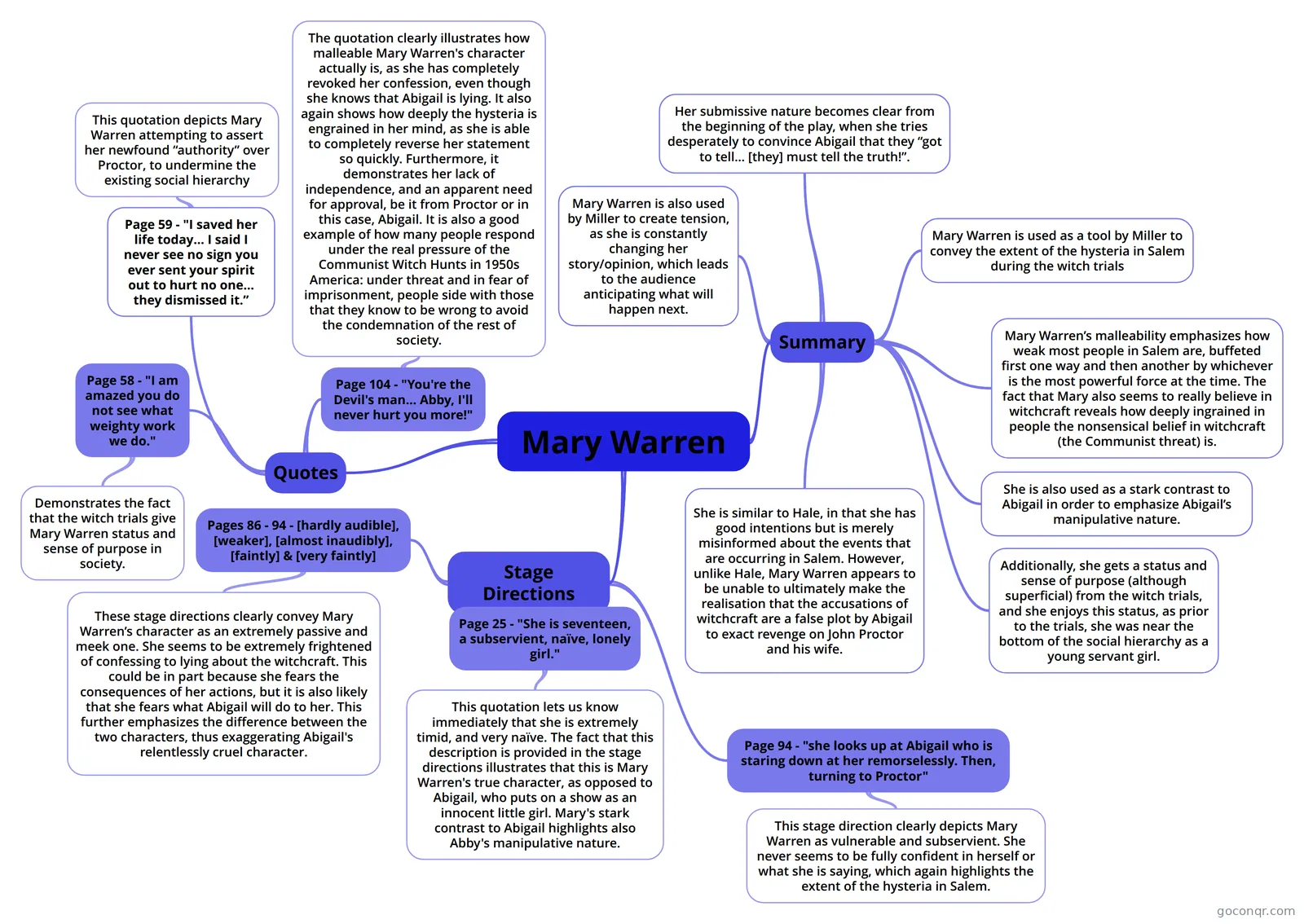
Mind map: Mary Warren in The Crucible
Contenido del mapa
Mary Warren
Summary
- Her submissive nature becomes clear from the beginning of the play, when she tries desperately to convince Abigail that they “got to tell… [they] must tell the truth!”.
- Mary Warren is used as a tool by Miller to convey the extent of the hysteria in Salem during the witch trials
- Mary Warren’s malleability emphasizes how weak most people in Salem are, buffeted first one way and then another by whichever is the most powerful force at the time. The fact that Mary also seems to really believe in witchcraft reveals how deeply ingrained in people the nonsensical belief in witchcraft (the Communist threat) is.
- She is also used as a stark contrast to Abigail in order to emphasize Abigail’s manipulative nature.
- She is similar to Hale, in that she has good intentions but is merely misinformed about the events that are occurring in Salem. However, unlike Hale, Mary Warren appears to be unable to ultimately make the realisation that the accusations of witchcraft are a false plot by Abigail to exact revenge on John Proctor and his wife.
- Additionally, she gets a status and sense of purpose (although superficial) from the witch trials, and she enjoys this status, as prior to the trials, she was near the bottom of the social hierarchy as a young servant girl.
- Mary Warren is also used by Miller to create tension, as she is constantly changing her story/opinion, which leads to the audience anticipating what will happen next.
Quotes
- Page 58 - "I am amazed you do not see what weighty work we do."
- Demonstrates the fact that the witch trials give Mary Warren status and sense of purpose in society.
- Page 59 - "I saved her life today… I said I never see no sign you ever sent your spirit out to hurt no one… they dismissed it.”
- This quotation depicts Mary Warren attempting to assert her newfound “authority” over Proctor, to undermine the existing social hierarchy
- Page 104 - "You're the Devil's man… Abby, I'll never hurt you more!"
- The quotation clearly illustrates how malleable Mary Warren's character actually is, as she has completely revoked her confession, even though she knows that Abigail is lying. It also again shows how deeply the hysteria is engrained in her mind, as she is able to completely reverse her statement so quickly. Furthermore, it demonstrates her lack of independence, and an apparent need for approval, be it from Proctor or in this case, Abigail. It is also a good example of how many people respond under the real pressure of the Communist Witch Hunts in 1950s America: under threat and in fear of imprisonment, people side with those that they know to be wrong to avoid the condemnation of the rest of society.
- Page 58 - "I am amazed you do not see what weighty work we do."
Stage Directions
- Page 25 - "She is seventeen, a subservient, naïve, lonely girl."
- This quotation lets us know immediately that she is extremely timid, and very naïve. The fact that this description is provided in the stage directions illustrates that this is Mary Warren's true character, as opposed to Abigail, who puts on a show as an innocent little girl. Mary's stark contrast to Abigail highlights also Abby's manipulative nature.
- Pages 86 - 94 - [hardly audible], [weaker], [almost inaudibly], [faintly] & [very faintly]
- These stage directions clearly convey Mary Warren’s character as an extremely passive and meek one. She seems to be extremely frightened of confessing to lying about the witchcraft. This could be in part because she fears the consequences of her actions, but it is also likely that she fears what Abigail will do to her. This further emphasizes the difference between the two characters, thus exaggerating Abigail's relentlessly cruel character.
- Page 94 - "she looks up at Abigail who is staring down at her remorselessly. Then, turning to Proctor"
- This stage direction clearly depicts Mary Warren as vulnerable and subservient. She never seems to be fully confident in herself or what she is saying, which again highlights the extent of the hysteria in Salem.
- Page 25 - "She is seventeen, a subservient, naïve, lonely girl."
Información
- Descripción
- GCSE (The Crucible) Literature Mapa Mental sobre Mary Warren, creado por rebeccachelsea el 04/04/2015.
- Creado por
- rebeccachelsea
- Visitas
- 1
- Valoración