
Mapa mental
C3
Contenido del mapa
C3
Water
- Hard Water
- Needs more soap to form a lather
- Because it contains dissolved compounds that react with the soap
- Forms Scum
- Soapless detergents dont react witht he hard water to form scum
- Because it contains dissolved compounds that react with the soap
- Contain Mg 2+ ions or Ca 2+ ions
- Temporary Hard water - when heated - reacts and forms scale
- Deposited in kettles etc.
- Calcium ions are good for teeth & bones and reduce the risk of Heart Disease
- Needs more soap to form a lather
- Removing Hardness
- Made soft when Mg 2+ ions & Ca 2+ ions are removed
- Tempory hard water made soft when heated as the Mg 2+ ions & Ca 2+ ions react
- Can also be removed using sodium carbonate that reacts with the calcium ions to form calcium carbonate
- Or removed using an Ion exchange column, that swaps sodium ions for Mg 2+ ions & Ca 2+ ions
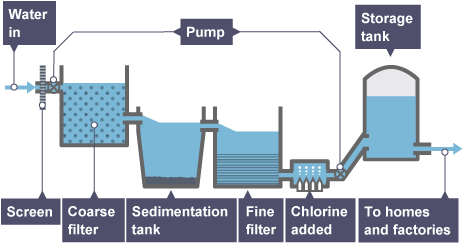
- Water treatment
- The stages of treatment - Not shown in the pictrure; Aluminium sulfate is added to clump small bits of sediment together in the sedementation tank
- Hard Water
Periodic Table
- Early Periodic Table
- They arranged the elements in atomic weight rather than in proton numbers
- 1863 - Newlands proposed his Law of Octaves
- It stated there would be similar properties every eigth element
- Didnt work after the 20 element - Calcium
- Mendeleev - 1869
- He left gaps for undiscovered elements
- This left elements with similar elements
- When missing elements werer discovered, Mendeleev's predictions were confirmed
- He left gaps for undiscovered elements
- Modern periodic Table
- Now aranged in proton number
- Groups have similar properties as they have the same number of electreons on the outer shell
- Alkali Metals
- Group 1
- 1 electron in outer shell
- Soft Solids at room temp.
- Low Density
- React with Halogens to form salts that are white/colourless
- Group 1
- Transition Metals
- Middle of table
- Malleable & Ductile
- Strong and dense
- Often used as alloys for building
- Halogens
- Non - Metals & in group 7
- 7 electrons in outer shell
- Early Periodic Table
Energy & Fuel
- Energy Released when oxidation occurs e.g. when food reacts with water
- Use a calorimeter to Measure this
- Work out the amount of energy transferred using the equation
- Q = m c *T
- Energy Transferred = mass of substance X Specific heat capacity X Temp. change
- E.G ~ Q=m c *T
- Q = 200g X 4.2 X 30
- Q = 25200 J
- = 25.2 KJ
- Q = 25200 J
- Q = 200g X 4.2 X 30
- E.G ~ Q=m c *T
- Energy Transferred = mass of substance X Specific heat capacity X Temp. change
- * represents delta
- Q = m c *T
- Work out the amount of energy transferred using the equation
- Use a calorimeter to Measure this
- When we work out the energy transfer in solutions we:
- Assume it has the same properties of water: 1cm3 = 1g & it has a specific heat capacity of 4.2
- This stays the same even if a solid is added
- Assume it has the same properties of water: 1cm3 = 1g & it has a specific heat capacity of 4.2
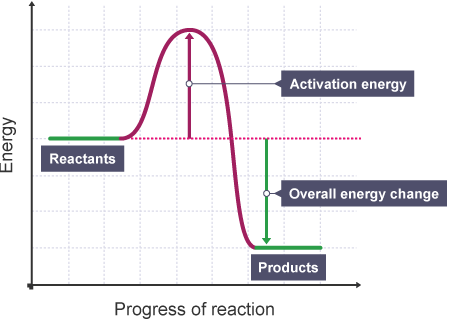
- Energy Level Diagrams
- An energy level diagram of an exothermic reaction
- It is exothermic as the energy of the products is less than the reactants
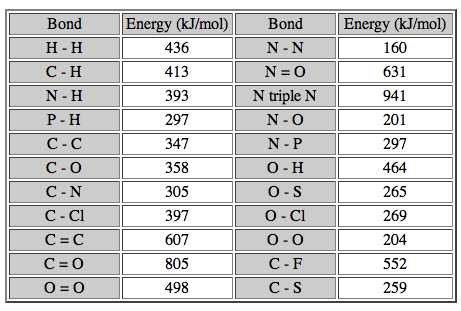
- Bond Energies
- It is the energy required to make or break a bond
- Energy Change is 'Bonds Made' - 'Bonds Broken'
- It is the energy required to make or break a bond
- Fuel Issues
- Fossil fuels are running out - new fuels need to be developed
- Hydrogen - Can be used in fuels cells or burnt in a combustion engine
- Ads - burns easily, release a large amount of energy per gram, produces no C02 when burnt only water
- Dis - the supply, storage of the gas, safety problems
- Fuel cell vehicles need to match normal vehicles in; performance, convienience & costs
- Energy Released when oxidation occurs e.g. when food reacts with water
Analysis and synthesis
- Positve Ions
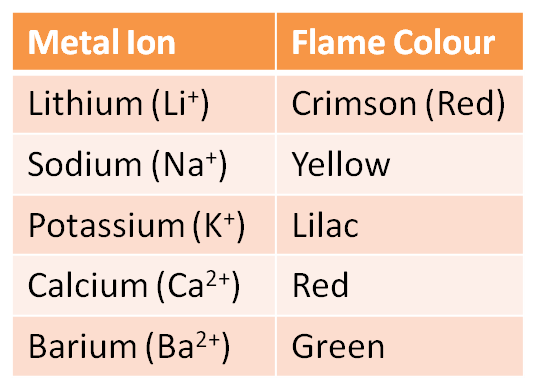
- Flame Test
- Dip a clean flame test loop in the sample solution. Hold the flame test loop at the edge of a Bunsen burner flame. Observe the changed colour of the flame, and decide which metal it indicates. Clean the loop in acid and rinse with water, then repeat steps 1 to 3 with a new sample
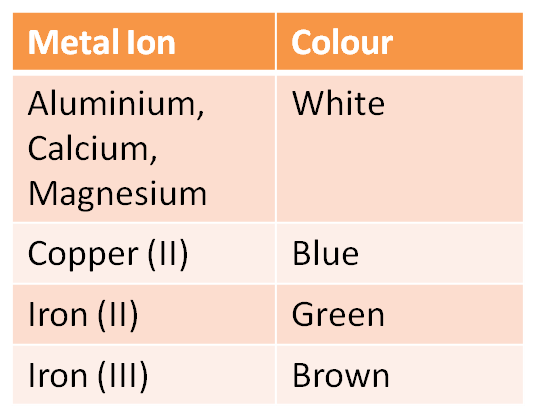
- Most of the Metal hydoxides are insolouble - Some have colurs and so we can identify them from that
- The reaction is the ion + sodium hydroxide
- When excess NaOH is added to AlOH the AlOH precipitate dissolves
- Flame Test
- Negative Ions
- Carbonate Ions
- Add HCl to substances if there is a gas produced and it turns limewater milky it contains carbonate ions
- Halide Ions
- Add Nitric acid, then silver nitrate
- Chloride ion - white precipitate
- Bromide ions = Cream Precipitate
- Iodide ions = Yellow precipitate
- Add Nitric acid, then silver nitrate
- Sulphate ions
- Add dilute HCl, the barium chloride. If white precipitate forms, sulphate ion present.
- Carbonate Ions
- Titrations
- When an Acid and alkali react, a neutralisation reaction occurs
- The volumes of acid & alkali that react exactly can be found using titration
- 1. Use a pipette to add the correct volume of Alkaline to a conical flask
- Add a few drops of indicator to the alkali
- Fill a burette with acid. Remove any bubbles by opening the stopcock
- Record the start measuremnt on the burette & slowly add acid to the solution and swirl the conical flask.
- When the solution changes colour, close the stopcock and record the reading on the burette. Work out the difference.
- Repeat for improved reliability
- When the solution changes colour, close the stopcock and record the reading on the burette. Work out the difference.
- Record the start measuremnt on the burette & slowly add acid to the solution and swirl the conical flask.
- Fill a burette with acid. Remove any bubbles by opening the stopcock
- Add a few drops of indicator to the alkali
- When an Acid and alkali react, a neutralisation reaction occurs
- Positve Ions
Imágenes y archivos del mapa
Información
- Descripción
- The first part of 2. Mind map covering C3
- Creado por
- Lewis Appleton-Jones · may 2015
- Actualizado
- 6 abr 2018
- Visitas
- 68
- Etiquetas
- Valoración