
Mapa mental
Modal verbs
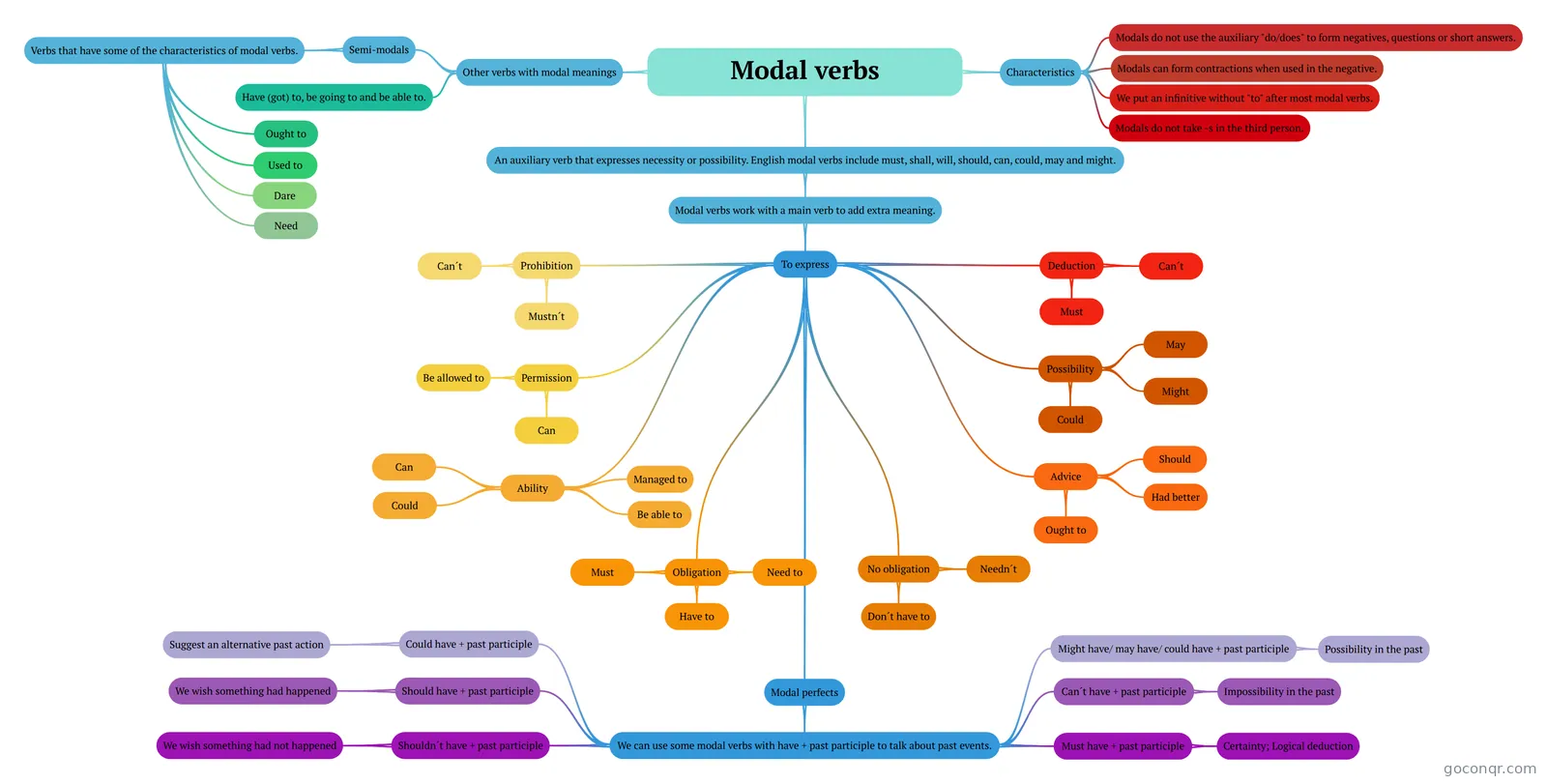
Mind map: Modal verbs
Contenido del mapa
Modal verbs
An auxiliary verb that expresses necessity or possibility. English modal verbs include must, shall, will, should, can, could, may and might.
- Modal verbs work with a main verb to add extra meaning.
- To express
- Prohibition
- Can´t
- Mustn´t
- Permission
- Can
- Be allowed to
- Ability
- Managed to
- Can
- Be able to
- Could
- Obligation
- Must
- Have to
- Need to
- No obligation
- Don´t have to
- Needn´t
- Advice
- Should
- Ought to
- Had better
- Possibility
- May
- Might
- Could
- Deduction
- Can´t
- Must
- Modal perfects
- We can use some modal verbs with have + past participle to talk about past events.
- Must have + past participle
- Certainty; Logical deduction
- Can´t have + past participle
- Impossibility in the past
- Might have/ may have/ could have + past participle
- Possibility in the past
- Could have + past participle
- Suggest an alternative past action
- Should have + past participle
- We wish something had happened
- Shouldn´t have + past participle
- We wish something had not happened
- Must have + past participle
- We can use some modal verbs with have + past participle to talk about past events.
- Prohibition
- To express
- Modal verbs work with a main verb to add extra meaning.
Characteristics
- We put an infinitive without "to" after most modal verbs.
- Modals do not take -s in the third person.
- Modals do not use the auxiliary "do/does" to form negatives, questions or short answers.
- Modals can form contractions when used in the negative.
Other verbs with modal meanings
- Semi-modals
- Verbs that have some of the characteristics of modal verbs.
- Dare
- Need
- Ought to
- Used to
- Verbs that have some of the characteristics of modal verbs.
- Have (got) to, be going to and be able to.
- Semi-modals
Información
- Descripción
- Mapa Mental sobre Modal verbs, creado por Nerea ZM el 05/03/2021.
- Creado por
- Nerea ZM
- Visitas
- 0
- Valoración