
Mapa mental
Modal verbs
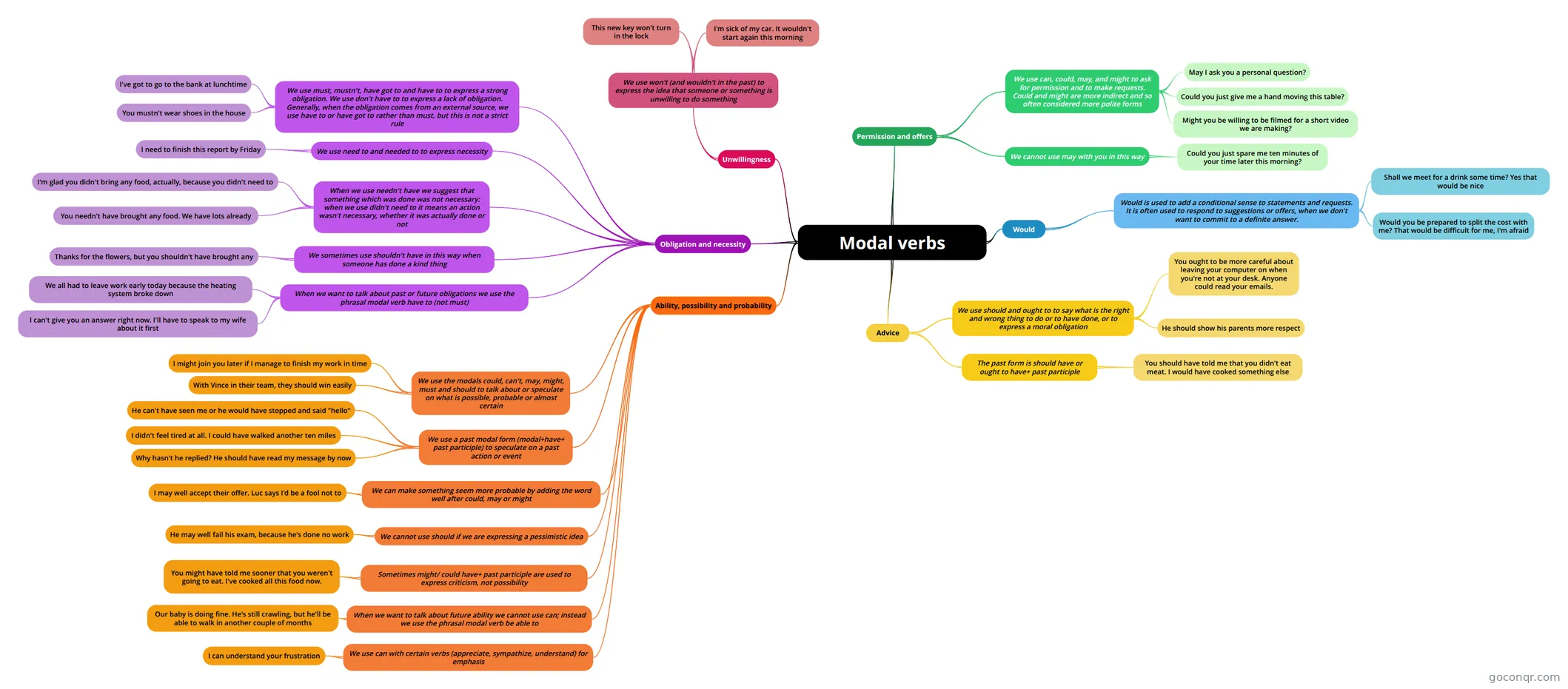
Mind map: Modal verbs
Contenido del mapa
Modal verbs
Obligation and necessity
- We use must, mustn't, have got to and have to to express a strong obligation. We use don't have to to express a lack of obligation. Generally, when the obligation comes from an external source, we use have to or have got to rather than must, but this is not a strict rule
- I've got to go to the bank at lunchtime
- You mustn't wear shoes in the house
- We use need to and needed to to express necessity
- I need to finish this report by Friday
- When we use needn't have we suggest that something which was done was not necessary: when we use didn't need to it means an action wasn't necessary, whether it was actually done or not
- I'm glad you didn't bring any food, actually, because you didn't need to
- You needn't have brought any food. We have lots already
- We sometimes use shouldn't have in this way when someone has done a kind thing
- Thanks for the flowers, but you shouldn't have brought any
- When we want to talk about past or future obligations we use the phrasal modal verb have to (not must)
- We all had to leave work early today because the heating system broke down
- I can't give you an answer right now. I'll have to speak to my wife about it first
- We use must, mustn't, have got to and have to to express a strong obligation. We use don't have to to express a lack of obligation. Generally, when the obligation comes from an external source, we use have to or have got to rather than must, but this is not a strict rule
Ability, possibility and probability
- We use the modals could, can't, may, might, must and should to talk about or speculate on what is possible, probable or almost certain
- I might join you later if I manage to finish my work in time
- With Vince in their team, they should win easily
- We use a past modal form (modal+have+ past participle) to speculate on a past action or event
- He can't have seen me or he would have stopped and said "hello"
- I didn't feel tired at all. I could have walked another ten miles
- Why hasn't he replied? He should have read my message by now
- We can make something seem more probable by adding the word well after could, may or might
- I may well accept their offer. Luc says I'd be a fool not to
- We cannot use should if we are expressing a pessimistic idea
- He may well fail his exam, because he's done no work
- Sometimes might/ could have+ past participle are used to express criticism, not possibility
- You might have told me sooner that you weren't going to eat. I've cooked all this food now.
- When we want to talk about future ability we cannot use can; instead we use the phrasal modal verb be able to
- Our baby is doing fine. He's still crawling, but he'll be able to walk in another couple of months
- We use can with certain verbs (appreciate, sympathize, understand) for emphasis
- I can understand your frustration
- We use the modals could, can't, may, might, must and should to talk about or speculate on what is possible, probable or almost certain
Advice
- We use should and ought to to say what is the right and wrong thing to do or to have done, or to express a moral obligation
- You ought to be more careful about leaving your computer on when you're not at your desk. Anyone could read your emails.
- He should show his parents more respect
- The past form is should have or ought to have+ past participle
- You should have told me that you didn't eat meat. I would have cooked something else
- We use should and ought to to say what is the right and wrong thing to do or to have done, or to express a moral obligation
Unwillingness
- We use won't (and wouldn't in the past) to express the idea that someone or something is unwilling to do something
- This new key won't turn in the lock
- I'm sick of my car. It wouldn't start again this morning
- We use won't (and wouldn't in the past) to express the idea that someone or something is unwilling to do something
Permission and offers
- We use can, could, may, and might to ask for permission and to make requests. Could and might are more indirect and so often considered more polite forms
- May I ask you a personal question?
- Could you just give me a hand moving this table?
- Might you be willing to be filmed for a short video we are making?
- We cannot use may with you in this way
- Could you just spare me ten minutes of your time later this morning?
- We use can, could, may, and might to ask for permission and to make requests. Could and might are more indirect and so often considered more polite forms
Would
- Would is used to add a conditional sense to statements and requests. It is often used to respond to suggestions or offers, when we don't want to commit to a definite answer.
- Shall we meet for a drink some time? Yes that would be nice
- Would you be prepared to split the cost with me? That would be difficult for me, I'm afraid
- Would is used to add a conditional sense to statements and requests. It is often used to respond to suggestions or offers, when we don't want to commit to a definite answer.
Información
- Descripción
- Mapa Mental sobre Modal verbs, creado por Blanca Simon el 12/11/2021.
- Creado por
- Blanca Simon
- Visitas
- 0
- Valoración