
Mapa mental
Scientific Method
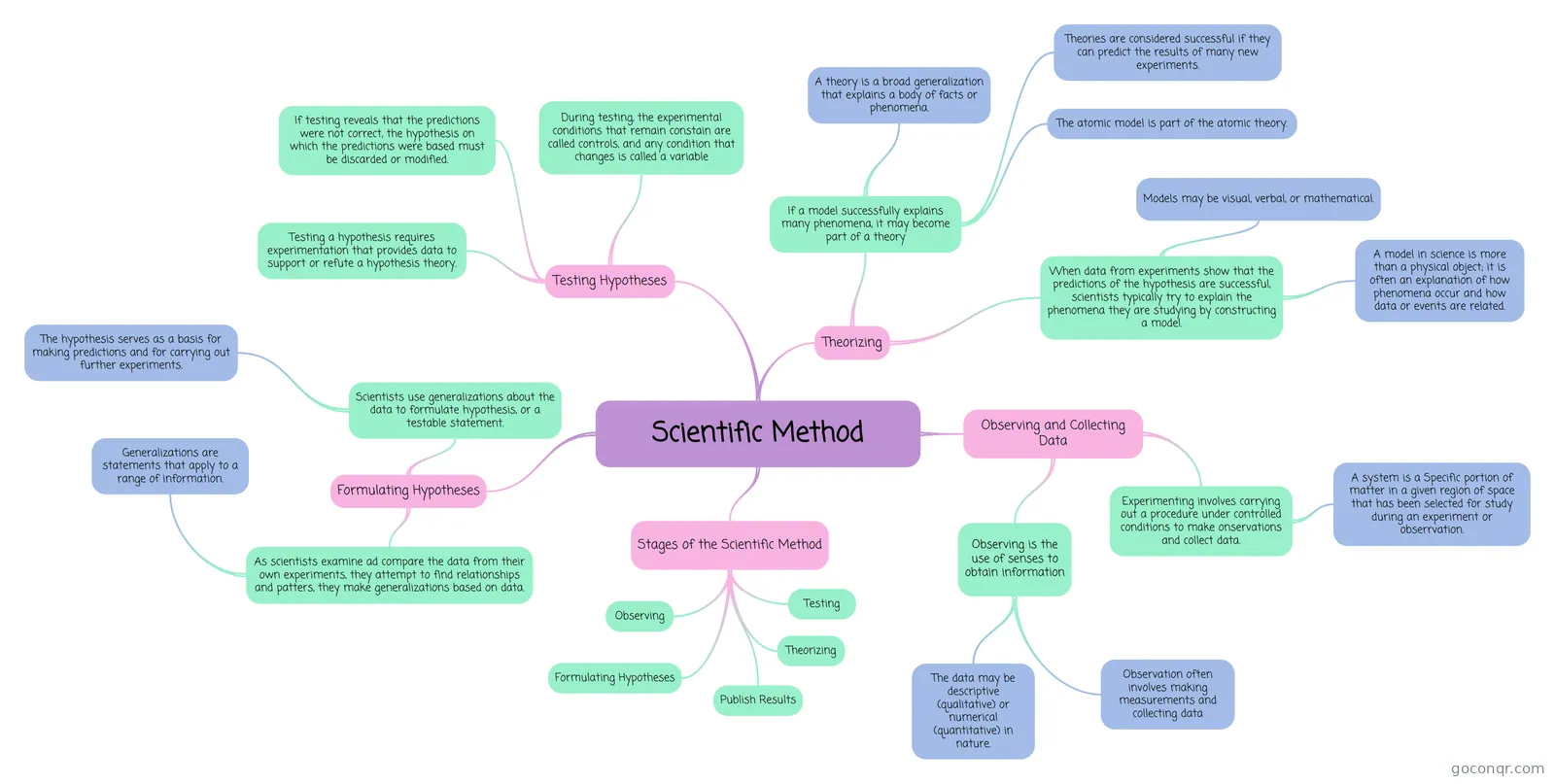
Mind map: Scientific method
Contenido del mapa
Scientific Method
Stages of the Scientific Method
- Observing
- Formulating Hypotheses
- Testing
- Publish Results
- Theorizing
Observing and Collecting Data
- Observing is the use of senses to obtain information
- Observation often involves making measurements and collecting data
- The data may be descriptive (qualitative) or numerical (quantitative) in nature.
- Experimenting involves carrying out a procedure under controlled conditions to make onservations and collect data.
- A system is a Specific portion of matter in a given region of space that has been selected for study during an experiment or obserrvation.
- Observing is the use of senses to obtain information
Formulating Hypotheses
- As scientists examine ad compare the data from their own experiments, they attempt to find relationships and patters, they make generalizations based on data.
- Generalizations are statements that apply to a range of information.
- Scientists use generalizations about the data to formulate hypothesis, or a testable statement.
- The hypothesis serves as a basis for making predictions and for carrying out further experiments.
- As scientists examine ad compare the data from their own experiments, they attempt to find relationships and patters, they make generalizations based on data.
Testing Hypotheses
- Testing a hypothesis requires experimentation that provides data to support or refute a hypothesis theory.
- During testing, the experimental conditions that remain constain are called controls, and any condition that changes is called a variable
- If testing reveals that the predictions were not correct, the hypothesis on which the predictions were based must be discarded or modified.
Theorizing
- When data from experiments show that the predictions of the hypothesis are successful, scientists typically try to explain the phenomena they are studying by constructing a model.
- A model in science is more than a physical object; it is often an explanation of how phenomena occur and how data or events are related.
- Models may be visual, verbal, or mathematical.
- If a model successfully explains many phenomena, it may become part of a theory
- The atomic model is part of the atomic theory.
- A theory is a broad generalization that explains a body of facts or phenomena.
- Theories are considered successful if they can predict the results of many new experiments.
- When data from experiments show that the predictions of the hypothesis are successful, scientists typically try to explain the phenomena they are studying by constructing a model.
Información
- Descripción
- Mapa Mental sobre Scientific Method, creado por Fernanda Cáceres el 01/03/2022.
- Creado por
- Fernanda Cáceres
- Visitas
- 0
- Valoración