
Mapa mental
Object relations
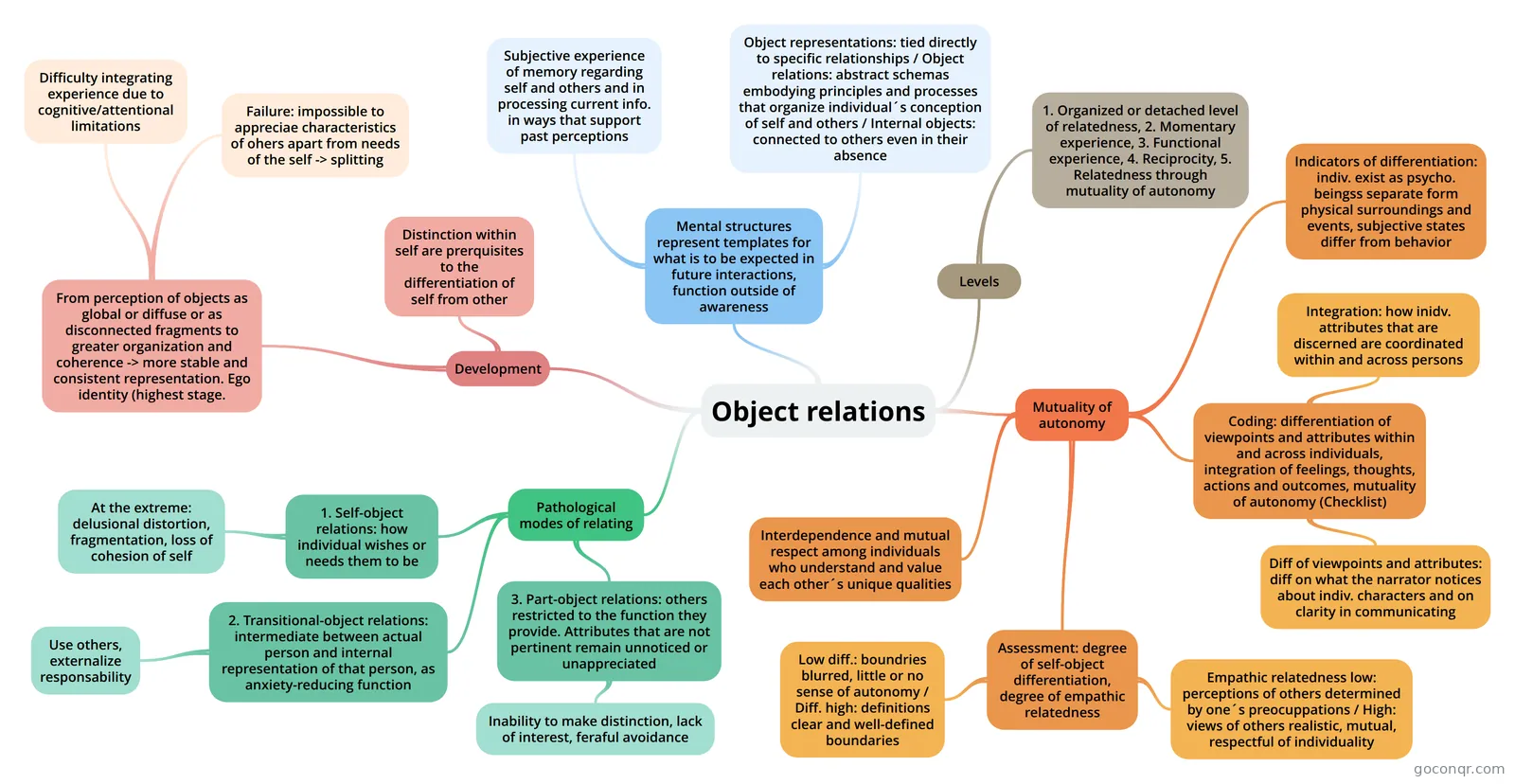
Mind map: Object relations
Contenido del mapa
Object relations
Mental structures represent templates for what is to be expected in future interactions, function outside of awareness
- Subjective experience of memory regarding self and others and in processing current info. in ways that support past perceptions
- Object representations: tied directly to specific relationships / Object relations: abstract schemas embodying principles and processes that organize individual´s conception of self and others / Internal objects: connected to others even in their absence
Development
- Distinction within self are prerquisites to the differentiation of self from other
- From perception of objects as global or diffuse or as disconnected fragments to greater organization and coherence -> more stable and consistent representation. Ego identity (highest stage.
- Failure: impossible to appreciae characteristics of ohers apart from needs of the self -> splitting
- Difficulty integrating experience due to cognitive/attentional limitations
Pathological modes of relating
- 1. Self-object relations: how individual wishes or needs them to be
- At the extreme: delusional distortion, fragmentation, loss of cohesion of self
- 2. Transitional-object relations: intermediate between actual person and internal representation of that person, as anxiety-reducing function
- Use others, externalize responsability
- 3. Part-object relations: others restricted to the function they provide. Attributes that are not pertinent remain unnoticed or unappreciated
- Inability to make distinction, lack of interest, feraful avoidance
- 1. Self-object relations: how individual wishes or needs them to be
Mutuality of autonomy
- Interdependence and mutual respect among individuals who understand and value each other´s unique qualities
- Assessment: degree of self-object differentiation, degree of empathic relatedness
- Low diff.: boundries blurred, little or no sense of autonomy / Diff. high: definitions clear and well-defined boundaries
- Empathic relatedness low: perceptions of others determined by one´s preocuppations / High: views of others realistic, mutual, respectful of individuality
- Coding: differentiation of viewpoints and attributes within and across individuals, integration of feelings, thoughts, actions and outcomes, mutuality of autonomy (Checklist)
- Diff of viewpoints and attributes: diff on what the narrator notices about indiv. characters and on clarity in communicating
- Integration: how inidv. attributes that are discerned are coordinated within and across persons
- Indicators of differentiation: indiv. exist as psycho. beingss separate form physical surroundings and events, subjective states differ from behavior
Levels
- 1. Organized or detached level of relatedness, 2. Momentary experience, 3. Functional experience, 4. Reciprocity, 5. Relatedness through mutuality of autonomy
Información
- Descripción
- Mapa Mental sobre Object relations, creado por Silvana Mendoza el 24/03/2022.
- Creado por
- Silvana Mendoza
- Visitas
- 0
- Valoración
Más sobre Object Relations Theory