
Mapa mental
Multiculturalism
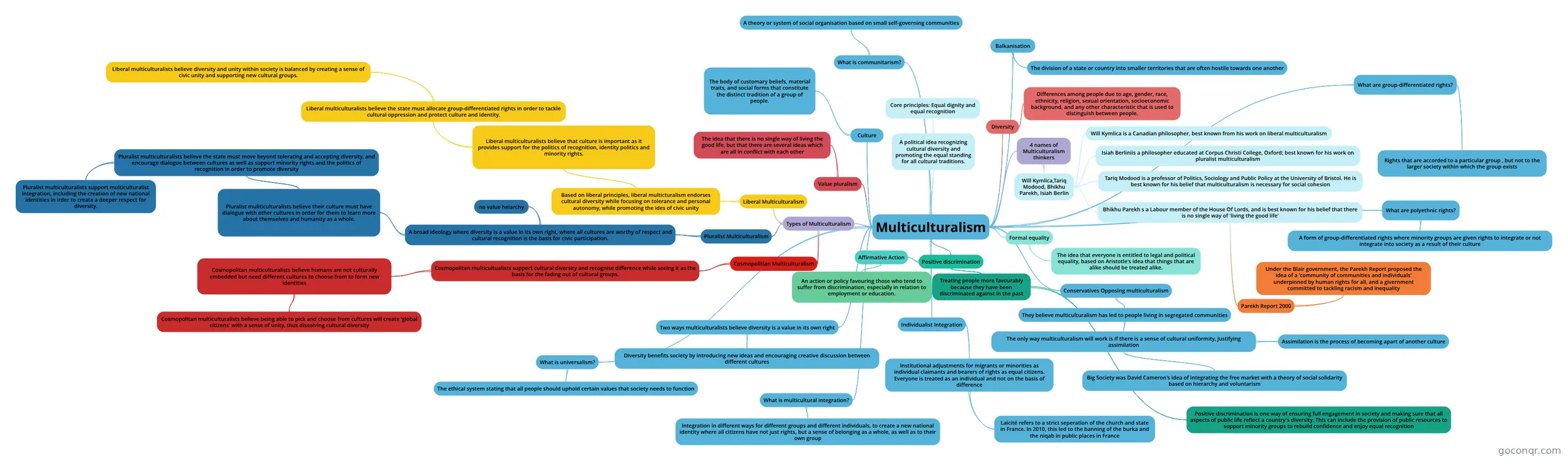
Mind map: Multiculturalism
Contenido del mapa
Multiculturalism
4 names of Multiculturalism thinkers
- Will Kymlica,Tariq Modood, Bhikhu Parekh, Isiah Berlin
- Will Kymlica is a Canadian philosopher, best known from his work on liberal multiculturalism
- Isiah Berliniis a philosopher educated at Corpus Christi College, Oxford; best known for his work on pluralist multiculturalism
- Bhikhu Parekh s a Labour member of the House Of Lords, and is best known for his belief that there is no single way of 'living the good life'
- Parekh Report 2000
- Under the Blair government, the Parekh Report proposed the idea of a 'community of communities and individuals' underpinned by human rights for all, and a givernment committed to tackling racism and inequality
- Parekh Report 2000
- Tariq Modood is a professor of Politics, Sociology and Public Policy at the University of Bristol. He is best known for his belief that multiculturalism is necessary for social cohesion
- Will Kymlica,Tariq Modood, Bhikhu Parekh, Isiah Berlin
A political idea recognizing cultural diversity and promoting the equal standing for all cultural traditions.
- Core principles: Equal dignity and equal recognition
Positive discrimination
- Treating people more favourably because they have been discriminated against in the past
- Positive discrimination is one way of ensuring full engagement in society and making sure that all aspects of public life reflect a country's diversity. This can include the provision of public resources to support minority groups to rebuild confidence and enjoy equal recognition
- Affirmative Action
- An action or policy favouring those who tend to suffer from discrimination, especially in relation to employment or education.
- Treating people more favourably because they have been discriminated against in the past
Value pluralism
- The idea that there is no single way of living the good life, but that there are several ideas which are all in conflict with each other
Types of Multiculturalism
- Liberal Multiculturalism
- Based on liberal principles, liberal multicturalism endorses cultural diversity while focusing on tolerance and personal autonomy, while promoting the ides of civic unity
- Liberal multiculturalists believe that culture is important as it provides support for the politics of recognition, identity politics and minority rights.
- Liberal multiculturalists believe the state must allocate group-differentiated rights in order to tackle cultural oppression and protect culture and identity.
- Liberal multiculturalists believe diversity and unity within society is balanced by creating a sense of civic unity and supporting new cultural groups.
- Liberal multiculturalists believe the state must allocate group-differentiated rights in order to tackle cultural oppression and protect culture and identity.
- Liberal multiculturalists believe that culture is important as it provides support for the politics of recognition, identity politics and minority rights.
- Based on liberal principles, liberal multicturalism endorses cultural diversity while focusing on tolerance and personal autonomy, while promoting the ides of civic unity
- Pluralist Multiculturalism
- A broad ideology where diversity is a value in its own right, where all cultures are worthy of respect and cultural recognition is the basis for civic participation.
- Pluralist muliticulturalists believe their culture must have dialogue with other cultures in order for them to learn more about themselves and humanity as a whole.
- Pluralist multiculturalists believe the state must move beyond tolerating and accepting diversity, and encourage dialogue between cultures as well as support minority rights and the politics of recognition in order to promote diversity
- Pluralist multiculturalists support multiculturalist integration, including the creation of new national identities in irder to create a deeper respect for diversity.
- Pluralist multiculturalists believe the state must move beyond tolerating and accepting diversity, and encourage dialogue between cultures as well as support minority rights and the politics of recognition in order to promote diversity
- no value heiarchy
- Pluralist muliticulturalists believe their culture must have dialogue with other cultures in order for them to learn more about themselves and humanity as a whole.
- A broad ideology where diversity is a value in its own right, where all cultures are worthy of respect and cultural recognition is the basis for civic participation.
- Cosmopolitian Multiculturalism
- Cosmopolitan multicultualists support cultural diversity and recognise difference while seeing it as the basis for the fading out of cultural groups.
- Cosmopolitan multiculturalists believe humans are not culturally embedded but need different cultures to choose from to form new identities
- Cosmopolitan multiculturalists believe being able to pick and choose from cultures will create 'global citizens' with a sense of unity, thus dissolving cultural diversity
- Cosmopolitan multiculturalists believe humans are not culturally embedded but need different cultures to choose from to form new identities
- Cosmopolitan multicultualists support cultural diversity and recognise difference while seeing it as the basis for the fading out of cultural groups.
- Liberal Multiculturalism
Formal equality
- The idea that everyone is entitled to legal and political equality, based on Aristotle's idea that things that are alike should be treated alike.
Diversity
- Differences among people due to age, gender, race, ethnicity, religion, sexual orientation, socioeconomic background, and any other characteristic that is used to distinguish between people.
Culture
- The body of customary beliefs, material traits, and social forms that constitute the distinct tradition of a group of people.
Conservatives Opposing multiculturalism
- They believe multiculturalism has led to people living in segregated communities
- The only way multiculturalism will work is if there is a sense of cultural uniformity, justifying assimilation
- Assimilation is the process of becoming apart of another culture
- Big Society was David Cameron's idea of integrating the free market with a theory of social solidarity based on hierarchy and voluntarism
- The only way multiculturalism will work is if there is a sense of cultural uniformity, justifying assimilation
- They believe multiculturalism has led to people living in segregated communities
Two ways multiculturalists believe diversity is a value in its own right
- Diversity benefits society by introducing new ideas and encouraging creative discussion between different cultures
Individualist Integration
- Institutional adjustments for migrants or minorities as individual claimants and bearers of rights as equal citizens. Everyone is treated as an individual and not on the basis of difference
- Laïcité refers to a strict seperation of the church and state in France. In 2010, this led to the banning of the burka and the niqab in public places in France
- Institutional adjustments for migrants or minorities as individual claimants and bearers of rights as equal citizens. Everyone is treated as an individual and not on the basis of difference
What is multicultural integration?
- Integration in different ways for different groups and different individuals, to create a new national identity where all citizens have not just rights, but a sense of belonging as a whole, as well as to their own group
What is universalism?
- The ethical system stating that all people should uphold certain values that society needs to function
What is communitarism?
- A theory or system of social organisation based on small self-governing communities
What are polyethnic rights?
- A form of group-differentiated rights where minority groups are given rights to integrate or not integrate into society as a result of their culture
What are group-differentiated rights?
- Rights that are accorded to a particular group , but not to the larger society within which the group exists
Balkanisation
- The division of a state or country into smaller territories that are often hostile towards one another
Información
- Descripción
- A level Politics Mapa Mental sobre Multiculturalism, creado por Courtney-leah Prendergast el 14/08/2022.
- Creado por
- Courtney-leah Prendergast
- Visitas
- 12
- Valoración