
Mapa mental
Media and Society Part 2
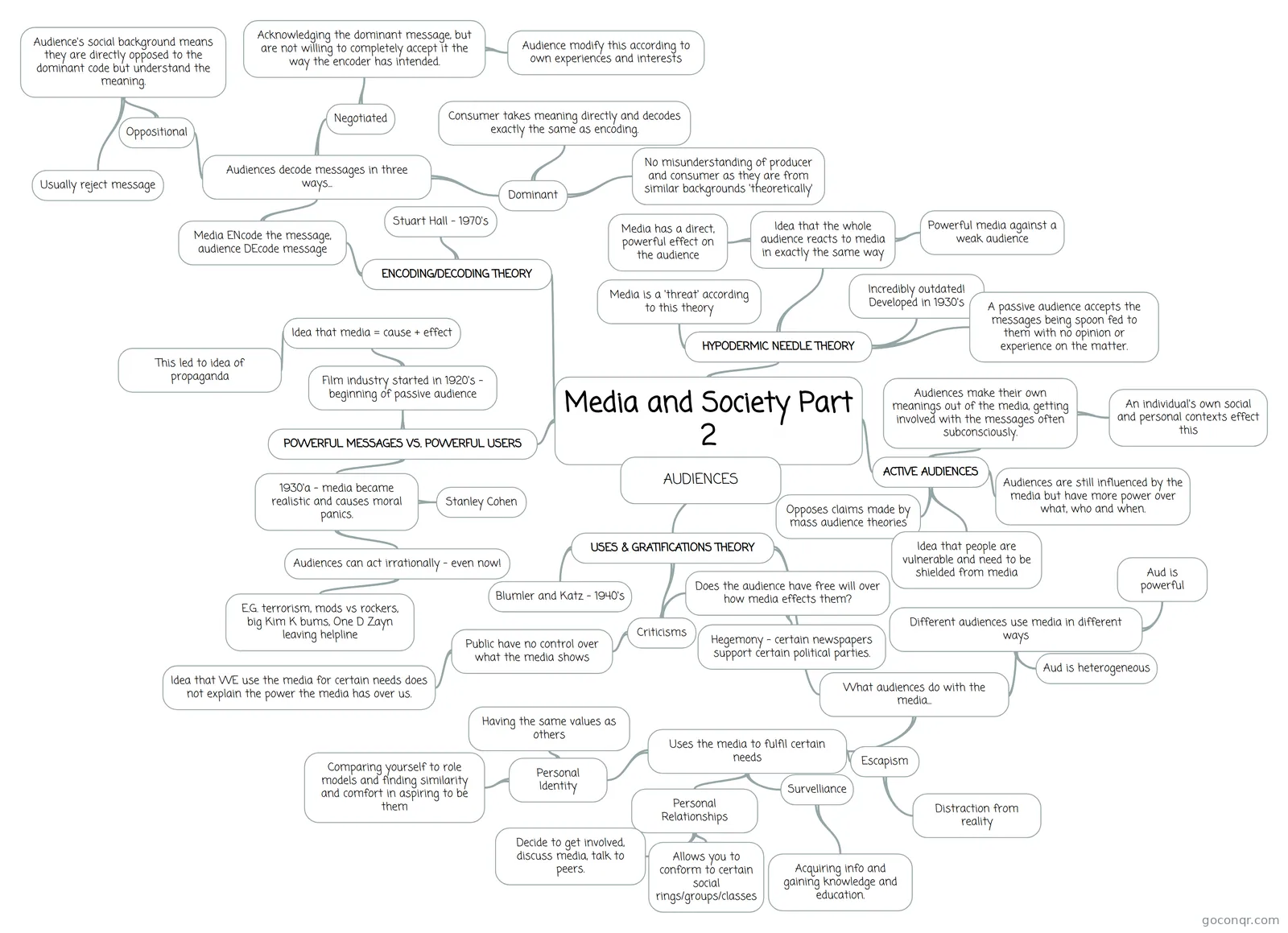
Mind map: media and society audiences theories
Contenido del mapa
Media and Society Part 2
AUDIENCES
POWERFUL MESSAGES VS. POWERFUL USERS
- Film industry started in 1920's - beginning of passive audience
- Idea that media = cause + effect
- This led to idea of propaganda
- Idea that media = cause + effect
- 1930'a - media became realistic and causes moral panics.
- http://www.slideshare.net/kimberleyfinn/moral-panic http://eprints.bournemouth.ac.uk/21051/1/JNC-2013-Chapter-24-Luce.pdf
- Audiences can act irrationally - even now!
- E.G. terrorism, mods vs rockers, big Kim K bums, One D Zayn leaving helpline
- Stanley Cohen
- http://eprints.bournemouth.ac.uk/21051/1/JNC-2013-Chapter-24-Luce.pdf
- Film industry started in 1920's - beginning of passive audience
HYPODERMIC NEEDLE THEORY
- Incredibly outdated! Developed in 1930's
- Idea that the whole audience reacts to media in exactly the same way
- Media has a direct, powerful effect on the audience
- Powerful media against a weak audience
- A passive audience accepts the messages being spoon fed to them with no opinion or experience on the matter.
- Media is a 'threat' according to this theory
ACTIVE AUDIENCES
- Opposes claims made by mass audience theories
- Audiences make their own meanings out of the media, getting involved with the messages often subconsciously.
- An individual's own social and personal contexts effect this
- Audiences are still influenced by the media but have more power over what, who and when.
- Idea that people are vulnerable and need to be shielded from media
USES & GRATIFICATIONS THEORY
- Blumler and Katz - 1940's
- What audiences do with the media...
- Different audiences use media in different ways
- Aud is heterogeneous
- Aud is powerful
- Uses the media to fulfil certain needs
- Personal Identity
- Comparing yourself to role models and finding similarity and comfort in aspiring to be them
- Having the same values as others
- Personal Relationships
- Decide to get involved, discuss media, talk to peers.
- Allows you to conform to certain social rings/groups/classes
- Survelliance
- Acquiring info and gaining knowledge and education.
- Escapism
- Distraction from reality
- Personal Identity
- Different audiences use media in different ways
- Criticisms
- Public have no control over what the media shows
- Idea that WE use the media for certain needs does not explain the power the media has over us.
- Does the audience have free will over how media effects them?
- Hegemony - certain newspapers support certain political parties.
- Public have no control over what the media shows
ENCODING/DECODING THEORY
- Stuart Hall - 1970's
- Media ENcode the message, audience DEcode message
- Audiences decode messages in three ways...
- Dominant
- Consumer takes meaning directly and decodes exactly the same as encoding.
- No misunderstanding of producer and consumer as they are from similar backgrounds 'theoretically'
- Negotiated
- Acknowledging the dominant message, but are not willing to completely accept it the way the encoder has intended.
- Audience modify this according to own experiences and interests
- Acknowledging the dominant message, but are not willing to completely accept it the way the encoder has intended.
- Oppositional
- Audience's social background means they are directly opposed to the dominant code but understand the meaning.
- Usually reject message
- Audience's social background means they are directly opposed to the dominant code but understand the meaning.
- Dominant
- Audiences decode messages in three ways...
Información
- Descripción
- Second part tp audiences - media and society.
- Creado por
- charlotte.cranny
- Visitas
- 44
- Etiquetas
- Valoración