
Mapa mental
understanding a problem
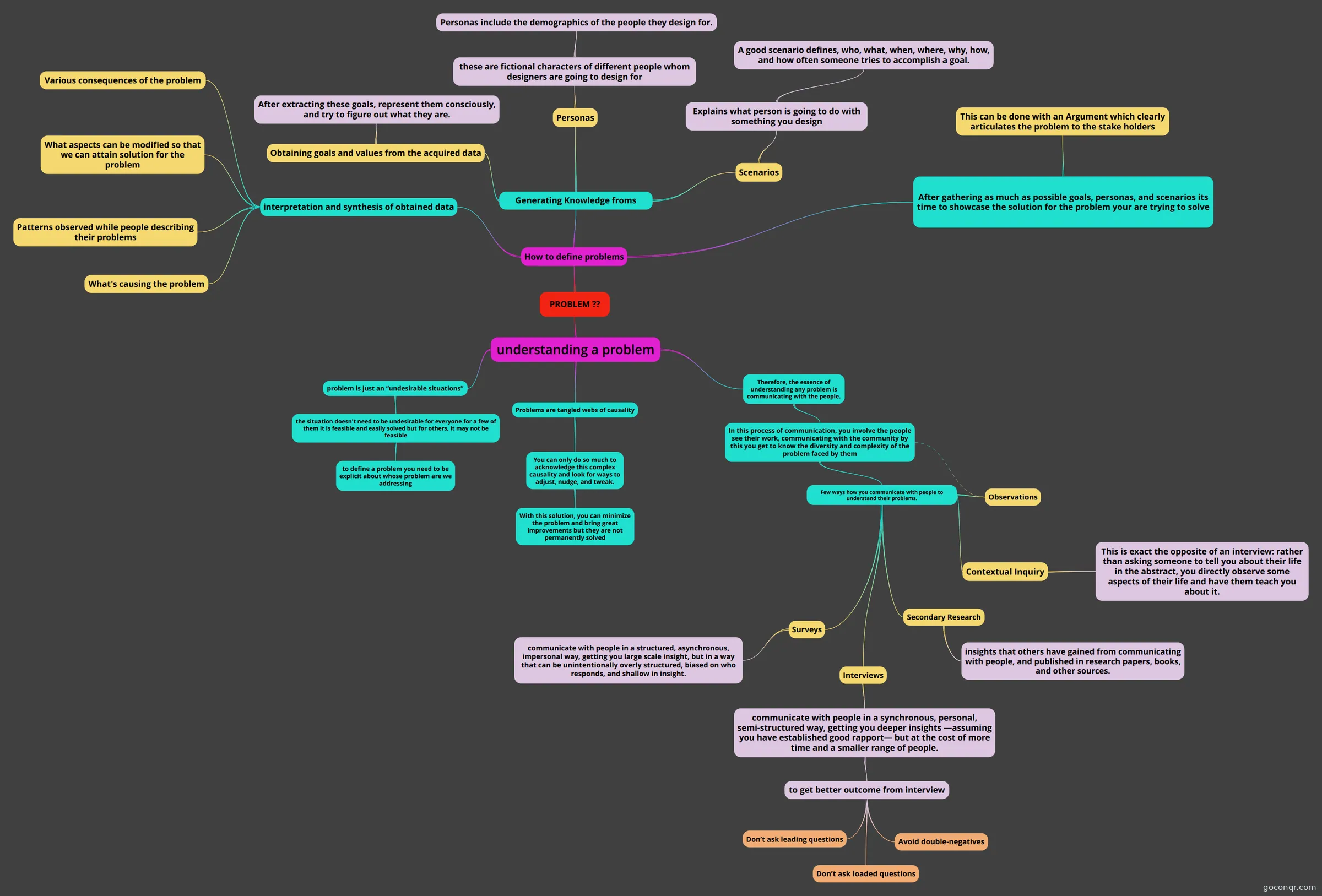
Mind map: understanding a problem
Contenido del mapa
understanding a problem
Problems are tangled webs of causality
- You can only do so much to acknowledge this complex causality and look for ways to adjust, nudge, and tweak.
- With this solution, you can minimize the problem and bring great improvements but they are not permanently solved
- You can only do so much to acknowledge this complex causality and look for ways to adjust, nudge, and tweak.
problem is just an “undesirable situations”
- the situation doesn't need to be undesirable for everyone for a few of them it is feasible and easily solved but for others, it may not be feasible
- to define a problem you need to be explicit about whose problem are we addressing
- the situation doesn't need to be undesirable for everyone for a few of them it is feasible and easily solved but for others, it may not be feasible
PROBLEM ??
- How to define problems
- interpretation and synthesis of obtained data
- Various consequences of the problem
- What's causing the problem
- What aspects can be modified so that we can attain solution for the problem
- Patterns observed while people describing their problems
- Generating Knowledge froms
- Obtaining goals and values from the acquired data
- After extracting these goals, represent them consciously, and try to figure out what they are.
- Personas
- these are fictional characters of different people whom designers are going to design for
- Personas include the demographics of the people they design for.
- these are fictional characters of different people whom designers are going to design for
- Scenarios
- Explains what person is going to do with something you design
- A good scenario defines, who, what, when, where, why, how, and how often someone tries to accomplish a goal.
- Explains what person is going to do with something you design
- Obtaining goals and values from the acquired data
- After gathering as much as possible goals, personas, and scenarios its time to showcase the solution for the problem your are trying to solve
- This can be done with an Argument which clearly articulates the problem to the stake holders
- interpretation and synthesis of obtained data
- How to define problems
Therefore, the essence of understanding any problem is communicating with the people.
- In this process of communication, you involve the people see their work, communicating with the community by this you get to know the diversity and complexity of the problem faced by them
- Few ways how you communicate with people to understand their problems.
- Surveys
- communicate with people in a structured, asynchronous, impersonal way, getting you large scale insight, but in a way that can be unintentionally overly structured, biased on who responds, and shallow in insight.
- Interviews
- communicate with people in a synchronous, personal, semi-structured way, getting you deeper insights —assuming you have established good rapport— but at the cost of more time and a smaller range of people.
- to get better outcome from interview
- Don’t ask leading questions
- Don’t ask loaded questions
- Avoid double-negatives
- to get better outcome from interview
- communicate with people in a synchronous, personal, semi-structured way, getting you deeper insights —assuming you have established good rapport— but at the cost of more time and a smaller range of people.
- Observations
- Secondary Research
- insights that others have gained from communicating with people, and published in research papers, books, and other sources.
- Contextual Inquiry
- This is exact the opposite of an interview: rather than asking someone to tell you about their life in the abstract, you directly observe some aspects of their life and have them teach you about it.
- Surveys
- Few ways how you communicate with people to understand their problems.
- In this process of communication, you involve the people see their work, communicating with the community by this you get to know the diversity and complexity of the problem faced by them
Información
- Descripción
- Mapa Mental sobre understanding a problem, creado por K TARUN KUMAR REDDY el 27/01/2023.
- Creado por
- K TARUN KUMAR REDDY
- Visitas
- 0
- Valoración