
Mapa mental
Quality management system
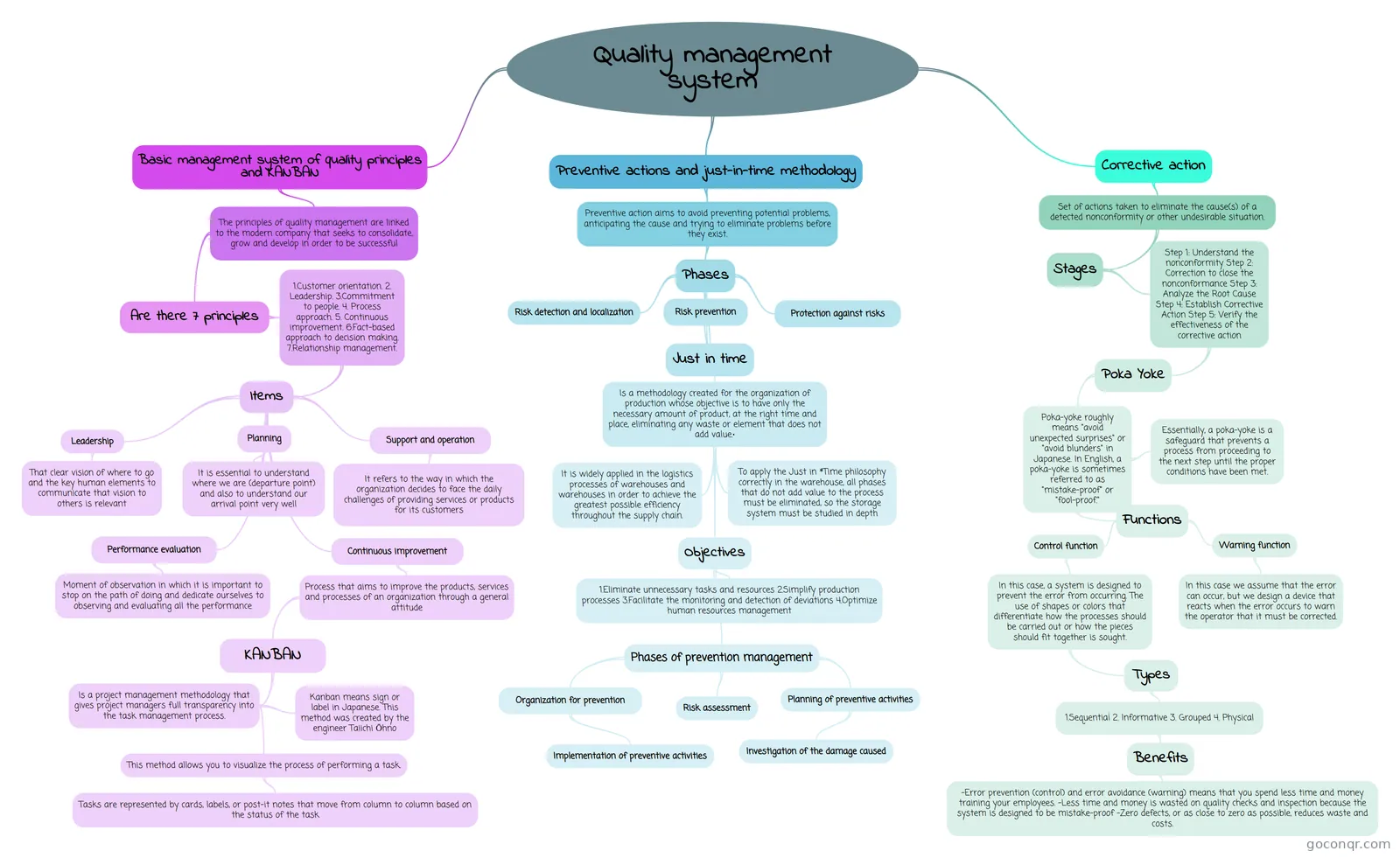
Mind map: Quality management system
Contenido del mapa
Quality management system
Basic management system of quality principles and KANBAN
- The principles of quality management are linked to the modern company that seeks to consolidate, grow and develop in order to be successful
- Are there 7 principles
- 1.Customer orientation. 2. Leadership. 3.Commitment to people. 4. Process approach. 5. Continuous improvement. 6.Fact-based approach to decision making. 7.Relationship management.
- Items
- Leadership
- That clear vision of where to go and the key human elements to communicate that vision to others is relevant
- Planning
- It is essential to understand where we are (departure point) and also to understand our arrival point very well
- Support and operation
- It refers to the way in which the organization decides to face the daily challenges of providing services or products for its customers
- Performance evaluation
- Moment of observation in which it is important to stop on the path of doing and dedicate ourselves to observing and evaluating all the performance
- Continuous improvement
- Process that aims to improve the products, services and processes of an organization through a general attitude
- KANBAN
- Is a project management methodology that gives project managers full transparency into the task management process.
- Kanban means sign or label in Japanese. This method was created by the engineer Taiichi Ōhno
- This method allows you to visualize the process of performing a task.
- Tasks are represented by cards, labels, or post-it notes that move from column to column based on the status of the task
- Is a project management methodology that gives project managers full transparency into the task management process.
- KANBAN
- Process that aims to improve the products, services and processes of an organization through a general attitude
- Leadership
- Items
- 1.Customer orientation. 2. Leadership. 3.Commitment to people. 4. Process approach. 5. Continuous improvement. 6.Fact-based approach to decision making. 7.Relationship management.
- Are there 7 principles
- The principles of quality management are linked to the modern company that seeks to consolidate, grow and develop in order to be successful
Preventive actions and just-in-time methodology
- Preventive action aims to avoid preventing potential problems, anticipating the cause and trying to eliminate problems before they exist.
- Phases
- Risk detection and localization
- Risk prevention
- Is a methodology created for the organization of production whose objective is to have only the necessary amount of product, at the right time and place, eliminating any waste or element that does not add value.•
- It is widely applied in the logistics processes of warehouses and warehouses in order to achieve the greatest possible efficiency throughout the supply chain.
- To apply the Just in *Time philosophy correctly in the warehouse, all phases that do not add value to the process must be eliminated, so the storage system must be studied in depth
- Objectives
- 1.Eliminate unnecessary tasks and resources 2.Simplify production processes 3.Facilitate the monitoring and detection of deviations 4.Optimize human resources management
- Phases of prevention management
- Organization for prevention
- Implementation of preventive activities
- Risk assessment
- Planning of preventive activities
- Investigation of the damage caused
- Organization for prevention
- Is a methodology created for the organization of production whose objective is to have only the necessary amount of product, at the right time and place, eliminating any waste or element that does not add value.•
- Protection against risks
- Just in time
- Phases
- Preventive action aims to avoid preventing potential problems, anticipating the cause and trying to eliminate problems before they exist.
Corrective action
- Set of actions taken to eliminate the cause(s) of a detected nonconformity or other undesirable situation.
- Stages
- Step 1: Understand the nonconformity Step 2: Correction to close the nonconformance Step 3: Analyze the Root Cause Step 4: Establish Corrective Action Step 5: Verify the effectiveness of the corrective action
- Poka Yoke
- Poka-yoke roughly means "avoid unexpected surprises" or "avoid blunders" in Japanese. In English, a poka-yoke is sometimes referred to as "mistake-proof" or "fool-proof."
- Essentially, a poka-yoke is a safeguard that prevents a process from proceeding to the next step until the proper conditions have been met.
- Functions
- Control function
- In this case, a system is designed to prevent the error from occurring. The use of shapes or colors that differentiate how the processes should be carried out or how the pieces should fit together is sought.
- Types
- 1.Sequential 2. Informative 3. Grouped 4. Physical
- Benefits
- -Error prevention (control) and error avoidance (warning) means that you spend less time and money training your employees. -Less time and money is wasted on quality checks and inspection because the system is designed to be mistake-proof -Zero defects, or as close to zero as possible, reduces waste and costs.
- Benefits
- 1.Sequential 2. Informative 3. Grouped 4. Physical
- Types
- In this case, a system is designed to prevent the error from occurring. The use of shapes or colors that differentiate how the processes should be carried out or how the pieces should fit together is sought.
- Warning function
- In this case we assume that the error can occur, but we design a device that reacts when the error occurs to warn the operator that it must be corrected.
- Control function
- Poka-yoke roughly means "avoid unexpected surprises" or "avoid blunders" in Japanese. In English, a poka-yoke is sometimes referred to as "mistake-proof" or "fool-proof."
- Poka Yoke
- Step 1: Understand the nonconformity Step 2: Correction to close the nonconformance Step 3: Analyze the Root Cause Step 4: Establish Corrective Action Step 5: Verify the effectiveness of the corrective action
- Stages
- Set of actions taken to eliminate the cause(s) of a detected nonconformity or other undesirable situation.
Información
- Descripción
- Mapa Mental sobre Quality management system, creado por Christopher Molina el 08/02/2023.
- Creado por
- Christopher Molina
- Visitas
- 35
- Valoración
Más sobre Quality Management Systems and Models