
Mapa mental
Occupiers' Liability Act 1957
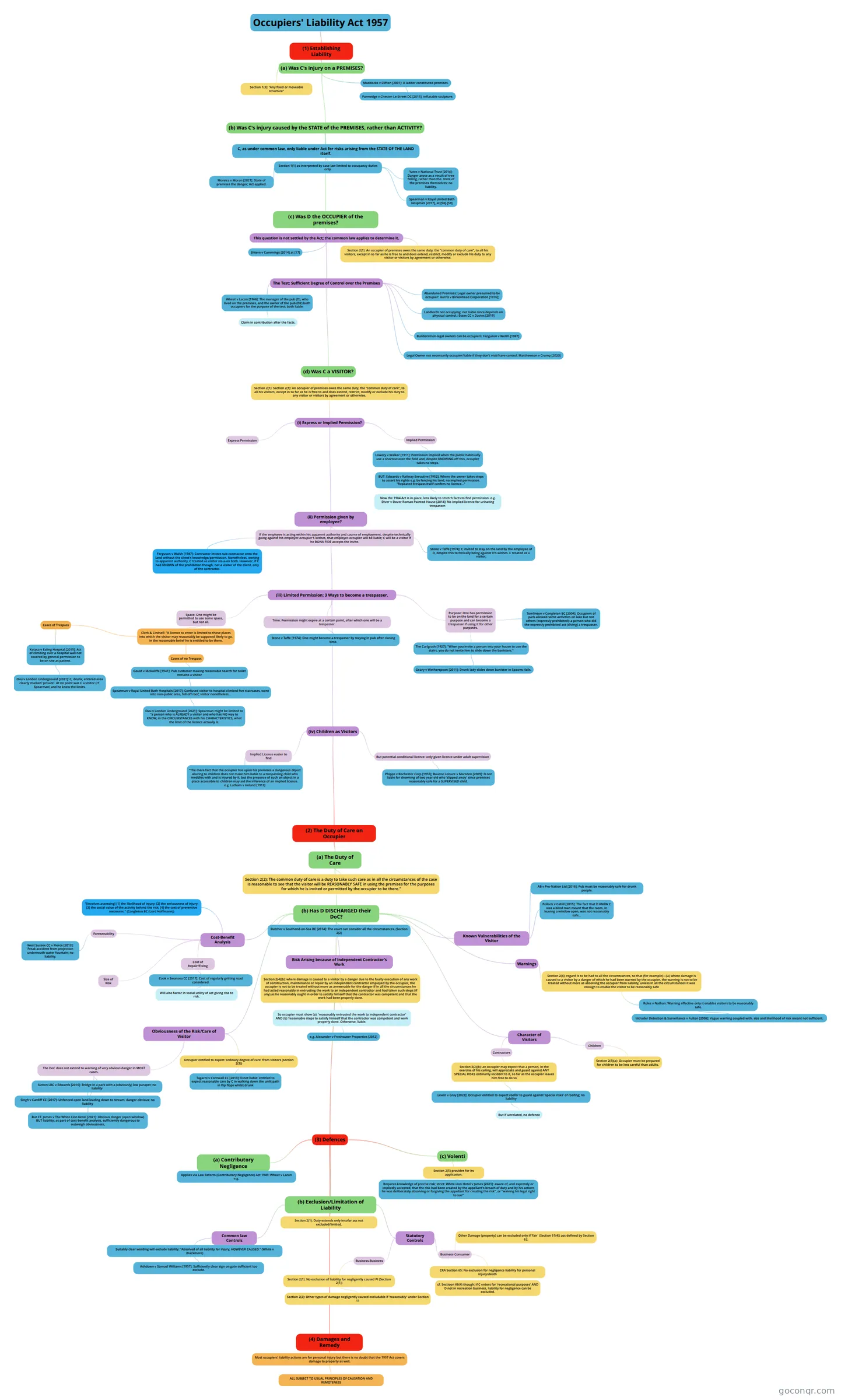
Mind map: Occupiers' Liability Act 1957
Contenido del mapa
Occupiers' Liability Act 1957
(1) Establishing Liability
- (a) Was C's injury on a PREMISES?
- Section 1(3): "Any fixed or moveable structure"
- Maddocks v Clifton [2001]: A ladder constituted premises.
- Furmedge v Chester-Le-Street DC [2011]: Inflatable sculpture.
- (b) Was C's injury caused by the STATE of the PREMISES, rather than ACTIVITY?
- C, as under common law, only liable under Act for risks arising from the STATE OF THE LAND itself.
- Section 1(1) as interpreted by case law limited to occupancy duties only.
- Yates v National Trust [2014]: Danger arose as a result of tree felling, rather than the. state of the premises themselves; no liability.
- Spearman v Royal United Bath Hospitals [2017], at [58]-[59]
- Moreira v Moran [2021]: State of premises the danger; Act applied.
- Section 1(1) as interpreted by case law limited to occupancy duties only.
- (c) Was D the OCCUPIER of the premises?
- This question is not settled by the Act; the common law applies to determine it.
- Shtern v Cummings [2014] at [17]
- The Test: Sufficient Degree of Control over the Premises
- Wheat v Lacon [1966]: The manager of the pub (D), who lived on the premises, and the owner of the pub (D2) both occupiers for the purpose of the test; both liable.
- Claim in contribution after the facts.
- Landlords not occupying: not liable since depends on physical control.: Essex CC v Davies [2019]
- Abandoned Premises: Legal owner presumed to be occupier: Harris v Birkenhead Corporation [1976];
- Builders/non-legal owners can be occupiers: Ferguson v Welsh [1987]
- (d) Was C a VISITOR?
- Section 2(1): Section 2(1): An occupier of premises owes the same duty, the “common duty of care”, to all his visitors, except in so far as he is free to and does extend, restrict, modify or exclude his duty to any visitor or visitors by agreement or otherwise.
- (i) Express or Implied Permission?
- Implied Permission
- Lowery v Walker [1911]: Permission implied when the public habitually use a shortcut over the field and, despite KNOWING off this, occupier takes no steps.
- BUT: Edwards v Railway Executive [1952]: Where the owner takes steps to assert his rights e.g. by fencing his land, no implied permission. "Repeated trespass itself confers no licence..."
- Now the 1984 Act is in place, less likely to stretch facts to find permission. e.g. Diver v Dover Roman Painted House [2014]: No implied licence for urinating trespasser.
- BUT: Edwards v Railway Executive [1952]: Where the owner takes steps to assert his rights e.g. by fencing his land, no implied permission. "Repeated trespass itself confers no licence..."
- Lowery v Walker [1911]: Permission implied when the public habitually use a shortcut over the field and, despite KNOWING off this, occupier takes no steps.
- Express Permission
- (ii) Permission given by employee?
- If the employee is acting within his apparent authority and course of employment, despite technically going against his employer-occupier's wishes, that employer-occupier will be liable; C will be a visitor if he BONA FIDE accepts the invite.
- Stone v Taffe [1974]: C invited to stay on the land by the employee of D, despite this technically being against D's wishes. C treated as a visitor;
- Ferguson v Walsh [1987]: Contractor invites sub-contractor onto the land without the client's knowledge/permission. Nonetheless, owning to apparent authority, C treated as visitor vis-a-vis both. However, if C had KNOWN of the prohibition though, not a visitor of the client, only of the contractor.
- (iii) Limited Permission: 3 Ways to become a trespasser.
- Purpose: One has permission to be on the land for a certain purpose and can become a trespasser if using it for other purposes.
- The Carlgrath [1927]: "When you invite a person into your house to use the stairs, you do not invite him to slide down the banisters."
- Geary v Wetherspoon [2011]: Drunk lady slides down banister in Spoons; fails.
- Tomlinson v Congleton BC [2004]: Occupiers of park allowed some activities on lake but not others (expressly prohibited): a person who did the expressly prohibited act (diving) a trespasser.
- The Carlgrath [1927]: "When you invite a person into your house to use the stairs, you do not invite him to slide down the banisters."
- Space: One might be permitted to use some space, but not all.
- Clerk & Lindsell: "A licence to enter is limited to those places into which the visitor may reasonably be supposed likely to go, in the reasonable belief he is entitled to be there.
- Cases of no Trespass
- Gould v McAuliffe [1941]: Pub customer making reasonable search for toilet remains a visitor
- Spearman v Royal United Bath Hospitals [2017]: Confused visitor to hospital climbed five staircases, went into non-public area, fell off roof; visitor nonetheless...
- Ovu v London Underground [2021]: Spearman might be limited to "a person who is ALREADY a visitor and who has NO way to KNOW, in the CIRCUMSTANCES with his CHARACTERISTICS, what the limit of the licence actually is.
- Spearman v Royal United Bath Hospitals [2017]: Confused visitor to hospital climbed five staircases, went into non-public area, fell off roof; visitor nonetheless...
- Gould v McAuliffe [1941]: Pub customer making reasonable search for toilet remains a visitor
- Cases of Trespass
- Kolasa v Ealing Hospital [2015]: Act of climbing over a hospital wall not covered by general permission to be on site as patient.
- Ovu v London Underground [2021]: C, drunk, entered area clearly marked 'private'. At no point was C a visitor (cf. Spearman) and he knew the limits.
- Kolasa v Ealing Hospital [2015]: Act of climbing over a hospital wall not covered by general permission to be on site as patient.
- Cases of no Trespass
- Clerk & Lindsell: "A licence to enter is limited to those places into which the visitor may reasonably be supposed likely to go, in the reasonable belief he is entitled to be there.
- Time: Permission might expire at a certain point, after which one will be a trespasser.
- Stone v Taffe [1974]: One might become a trespasser by staying in pub after closing time.
- (iv) Children as Visitors
- Implied Licence easier to find
- “The mere fact that the occupier has upon his premises a dangerous object alluring to children does not make him liable to a trespassing child who meddles with and is injured by it; but the presence of such an object in a place accessible to children may aid the inference of an implied licence. e.g. Latham v Ireland [1913]
- But potential conditional licence: only given licence under adult supervision
- Phipps v Rochester Corp [1955]; Bourne Leisure v Marsden [2009]: D not liable for drowning of two year old who 'slipped away' since premises reasonably safe for a SUPERVISED child.
- (2) The Duty of Care on Occupier
- (a) The Duty of Care
- Section 2(2): The common duty of care is a duty to take such care as in all the circumstances of the case is reasonable to see that the visitor will be REASONABLY SAFE in using the premises for the purposes for which he is invited or permitted by the occupier to be there.”
- (b) Has D DISCHARGED their DoC?
- Cost-Benefit Analysis
- "[involves assessing] [1] the likelihood of injury; [2] the seriousness of injury; [3] the social value of the activity behind the risk; [4] the cost of preventive measures." (Congleton BC (Lord Hoffmann))
- Foreseeability
- West Sussex CC v Pierce [2013]: Freak accident from projection underneath water fountain; no liability.
- Cost of Repair/Fixing
- Cook v Swansea CC [2017]: Cost of regularly gritting road considered.
- Will also factor in social utility of act giving rise to risk.
- Cook v Swansea CC [2017]: Cost of regularly gritting road considered.
- Size of Risk
- Butcher v Southend-on-Sea BC [2014]: The court can consider all the circumstances. (Section 2(2)
- Known Vulnerabilities of the Visitor
- Pollock v Cahill [2015]: The fact that D KNEW C was a blind man meant that the room, in leaving a window open, was not reasonably safe...
- AB v Pro-Nation Ltd [2016]: Pub must be reasonably safe for drunk people.
- Warnings
- Section 2(4): regard is to be had to all the circumstances, so that (for example)—(a) where damage is caused to a visitor by a danger of which he had been warned by the occupier, the warning is not to be treated without more as absolving the occupier from liability, unless in all the circumstances it was enough to enable the visitor to be reasonably safe
- Roles v Nathan: Warning effective only it enables visitors to be reasonably safe.
- Intruder Detection & Surveillance v Fulton [2008]: Vague warning coupled with. size and likelihood of risk meant not sufficient.
- Roles v Nathan: Warning effective only it enables visitors to be reasonably safe.
- Section 2(4): regard is to be had to all the circumstances, so that (for example)—(a) where damage is caused to a visitor by a danger of which he had been warned by the occupier, the warning is not to be treated without more as absolving the occupier from liability, unless in all the circumstances it was enough to enable the visitor to be reasonably safe
- Obviousness of the Risk/Care of Visitor
- The DoC does not extend to warning of very obvious danger in MOST cases.
- Sutton LBC v Edwards [2016]: Bridge in a park with a (obviously) low parapet; no liability
- Singh v Cardiff CC [2017]: Unfenced open land leading down to stream; danger obvious; no liability
- But CF. James v The White Lion Hotel [2021]: Obvious danger (open window) BUT liability; as part of cost-benefit analysis, sufficiently dangerous to outweigh obviousness,
- Occupier entitled to expect 'ordinary degree of care' from visitors (section 2(3))
- Tagacni v Cornwall CC [2013]: D not liable: entitled to expect reasonable care by C in walking down the unlit path in flip flops whilst drunk
- The DoC does not extend to warning of very obvious danger in MOST cases.
- Character of Visitors
- Children
- Section 2(3)(a): Occupier must be prepared for children to be less careful than adults.
- Contractors
- Section 3(2)(b): an occupier may expect that a person, in the exercise of his calling, will appreciate and guard against ANY SPECIAL RISKS ordinarily incident to it, so far as the occupier leaves him free to do so
- Lewin v Gray [2023]: Occupier entitled to expect roofer to guard against 'special risks' of roofing; no liability
- But if unrelated, no defence
- Lewin v Gray [2023]: Occupier entitled to expect roofer to guard against 'special risks' of roofing; no liability
- Section 3(2)(b): an occupier may expect that a person, in the exercise of his calling, will appreciate and guard against ANY SPECIAL RISKS ordinarily incident to it, so far as the occupier leaves him free to do so
- Children
- Risk Arising because of Independent Contractor's Work
- Section 2(4)(b): where damage is caused to a visitor by a danger due to the faulty execution of any work of construction, maintenance or repair by an independent contractor employed by the occupier, the occupier is not to be treated without more as answerable for the danger if in all the circumstances he had acted reasonably in entrusting the work to an independent contractor and had taken such steps (if any) as he reasonably ought in order to satisfy himself that the contractor was competent and that the work had been properly done.
- So occupier must show (a): 'reasonably entrusted the work to independent contractor' AND (b) 'reasonable steps to satisfy himself that the contractor was competent and work properly done. Otherwise, liable.
- e.g. Alexander v Freshwater Properties [2012]
- So occupier must show (a): 'reasonably entrusted the work to independent contractor' AND (b) 'reasonable steps to satisfy himself that the contractor was competent and work properly done. Otherwise, liable.
- Section 2(4)(b): where damage is caused to a visitor by a danger due to the faulty execution of any work of construction, maintenance or repair by an independent contractor employed by the occupier, the occupier is not to be treated without more as answerable for the danger if in all the circumstances he had acted reasonably in entrusting the work to an independent contractor and had taken such steps (if any) as he reasonably ought in order to satisfy himself that the contractor was competent and that the work had been properly done.
- (3) Defences
- (a) Contributory Negligence
- Applies via Law Reform (Contributory Negligence) Act 1945: Wheat v Lacon e.g.
- (c) Volenti
- Section 2(5) provides for its application.
- Requires knowledge of precise risk; strict: White Lion Hotel v James [2021]: aware of, and expressly or impliedly accepted, that the risk had been created by the appellant's breach of duty and by his actions he was deliberately absolving or forgiving the appellant for creating the risk”, or “waiving his legal right to sue”
- Section 2(5) provides for its application.
- (b) Exclusion/Limitation of Liability
- Section 2(1): Duty extends only insofar ass not excluded/limited.
- Common law Controls
- Suitably clear wording will exclude liability: "Absolved of all liability for injury, HOWEVER CAUSED." (White v Blackmore)
- Ashdown v Samuel Williams [1957]: Sufficiently clear sign on gate sufficient too exclude.
- Suitably clear wording will exclude liability: "Absolved of all liability for injury, HOWEVER CAUSED." (White v Blackmore)
- Statutory Controls
- Business-Business
- Section 2(1): No exclusion of liability for negligently caused PI (Section 2(1))
- Section 2(2): Other types of damage negligently caused excludable if 'reasonably' under Section 11
- Section 2(1): No exclusion of liability for negligently caused PI (Section 2(1))
- Business-Consumer
- CRA Section 65: No exclusion for negligence liability for personal injury/death
- cf. Sectioon 66(4) though: if C enters for 'recreational purposes' AND D not in recreation business, liability for negligence can be excluded.
- Other Damage (property) can be excluded only if 'fair' (Section 61(4)) ass defined by Section 62.
- CRA Section 65: No exclusion for negligence liability for personal injury/death
- Business-Business
- (4) Damages and Remedy
- Most occupiers’ liability actions are for personal injury but there is no doubt that the 1957 Act covers damage to property as well.
- ALL SUBJECT TO USUAL PRINCIPLES OF CAUSATION AND REMOTENESS
- Most occupiers’ liability actions are for personal injury but there is no doubt that the 1957 Act covers damage to property as well.
- (a) Contributory Negligence
- Cost-Benefit Analysis
- (a) The Duty of Care
- Implied Licence easier to find
- Purpose: One has permission to be on the land for a certain purpose and can become a trespasser if using it for other purposes.
- If the employee is acting within his apparent authority and course of employment, despite technically going against his employer-occupier's wishes, that employer-occupier will be liable; C will be a visitor if he BONA FIDE accepts the invite.
- Implied Permission
- (i) Express or Implied Permission?
- Section 2(1): Section 2(1): An occupier of premises owes the same duty, the “common duty of care”, to all his visitors, except in so far as he is free to and does extend, restrict, modify or exclude his duty to any visitor or visitors by agreement or otherwise.
- Legal Owner not necessarily occupier/liable if they don't visit/have control: Matthewson v Crump [2020]
- Wheat v Lacon [1966]: The manager of the pub (D), who lived on the premises, and the owner of the pub (D2) both occupiers for the purpose of the test; both liable.
- Section 2(1): An occupier of premises owes the same duty, the “common duty of care”, to all his visitors, except in so far as he is free to and does extend, restrict, modify or exclude his duty to any visitor or visitors by agreement or otherwise.
- This question is not settled by the Act; the common law applies to determine it.
- C, as under common law, only liable under Act for risks arising from the STATE OF THE LAND itself.
- (a) Was C's injury on a PREMISES?
Información
- Descripción
- Mapa Mental sobre Occupiers' Liability Act 1957, creado por Alex Scoby el 04/06/2023.
- Creado por
- Alex Scoby
- Visitas
- 0
- Valoración