
Mapa mental
GLOSSARY.
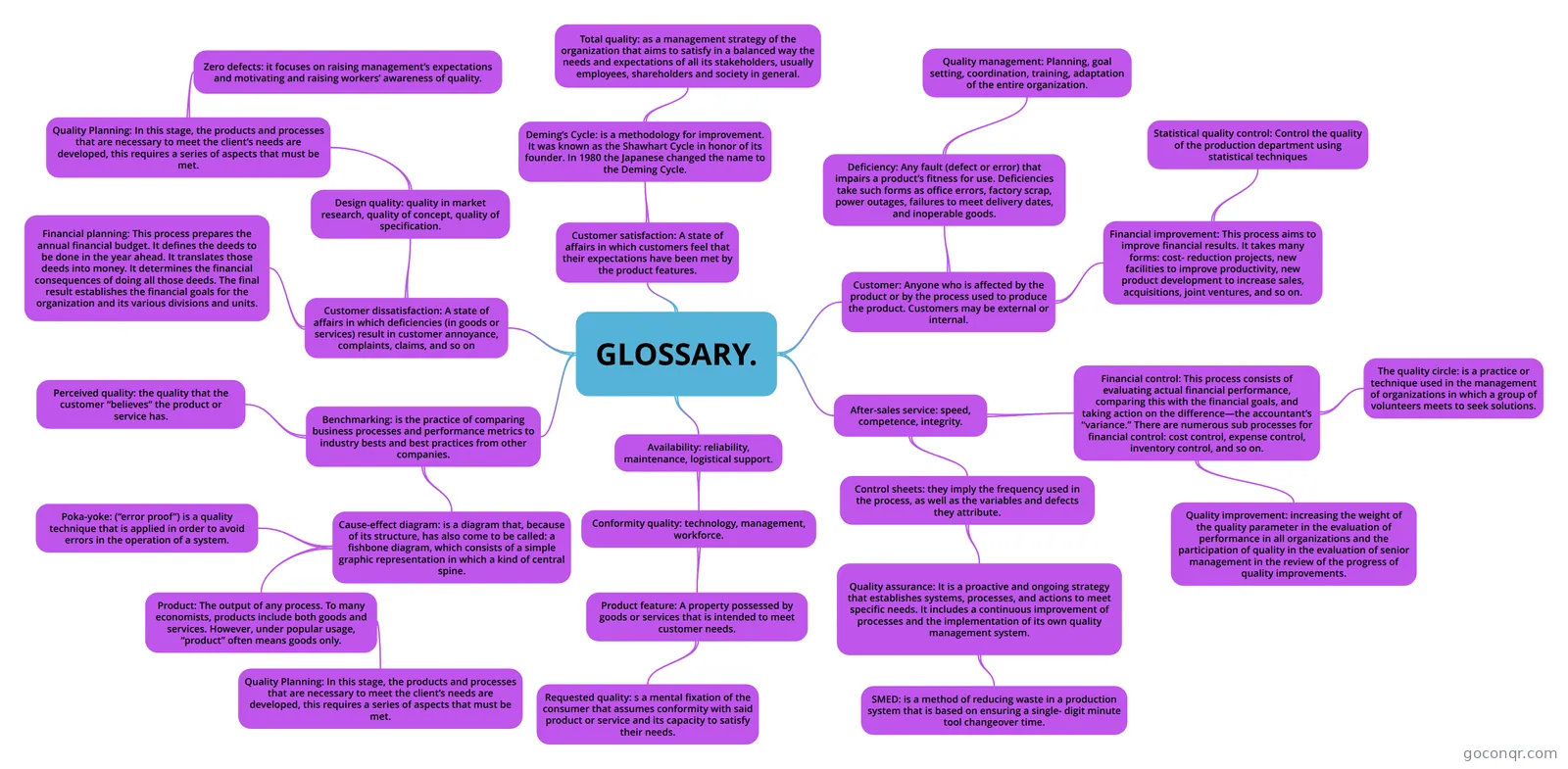
Mind map: Quality glossary
Contenido del mapa
GLOSSARY.
Benchmarking: is the practice of comparing business processes and performance metrics to industry bests and best practices from other companies.
- Cause-effect diagram: is a diagram that, because of its structure, has also come to be called: a fishbone diagram, which consists of a simple graphic representation in which a kind of central spine.
- Poka-yoke: (“error proof”) is a quality technique that is applied in order to avoid errors in the operation of a system.
- Product: The output of any process. To many economists, products include both goods and services. However, under popular usage, “product” often means goods only.
- Quality Planning: In this stage, the products and processes that are necessary to meet the client’s needs are developed, this requires a series of aspects that must be met.
- Perceived quality: the quality that the customer “believes” the product or service has.
- Cause-effect diagram: is a diagram that, because of its structure, has also come to be called: a fishbone diagram, which consists of a simple graphic representation in which a kind of central spine.
Availability: reliability, maintenance, logistical support.
- Conformity quality: technology, management, workforce.
- Product feature: A property possessed by goods or services that is intended to meet customer needs.
- Requested quality: s a mental fixation of the consumer that assumes conformity with said product or service and its capacity to satisfy their needs.
- Product feature: A property possessed by goods or services that is intended to meet customer needs.
- Conformity quality: technology, management, workforce.
After-sales service: speed, competence, integrity.
- Control sheets: they imply the frequency used in the process, as well as the variables and defects they attribute.
- Quality assurance: It is a proactive and ongoing strategy that establishes systems, processes, and actions to meet specific needs. It includes a continuous improvement of processes and the implementation of its own quality management system.
- SMED: is a method of reducing waste in a production system that is based on ensuring a single- digit minute tool changeover time.
- Quality assurance: It is a proactive and ongoing strategy that establishes systems, processes, and actions to meet specific needs. It includes a continuous improvement of processes and the implementation of its own quality management system.
- Financial control: This process consists of evaluating actual financial performance, comparing this with the financial goals, and taking action on the difference—the accountant’s “variance.” There are numerous sub processes for financial control: cost control, expense control, inventory control, and so on.
- Quality improvement: increasing the weight of the quality parameter in the evaluation of performance in all organizations and the participation of quality in the evaluation of senior management in the review of the progress of quality improvements.
- The quality circle: is a practice or technique used in the management of organizations in which a group of volunteers meets to seek solutions.
- Control sheets: they imply the frequency used in the process, as well as the variables and defects they attribute.
Customer dissatisfaction: A state of affairs in which deficiencies (in goods or services) result in customer annoyance, complaints, claims, and so on
- Design quality: quality in market research, quality of concept, quality of specification.
- Quality Planning: In this stage, the products and processes that are necessary to meet the client’s needs are developed, this requires a series of aspects that must be met.
- Zero defects: it focuses on raising management’s expectations and motivating and raising workers’ awareness of quality.
- Quality Planning: In this stage, the products and processes that are necessary to meet the client’s needs are developed, this requires a series of aspects that must be met.
- Financial planning: This process prepares the annual financial budget. It defines the deeds to be done in the year ahead. It translates those deeds into money. It determines the financial consequences of doing all those deeds. The final result establishes the financial goals for the organization and its various divisions and units.
- Design quality: quality in market research, quality of concept, quality of specification.
Customer satisfaction: A state of affairs in which customers feel that their expectations have been met by the product features.
- Deming’s Cycle: is a methodology for improvement. It was known as the Shawhart Cycle in honor of its founder. In 1980 the Japanese changed the name to the Deming Cycle.
- Total quality: as a management strategy of the organization that aims to satisfy in a balanced way the needs and expectations of all its stakeholders, usually employees, shareholders and society in general.
- Deming’s Cycle: is a methodology for improvement. It was known as the Shawhart Cycle in honor of its founder. In 1980 the Japanese changed the name to the Deming Cycle.
Customer: Anyone who is affected by the product or by the process used to produce the product. Customers may be external or internal.
- Deficiency: Any fault (defect or error) that impairs a product’s fitness for use. Deficiencies take such forms as office errors, factory scrap, power outages, failures to meet delivery dates, and inoperable goods.
- Quality management: Planning, goal setting, coordination, training, adaptation of the entire organization.
- Financial improvement: This process aims to improve financial results. It takes many forms: cost- reduction projects, new facilities to improve productivity, new product development to increase sales, acquisitions, joint ventures, and so on.
- Statistical quality control: Control the quality of the production department using statistical techniques
- Deficiency: Any fault (defect or error) that impairs a product’s fitness for use. Deficiencies take such forms as office errors, factory scrap, power outages, failures to meet delivery dates, and inoperable goods.
Información
- Descripción
- Mapa Mental sobre GLOSSARY., creado por BRISEIDA ABIGAIL FUENTES RODRIGUEZ el 18/09/2024.
- Creado por
- BRISEIDA ABIGAIL FUENTES RODRIGUEZ
- Visitas
- 0
- Valoración