
Mapa mental
Chemical Synthesis
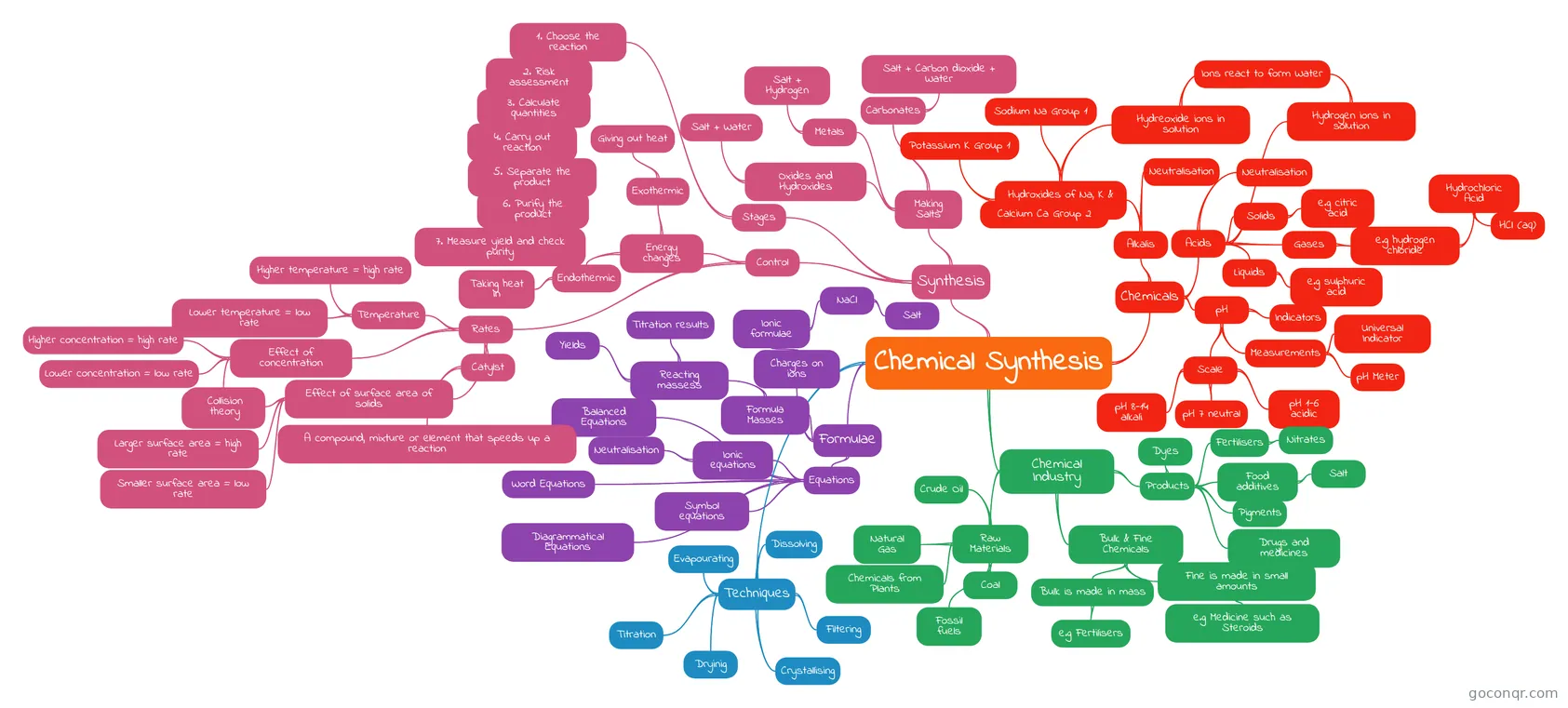
Mind map: chemical synthesis
Contenido del mapa
Chemical Synthesis
Chemicals
- Acids
- Neutralisation
- Solids
- e.g citric acid
- Liquids
- e.g sulphuric acid
- Gases
- e.g hydrogen chloride
- Hydrochloric Acid
- HCl (aq)
- Hydrochloric Acid
- e.g hydrogen chloride
- Hydrogen ions in solution
- Ions react to form Water
- Alkalis
- Neutralisation
- Hydroxides of Na, K & Ca
- Sodium Na Group 1
- Potassium K Group 1
- Calcium Ca Group 2
- Hydreoxide ions in solution
- H2O
- pH
- Indicators
- Measurements
- Universal Indicator
- pH Meter
- Scale
- pH 1-6 acidic
- pH 7 neutral
- pH 8-14 alkali
- Acids
Chemical Industry
- Products
- Fertilisers
- Nitrates
- Food additives
- Salt
- Pigments
- Dyes
- Drugs and medicines
- Fertilisers
- Raw Materials
- Crude Oil
- Natural Gas
- Chemicals from Plants
- Fossil fuels
- Coal
- Bulk & Fine Chemicals
- Bulk is made in mass
- e.g Fertilisers
- Fine is made in small amounts
- e.g Medicine such as Steroids
- Bulk is made in mass
- Products
Techniques
- Dissolving
- Crystallising
- Filtering
- Evapourating
- Dryinig
- Titration
Formulae
- Equations
- Ionic equations
- Neutralisation
- Balanced Equations
- Symbol equations
- Word Equations
- Diagrammatical Equations
- Ionic equations
- Formula Masses
- Reacting massess
- Titration results
- Yields
- Reacting massess
- Charges on ions
- Ionic formulae
- NaCl
- Salt
- NaCl
- Ionic formulae
- Equations
Synthesis
- Control
- Rates
- Catylst
- A compound, mixture or element that speeds up a reaction
- Temperature
- Higher temperature = high rate
- Lower temperature = low rate
- Effect of concentration
- Higher concentration = high rate
- Lower concentration = low rate
- Collision Theory
- Effect of surface area of solids
- Collision theory
- Larger surface area = high rate
- Smaller surface area = low rate
- Catylst
- Energy changes
- Exothermic
- Giving out heat
- Endothermic
- Taking heat in
- Exothermic
- Rates
- Stages
- 1. Choose the reaction
- 2. Risk assessment
- 3. Calculate quantities
- 4. Carry out reaction
- 5. Separate the product
- 6. Purify the product
- 7. Measure yield and check purity
- 6. Purify the product
- 5. Separate the product
- 4. Carry out reaction
- 3. Calculate quantities
- 2. Risk assessment
- 1. Choose the reaction
- Making Salts
- Carbonates
- Salt + Carbon dioxide + Water
- Metals
- Salt + Hydrogen
- Oxides and Hydroxides
- Salt + Water
- Carbonates
- Control
Información
- Descripción
- Chemical Synthesis, C6 Mind-map
- Creado por
- haydena
- Visitas
- 46
- Etiquetas
- Valoración