
Mapa mental
Immune system(II)
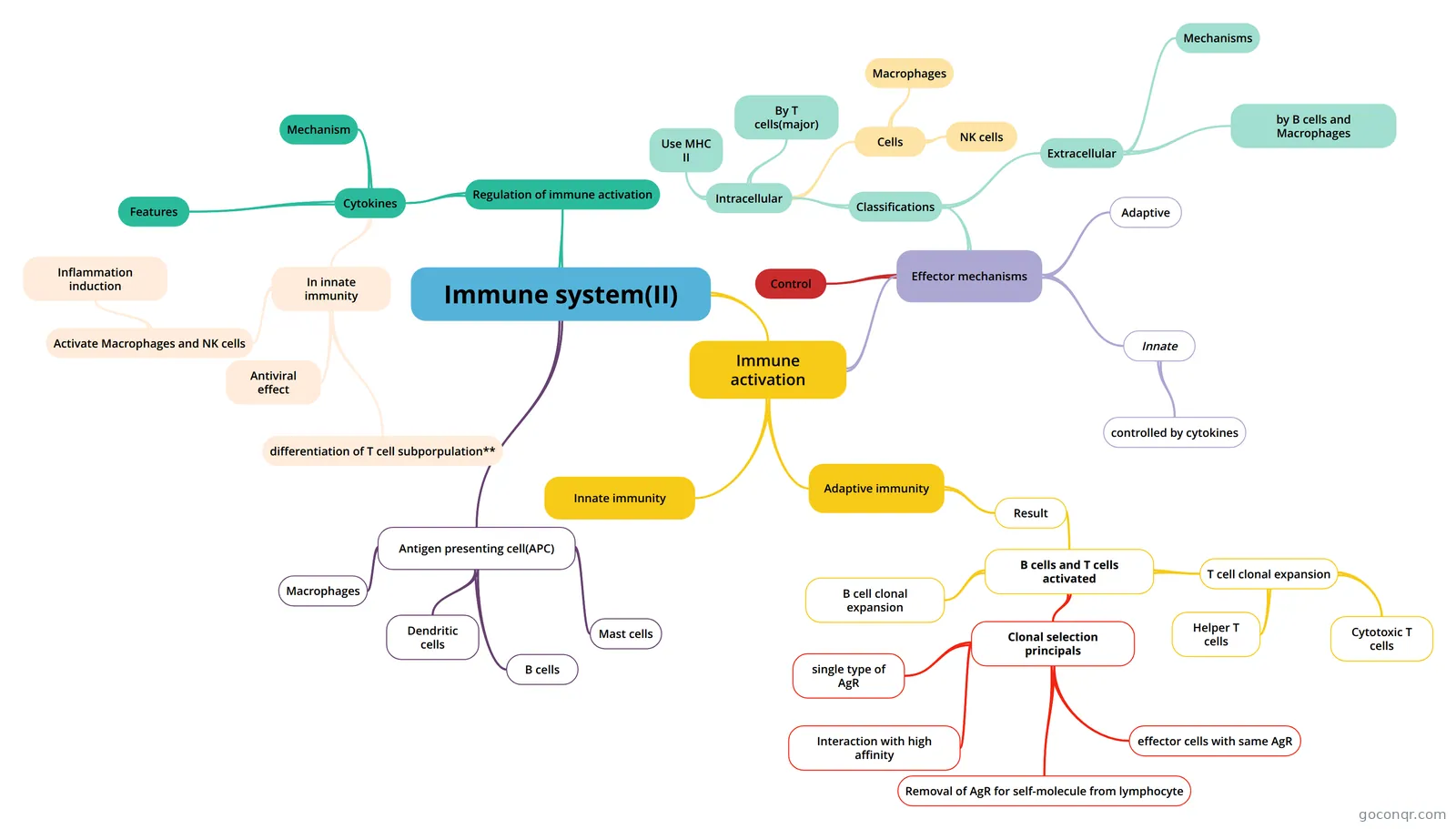
Mind map: immune system
Contenido del mapa
Immune system(II)
Regulation of immune activation
- Cytokines
- 1.Bind to receptors 2.phosphorylation of JAk family tyrosin kinase 3.activated JAK kinase phosphorylate STAT 4.Dimerization of STAT 5.work on transcription of specific gene Key function:promotion of activation, differentiation, poliferation, or cell death of T cells, B cells, Macrophages, dendritic cells, NK or other leukocytes
- Features
- 1. small short-lived proteins 2.function like hormones a.produced in small quantities b. they have different functions c. bind tightly to receptors d.cytokine receptors can bind more than one cytokines e regulator for immune response
- Mechanism
- 1. bind cytokine receptor with high affinity and initiate transduction of regulatory signals across cell membrane: -regulated by amount and types of cytokines -the level of cytokine receptors of immune cells -the types of cells concerned -antibodies that recognize and bind to the offending antigens.
- In innate immunity
- Activate Macrophages and NK cells
- IL-12 and IFN -y
- Inflammation induction
- 1.TNF 2.IL-1 3.Chemokines
- Antiviral effect
- IFN type 1, IFN-alpha and IFN-beta
- differentiation of T cell subporpulation**
- 1. IL-12
- Activate Macrophages and NK cells
- Cytokines
Immune activation
- 1.Normal state:lymphocytes exist in the blood in a 'resting state: allow immune system to send cells where they neey to do when a trigger occurs 2. regulation is important to avoid incontrolled IR
- Innate immunity
- how to activate adaptive immunity?? transfer 2 signal to activate T and B cells: 1st signal for antigen recognition 2nd signal derived by innate immunity
- Adaptive immunity
- T/B cells Antigen receptors are anchored in the cell membrane : when antigen bound receptor , the associated molecules are altered to activate lymphocytes(activation of intracellular processes) -required signal transduction (usually more than one signal)
- Result
- B cells and T cells activated
- antigenic activation
- B cell clonal expansion
- Produce: Plasma cells-antibodies generation Memory cells
- T cell clonal expansion
- produce: memory T-cells Cytotoxic T-cells (CD8+)-killed infected cells Helper T-cells(CD 4+) -activate other effector cells
- Helper T cells
- Functions 1. Express CD4 on their surface 2. produce cytokines to help macrophages kill ingested organisms 3. help B cells to differentiate into plasma cells 4. activate other CD4 cells to expand clonally 5. Help cytotoxic T cells and NK cells kill target cells 6.directly infected with HIV 7. Bind epitopes presented by MHC II 8. regulate both cellular and humoral immune systems
- Types: Th 1 Th 2 Th 17 T-reg
- Cytotoxic T cells
- 1. express CD8 on their surface 2. inhibit other cells or kill them 3.Bind epitope presented by MHC I
- Clonal selection principals
- single type of AgR
- each lymphocyte with a single type of AgR
- Interaction with high affinity
- between molecules and AgR
- effector cells with same AgR
- -the same as parental lymphocytes
- Removal of AgR for self-molecule from lymphocyte
- during lymphoid development
- single type of AgR
- B cells and T cells activated
- Effector mechanisms
- 1. pathogen enter the host 2. innate immune system: first line of defense , tries to lessen the strength of pathogen 3. activation of second immune response:low number of specific cells,need to activate and expand.
- Adaptive
- 1. antibody production 2. activating immune cells getting them ready to directly/indirectly kill organisms 3.regulate all of these function(e.g. NK)
- Innate
- controlled by cytokines
- Control
- 1. Amount and type of cytokine produced 2. level of cytokine receptor of imune cells 3. concerning different types of cells involved and how quickly they respond 4. Antibodies that can recognize and bind to offender antigens.
- Classifications
- Intracellular
- By T cells(major)
- 1. virus infects cells 2. viral proteins are produced 3. peptides are carried to cell surface of MHC I(serve as immune surveillance) 4. interaction between MHCI-peptide complex and T cell receptors(on CD 8+) 5.cell is killed by T cell
- Use MHC II
- -uses an extracellular pathway: loaded with peptides from antigens ingested outside of the cell. -By antigen presenting cells(macrophages, dendritic cells)
- Cells
- can ingest antibody coated organisms
- Macrophages
- 1.need activation by cytokine(e.g, IF-gamma)
- NK cells
- -Need cytokine to make them effective: IL-2 can differentiate them into activated killer cells -use perforin/granzyme and Fas/Fas ligand to induce apoptosis -produce cytokines to regulate immune response
- By T cells(major)
- Extracellular
- by B cells and Macrophages
- B cells secrete antibodies : have the same specificity as the receptor(antibody) on the cell surface.
- Mechanisms
- 1. Antibodies bind to whole antigens in their native forms:to defense against bacteria to grow outside -Neutrophils ingest these bacteria by recognize constant region of antibodies 2. interfere with the replication of pathogens
- by B cells and Macrophages
- Intracellular
Antigen presenting cell(APC)
- -link the innate and adaptive arm -rich in MHC class II molecules
- Macrophages
- Mast cells
- Dendritic cells
- B cells
Información
- Descripción
- Diploma/Certificado de qualificação profissional de nivel 3 public health Mapa Mental sobre Immune system(II), creado por Clare Yu el 23/11/2015.
- Creado por
- Clare Yu
- Visitas
- 495
- Valoración