Mapa mental
Internet
Contenido del mapa
Internet
- The most used network in the world. Not one network, but a network of networks: national and state government agencies, non-profit organizations, and for-profit companies. To exchange data, these networks must agree to use Internet protocols.
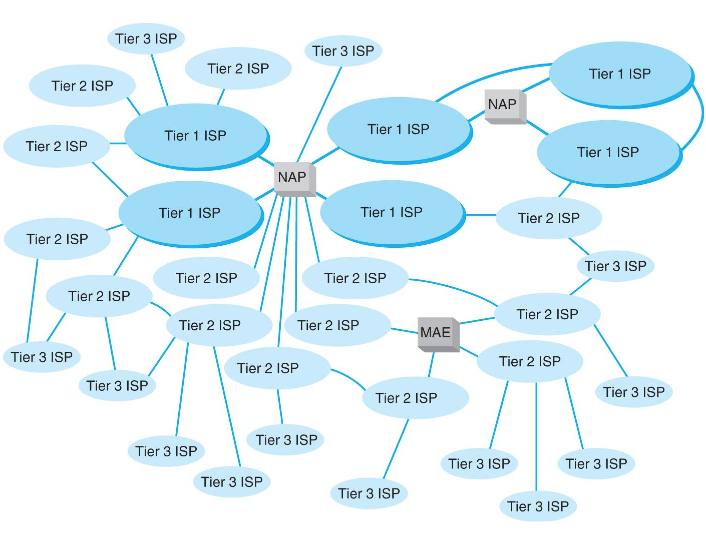
Tier 1 Internet Service Providers (ISPs)
- Provide services to their customers and sell access to tier 2 and 3 ISPs
- Tier 2 ISPs
- Connect with tier 1 ISPs - Provide services to their customers and sell to local ISPs
- Tier 3 ISPs
- Connect to tier 1 or 2 ISPs - sell access to individuals.
Internet Access Points
- Network Access Points (NAPs)
- Connect tier 1 ISPs together. Sometimes large tier 2 and 3 ISPs also have access directly to NAPs - Only about a dozen NAPs in the U.S. which are run by common carriers such as Sprint and AT&T
- Packet Exchange Charges
- Peering: ISPs at the same level usually do not charge each other for exchanging messages (Tier 1 to Tier 1 or Tier 2 to Tier 2) Higher level ISPs charge lower level ISPs Tier 3 ISPs charge individuals and corporate users or access
- Metropolitan Area Exchange (MAEs)
- Connect tier 2 ISPs together
- Network Access Points (NAPs)
Ways to connect to an ISP
- Point of Presence (POP)
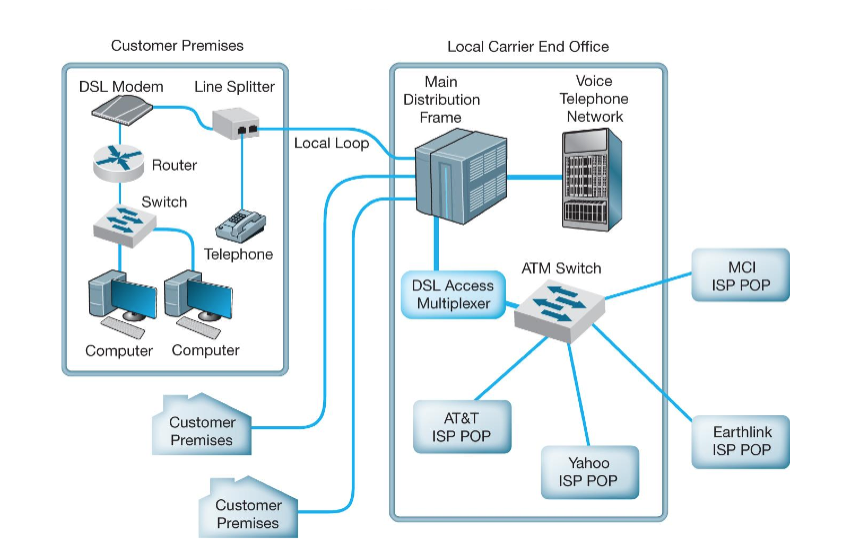
- Used to connect to an ISP, a place at which ISP provides service to its customers.
- Cable/DSL
- How an individual user connects to an ISP. The userID and password are checked by Remote Access Server
- Corporate Users
- Access the POP through T1, T3, or ATM OC-3 connections
- Point of Presence (POP)
OC 48, OC 192
- Backbone circuit for national ISPs, 10 Gbps
Internet Access Methods
- Broadband
- Most methods of accessing the internet are just called "broadband access" Doesn't refer to analog communication, rather it just means high speed
- DSL
- A point to point technology, designed to provide high speed data transmission over traditional telephone lines.
- Asymmetric DSL (ADSL)
- The most common type of DSL, uses frequency division multiplexing.
- Cable Modems
- a type of modem that connects a computer or local network to broadband Internet service through the same cable that supplies cable television service.
- Data Over Cable Service Interface Specifications (DOCSIS)
- Most common protocol used for cable modems, not a formal standard.
- Cable Modem Architecture
- Similar to DSL: use shared multipoint circuits instead of point-to-point technology. Equipment: CMTS: Cable Modem Termination System, used for upstream traffic only. - Fiber node with an optical electrical converter. - Combiner (combines Internet traffic with TV video traffic)
- Customer Premises Equipment (CPE)
- Installed at the customer's location and Contains a line splitter and directs traffic to phone network and DSL modems
- Local Loops
- Connect to the MDF, MDF splits neighorhood voice and data traffic to phone network and DSLAM (DSL access multiplexer)
- Traditional telephone lines (local loop)
- Has limited capacity due to telephone and switching equipment at the end offices. constrained by 4 KHz voice channel Much higher bandwidth possible
- WiMax
- • Wireless standard developed to connect to Ethernet LANs • Can be used as fixed or mobile wireless • Some vendors refer to it as 4G • ISPs are beginning to provide this service
- Broadband
Internet Governance
- no one organization operates the internet. closest thing: Internet Society (ISOC)
- Internet Society (ISOC)
- ISOC is an open membership professional society, that works in three areas: public policy, education, standards
- IETF
- Internet Engineering Task Force: Concerned with evolution of Internet architecture and smooth operation of Internet
- IESG
- Internet Engineering Steering Group: responsible for management of the standard process. Establishes and administers rules in creating standards.
- IAB
- Internet Architecture Board, provides strategic architectural oversight, guidance.
- IRFT
The future of the Internet
- NGI
- Next Generation Internet funded by NSF, A group called University Corporation for Advanced Internet Development (UCAID) started with 34 universities
- ARDNOC
- Advanced Research and Development Network Operations Center funded by the Canadian Government, who also developed CA*Net
- GIgapops
- Similar to NAPs, will provide access to the Internet in the future.
- NGI