
Mapa mental
The Basic Tools of Finance (Chapter 25)
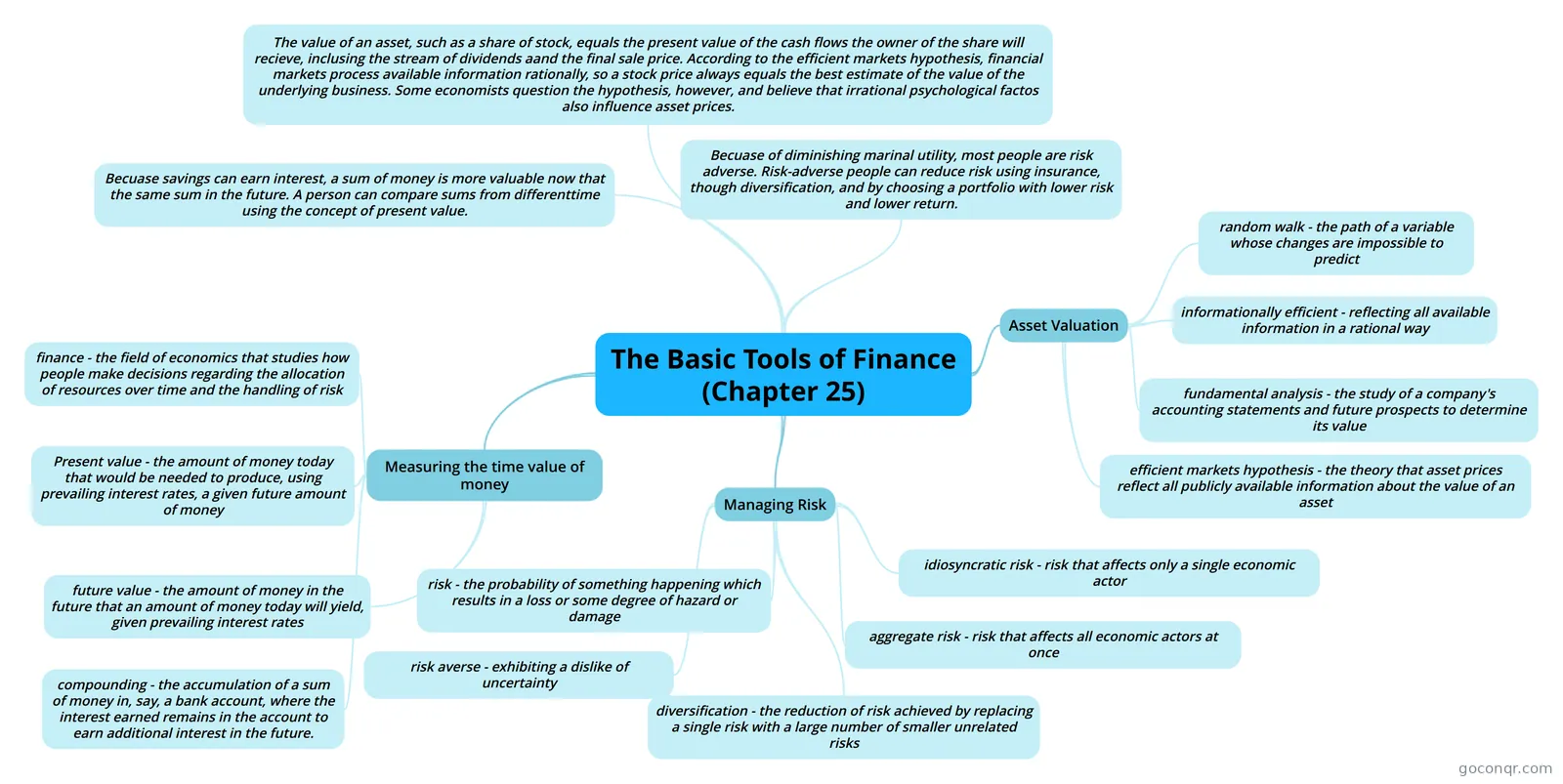
Mind map: The basic tools of finance
Contenido del mapa
The Basic Tools of Finance (Chapter 25)
Measuring the time value of money
- finance - the field of economics that studies how people make decisions regarding the allocation of resources over time and the handling of risk
- Present value - the amount of money today that would be needed to produce, using prevailing interest rates, a given future amount of money
- future value - the amount of money in the future that an amount of money today will yield, given prevailing interest rates
- compounding - the accumulation of a sum of money in, say, a bank account, where the interest earned remains in the account to earn additional interest in the future.
Managing Risk
- risk - the probability of something happening which results in a loss or some degree of hazard or damage
- risk averse - exhibiting a dislike of uncertainty
- diversification - the reduction of risk achieved by replacing a single risk with a large number of smaller unrelated risks
- idiosyncratic risk - risk that affects only a single economic actor
- aggregate risk - risk that affects all economic actors at once
Asset Valuation
- fundamental analysis - the study of a company's accounting statements and future prospects to determine its value
- efficient markets hypothesis - the theory that asset prices reflect all publicly available information about the value of an asset
- informationally efficient - reflecting all available information in a rational way
- random walk - the path of a variable whose changes are impossible to predict
Becuase savings can earn interest, a sum of money is more valuable now that the same sum in the future. A person can compare sums from differenttime using the concept of present value.
Becuase of diminishing marinal utility, most people are risk adverse. Risk-adverse people can reduce risk using insurance, though diversification, and by choosing a portfolio with lower risk and lower return.
The value of an asset, such as a share of stock, equals the present value of the cash flows the owner of the share will recieve, inclusing the stream of dividends aand the final sale price. According to the efficient markets hypothesis, financial markets process available information rationally, so a stock price always equals the best estimate of the value of the underlying business. Some economists question the hypothesis, however, and believe that irrational psychological factos also influence asset prices.
Información
- Descripción
- Mapa Mental sobre The Basic Tools of Finance (Chapter 25), creado por franvmiller el 07/12/2015.
- Creado por
- franvmiller
- Visitas
- 2
- Valoración
Más sobre Investments and Investment Funds