
Mapa mental
Chemical Reactions and Solutions
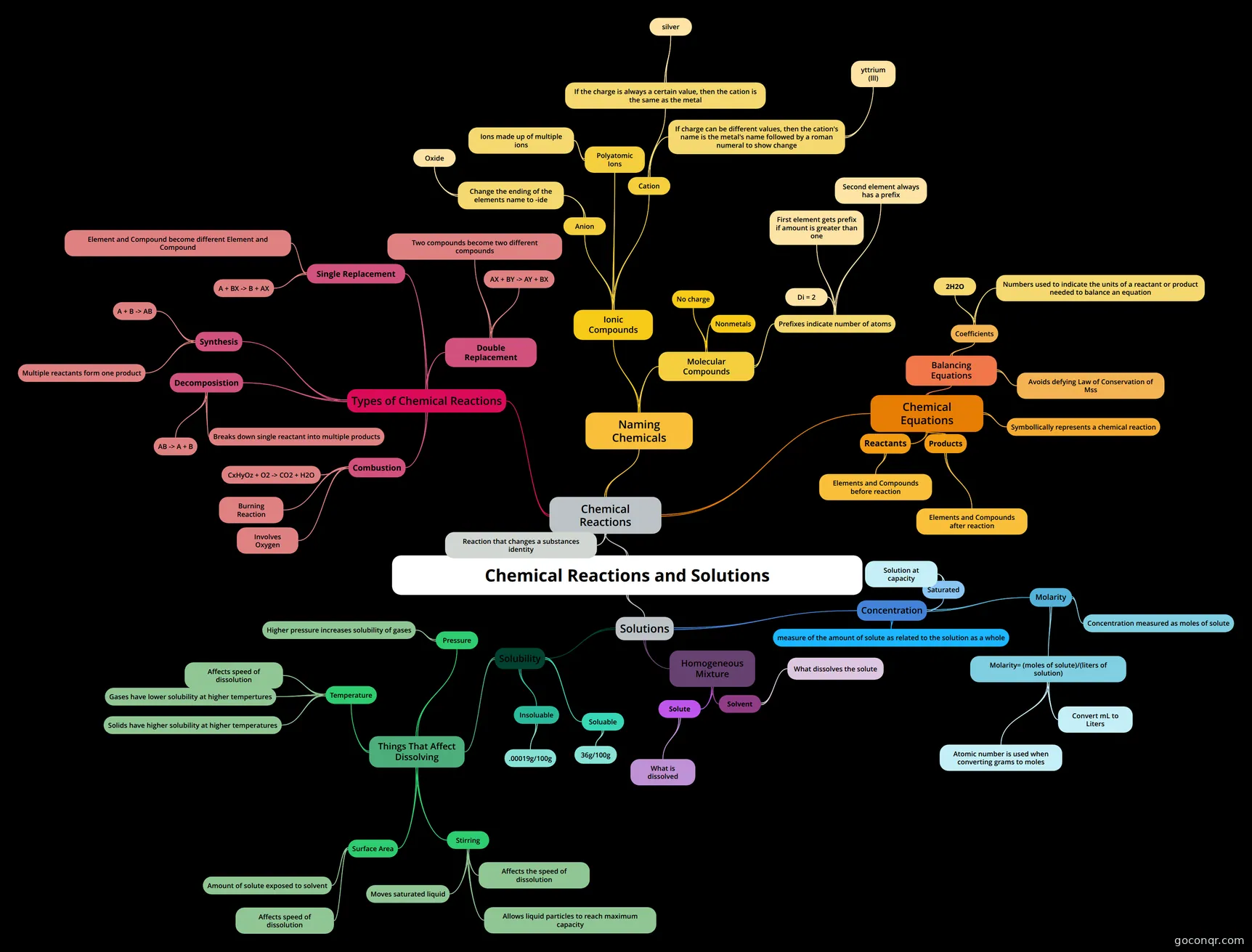
Mind map: Chemical reactions and solutions
Contenido del mapa
Chemical Reactions and Solutions
Solutions
- Homogeneous Mixture
- Solvent
- What dissolves the solute
- Solute
- What is dissolved
- Solvent
- Concentration
- measure of the amount of solute as related to the solution as a whole
- Molarity
- Concentration measured as moles of solute
- Molarity= (moles of solute)/(liters of solution)
- Atomic number is used when converting grams to moles
- Convert mL to Liters
- Saturated
- Solution at capacity
- Solubility
- Things That Affect Dissolving
- Temperature
- Affects speed of dissolution
- Solids have higher solubility at higher temperatures
- Gases have lower solubility at higher tempertures
- Surface Area
- Affects speed of dissolution
- Amount of solute exposed to solvent
- Pressure
- Higher pressure increases solubility of gases
- Stirring
- Affects the speed of dissolution
- Allows liquid particles to reach maximum capacity
- Moves saturated liquid
- Temperature
- Soluable
- 36g/100g
- Insoluable
- .00019g/100g
- Things That Affect Dissolving
- Homogeneous Mixture
Chemical Reactions
- Types of Chemical Reactions
- Single Replacement
- A + BX -> B + AX
- Element and Compound become different Element and Compound
- Double Replacement
- AX + BY -> AY + BX
- Two compounds become two different compounds
- Synthesis
- A + B -> AB
- Multiple reactants form one product
- Decomposistion
- Breaks down single reactant into multiple products
- AB -> A + B
- Combustion
- Burning Reaction
- Involves Oxygen
- CxHyOz + O2 -> CO2 + H2O
- Single Replacement
- Reaction that changes a substances identity
- Chemical Equations
- Reactants
- Elements and Compounds before reaction
- Products
- Elements and Compounds after reaction
- Balancing Equations
- Coefficients
- Numbers used to indicate the units of a reactant or product needed to balance an equation
- 2H2O
- Avoids defying Law of Conservation of Mss
- Coefficients
- Symbollically represents a chemical reaction
- Reactants
- Naming Chemicals
- Ionic Compounds
- Cation
- If charge can be different values, then the cation's name is the metal's name followed by a roman numeral to show change
- yttrium (lll)
- If the charge is always a certain value, then the cation is the same as the metal
- silver
- If charge can be different values, then the cation's name is the metal's name followed by a roman numeral to show change
- Anion
- Change the ending of the elements name to -ide
- Oxide
- Change the ending of the elements name to -ide
- Polyatomic Ions
- Ions made up of multiple ions
- Cation
- Molecular Compounds
- No charge
- Nonmetals
- Prefixes indicate number of atoms
- Di = 2
- Second element always has a prefix
- First element gets prefix if amount is greater than one
- Ionic Compounds
- Types of Chemical Reactions
Información
- Descripción
- Chemical Reactions and Solutions
- Creado por
- Adelene Somerville
- Visitas
- 650
- Etiquetas
- Valoración