
Mapa mental
Chemistry 2b
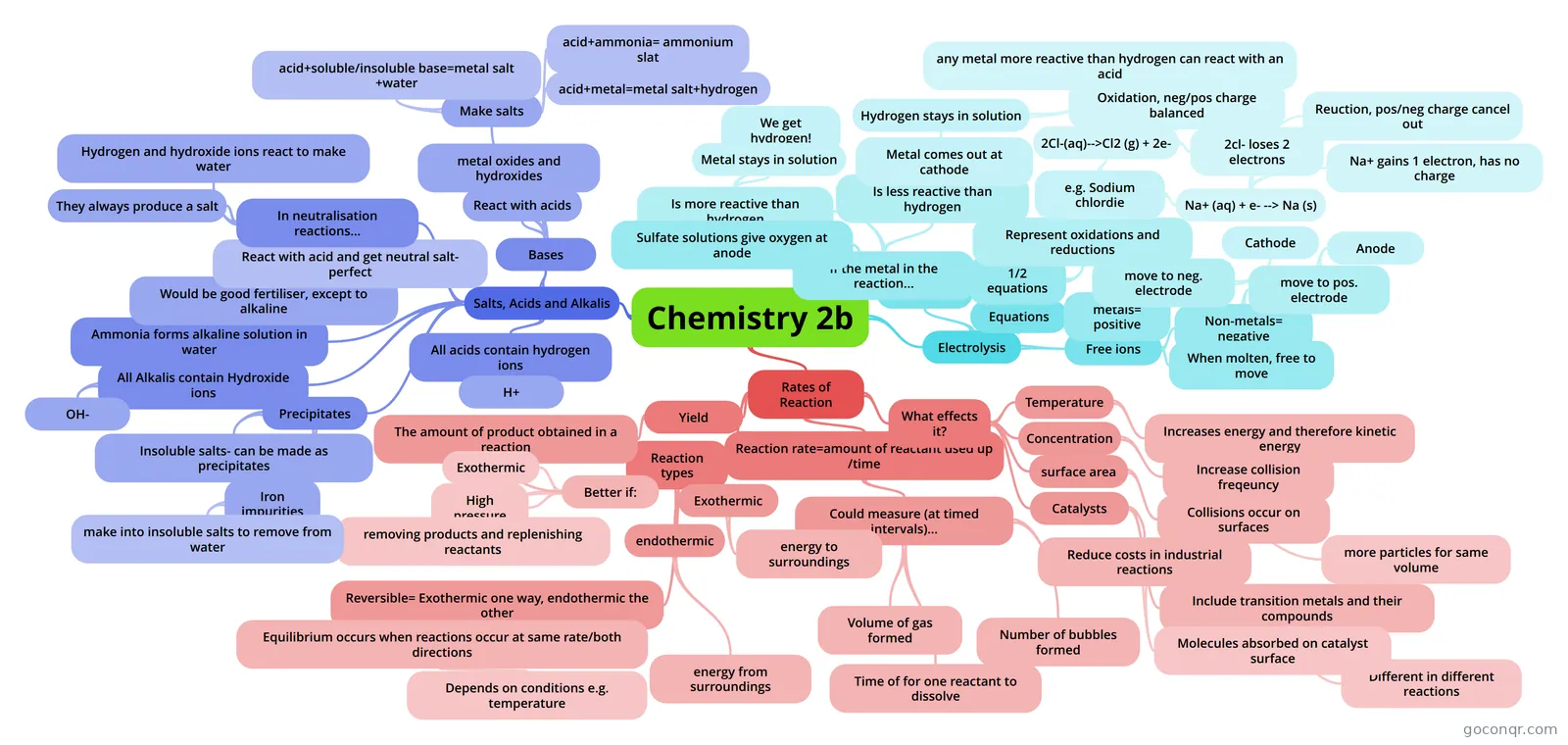
Mind map: Chemistry 2b
Contenido del mapa
Chemistry 2b
Rates of Reaction
- Reaction rate=amount of reactant used up /time
- Could measure (at timed intervals)...
- Volume of gas formed
- Number of bubbles formed
- Time of for one reactant to dissolve
- Could measure (at timed intervals)...
- What effects it?
- Temperature
- Increases energy and therefore kinetic energy
- Concentration
- Increase collision freqeuncy
- more particles for same volume
- Increase collision freqeuncy
- surface area
- Collisions occur on surfaces
- Catalysts
- Include transition metals and their compounds
- Different in different reactions
- Reduce costs in industrial reactions
- Molecules absorbed on catalyst surface
- Include transition metals and their compounds
- Temperature
- Reaction types
- Exothermic
- energy to surroundings
- endothermic
- energy from surroundings
- Reversible= Exothermic one way, endothermic the other
- Equilibrium occurs when reactions occur at same rate/both directions
- Depends on conditions e.g. temperature
- Equilibrium occurs when reactions occur at same rate/both directions
- Exothermic
- Yield
- The amount of product obtained in a reaction
- Better if:
- Exothermic
- High pressure
- removing products and replenishing reactants
- Better if:
- The amount of product obtained in a reaction
- Reaction rate=amount of reactant used up /time
Electrolysis
- Free ions
- metals= positive
- move to neg. electrode
- Cathode
- move to neg. electrode
- Non-metals= negative
- move to pos. electrode
- Anode
- move to pos. electrode
- When molten, free to move
- metals= positive
- Equations
- 1/2 equations
- Represent oxidations and reductions
- e.g. Sodium chlordie
- Na+ (aq) + e- --> Na (s)
- Reuction, pos/neg charge cancel out
- Na+ gains 1 electron, has no charge
- 2Cl-(aq)-->Cl2 (g) + 2e-
- Oxidation, neg/pos charge balanced
- 2cl- loses 2 electrons
- Na+ (aq) + e- --> Na (s)
- e.g. Sodium chlordie
- Represent oxidations and reductions
- 1/2 equations
- Uses
- If the metal in the reaction...
- Is less reactive than hydrogen
- Metal comes out at cathode
- Hydrogen stays in solution
- any metal more reactive than hydrogen can react with an acid
- Is more reactive than hydrogen
- We get hydrogen!
- Metal stays in solution
- Is less reactive than hydrogen
- Sulfate solutions give oxygen at anode
- If the metal in the reaction...
- Free ions
Salts, Acids and Alkalis
- Bases
- metal oxides and hydroxides
- React with acids
- Make salts
- acid+metal=metal salt+hydrogen
- acid+ammonia= ammonium slat
- acid+soluble/insoluble base=metal salt +water
- Ammonia forms alkaline solution in water
- Would be good fertiliser, except to alkaline
- React with acid and get neutral salt- perfect
- Would be good fertiliser, except to alkaline
- All acids contain hydrogen ions
- H+
- All Alkalis contain Hydroxide ions
- OH-
- In neutralisation reactions...
- Hydrogen and hydroxide ions react to make water
- They always produce a salt
- Precipitates
- Insoluble salts- can be made as precipitates
- Iron impurities
- make into insoluble salts to remove from water
- Bases
Información
- Descripción
- Chemistry C2b based on the Collins Science Revision book for Additional Science at GCSE. Lacks some detail, especially on salts, acids and alkalis.
- Creado por
- Alfie Ross
- Visitas
- 231
- Etiquetas
- Valoración