
Mapa mental
C2 - Material Choices (b)
Contenido del mapa
C2 - Material Choices
Crude Oil
- Mixture of hydrocarbons
- Molecules that are made of a chains of carbon and hydrogen atoms only.
- Varying chain length
- Properties
- As the length of the hydrocarbon changes the properties also change.
- When supplied heat the smaller molecules receive enough energy to overcome the weak intermolecular forces
- Low mpt and bpt
- Longer chains need more energy
- Higher mpt and bpt
- When supplied heat the smaller molecules receive enough energy to overcome the weak intermolecular forces
- Bonds in crude oil
- Strong covalent bonds between the carbons and hydrogens of the molecule
- Weak intermolecular molecular forces of attraction between molecules
- As the length of the hydrocarbon changes the properties also change.
- Mixture of hydrocarbons
Uses of Crude Oil
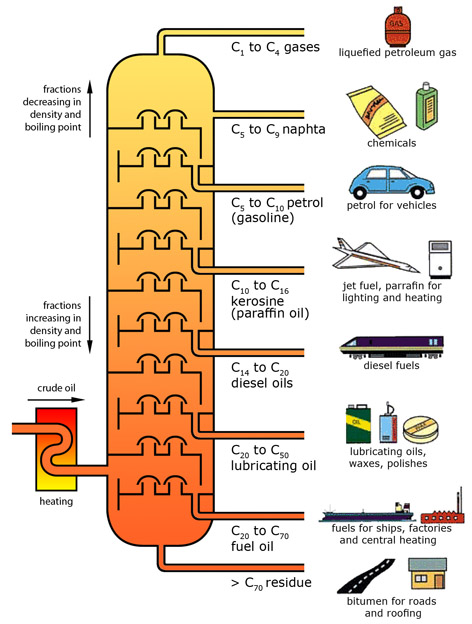
- Separated by fractional distillation
- Most of the hydrocarbons in crude oil are used to make fuels.
- Some are sued to make new compounds
- Plastics, medicines, fertilisers and food
- Chemical synthesis
- The petrochemical industry refines crude oil to produce fuels and lubricants.
- It also produced raw materials that can be used to make synthetic chemicals
- Some less useful hydrocarbons can be reacted with hydrogen so that they split into more useful hydrocarbons
- Separated by fractional distillation
Polymers
- Polymerisation
- Plastics are formed when lots of small molecules (monomer) join together to make a very long molecule (polymer)
- Carbon based
- Formed under high pressure
- Plastics are formed when lots of small molecules (monomer) join together to make a very long molecule (polymer)
- Properties
- Polymers made from varying monomers have different properties
- Strong and rigid
- HDPE
- Used to make milk bottles
- HDPE
- Light and stretchable
- LDPE
- Plastic bags and water bottles
- LDPE
- Strong and Durable
- PVC
- Rigid
- Window frames and piping
- Stretchy
- Synthetic leather
- Rigid
- PVC
- Impact resistant and soft
- Polystyrene
- Packaging
- Polystyrene
- Heat resistant
- Melamine resin and polypropene
- Plastic Kettles
- Melamine resin and polypropene
- Strong and rigid
- Polymers made from varying monomers have different properties
- Replacing natural materials
- Synthetic fibres are replacing cotton, wool and silk
- Lighter, more durable, water-resistant and often cheaper
- Rigid PVC has replaced wood as a material for window frames
- Weather-resistant, strong, durable, no painting
- Synthetic fibres are replacing cotton, wool and silk
- Polymerisation
Structure and Properties of Polymers
- Properties
- Depend on molecular arrangement
- Density
- Polymers packed together tightly = high density
- Polymer chains are spread out = low density
- Forces
- Weak forces
- Free to slide over each other
- Easily stretched
- Low mpt.
- Strong forces
- Inflexible
- higher mpt.
- Cross links prevent free movement
- Crosslinks are chemical bonds
- Weak forces
- Modification
- Increase chain length
- Stronger
- Cross-linking
- Stronger, stiffer, more heat resistance
- Plasticisers
- Softer and easier to shape
- Work by reducing intermolecular forces
- Crystallinity
- Made more crystalline
- Strighter chains with no branches
- Higher density
- Stronger and have higher mpt.
- Made more crystalline
- Increase chain length
- Properties
B
Imágenes y archivos del mapa
Información
- Descripción
- Chemistry Mapa Mental sobre C2 - Material Choices (b), creado por nicole_j_baldwin el 24/12/2013.
- Creado por
- nicole_j_baldwin
- Visitas
- 141
- Etiquetas
- Valoración